
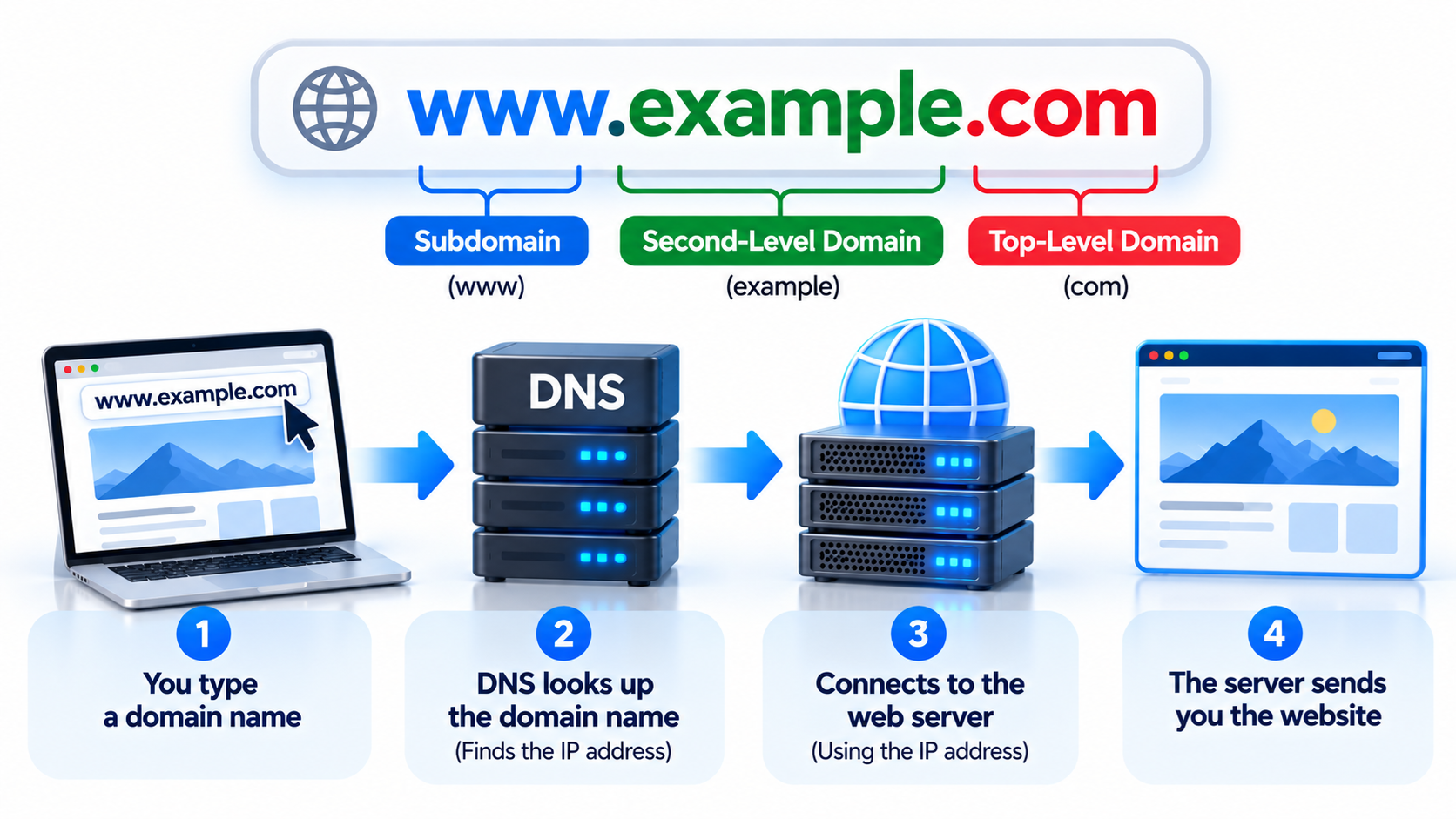
A domain name is the human-readable address people use to visit a website.
For example: example.com
Instead of remembering a numerical Internet Protocol address, or IP address, visitors can type a domain name into a web browser and reach the website they want.
A domain name is therefore one of the most important parts of a website’s identity.
It can appear in:
- Website addresses
- Email addresses
- Business cards
- Advertising
- Search results
- Social media profiles
- Customer communications
A good domain name should be easy to remember, easy to spell, and closely related to the website, business, organization, or project it represents.
Why Do We Need Domain Names?
Computers communicate across the Internet using numerical addresses called IP addresses.
An IP address identifies a device or server on a network.
For example, an IPv4 address might look like:
192.0.2.10
An IPv6 address is longer and may look something like:
2001:db8::10
Humans are generally much better at remembering names than long sequences of numbers.
That is why the Domain Name System, or DNS, was created.
DNS allows people to use names such as:
example.com
instead of having to remember the server’s IP address.
You can think of a domain name as a convenient label that points users toward the correct Internet service.
How Does a Domain Name Work?
When you type a domain name into your browser, the browser needs to find out which server hosts that website.
A simplified process looks like this:
Domain Name → DNS Lookup → IP Address → Web Server → Website
Suppose you type:
example.com
into your browser.
Your device asks the DNS system where that domain should go.
DNS returns the IP address associated with the domain.
Your browser then connects to that server and requests the website.
The server responds by sending the web page back to your browser.
This process usually happens very quickly.
What Is DNS?
DNS stands for Domain Name System.
DNS is the system that connects domain names with Internet addresses and services.
It does much more than simply point a website to a server.
DNS records can also control:
- Website hosting
- Email delivery
- Subdomains
- Verification services
- Security policies
- Third-party applications
Common DNS record types include:
A Record
An A record points a domain or subdomain to an IPv4 address.
AAAA Record
An AAAA record points a domain or subdomain to an IPv6 address.
CNAME Record
A CNAME record points one hostname to another hostname.
MX Record
An MX record tells the Internet which mail server should receive email for a domain.
TXT Record
A TXT record can store text-based information used for verification, email security, and other services.
DNS is one of the fundamental systems that makes domain names useful.
What Are the Parts of a Domain Name?
A domain name can contain several parts.
Consider:
blog.example.com
This can be divided into:
.com — Top-Level Domain
example — Second-Level Domain
blog — Subdomain
Top-Level Domain
The Top-Level Domain, or TLD, is the part at the end.
Examples include:
.com
.net
.org
.ca
.co.uk
.io
.dev
There are many different TLDs available today.
Some are generic, while others are associated with countries or particular types of organizations.
Second-Level Domain
The second-level domain is the main name you register.
In:
example.com
the word:
example
is the second-level domain.
This is usually the part people think of as the main website name.
Subdomain
A subdomain appears before the main domain.
For example:
support.example.com
blog.example.com
shop.example.com
mail.example.com
A subdomain can be used to organize different sections or services under the same domain.
What Is a Top-Level Domain?
A Top-Level Domain is the ending of a domain name.
Common examples include:
- .com
- .net
- .org
- .info
- .biz
- .ca
- .uk
- .de
- .jp
Some TLDs are called generic Top-Level Domains, or gTLDs.
Examples include:
.com
.net
.org
Other TLDs are country-code Top-Level Domains, or ccTLDs.
Examples include:
.ca for Canada
.uk for the United Kingdom
.de for Germany
.jp for Japan
Different domain extensions may have different registration rules.
Is a Domain Name the Same as a Website?
No.
A domain name and a website are different things.
The domain name is the address.
The website is the content and software stored on a server.
A simple analogy is:
Domain name = street address
Web hosting = the property or building
Website = what is inside the building
You can register a domain name without having a website.
Likewise, a website can technically exist on a server before a domain name is connected to it.
They are separate services that work together.
Is a Domain Name the Same as Web Hosting?
No.
This is one of the most common misunderstandings among beginners.
A domain name gives your website a recognizable Internet address.
Web hosting provides the server resources needed to store and run the website.
For a typical website, you need both.
For example:
Domain: example.com
Hosting: the server where the website files and database are stored
DNS connects the two.
What Is a Domain Registrar?
A domain registrar is a company authorized to register domain names for customers.
When you register a domain, the registrar submits the registration information to the appropriate domain registry.
The registrar usually provides tools for managing:
- Domain renewals
- Nameservers
- DNS settings
- Contact information
- Domain locking
- Transfers
The registrar manages the registration, but the domain itself is part of a larger global naming system.
What Is a Domain Registry?
A domain registry operates a particular top-level domain.
The registry maintains the database of registered names under that extension.
For example, a registry is responsible for tracking which domain names under a particular TLD are registered and where they are delegated.
Registrars interact with registries on behalf of customers.
Most website owners do not need to deal with the registry directly.
What Does It Mean to Register a Domain Name?
Registering a domain gives you the right to use that domain for a specific registration period, as long as you continue renewing it and follow the applicable rules.
You are not buying the domain forever in the same way you might buy a physical object.
Domain registrations are normally renewed periodically.
If you fail to renew the domain, it may eventually expire and become available for someone else to register.
How Long Can You Register a Domain?
Registration periods vary depending on the domain extension and registrar.
Many common domain names can be registered for one or more years at a time.
The important thing is to keep the registration current.
For business websites, enabling automatic renewal can help reduce the risk of accidentally losing a domain.
However, you should also keep your payment information and contact email address up to date.
What Happens If a Domain Expires?
If a domain expires, the website and email associated with it may stop working.
The domain may go through several stages before becoming available to the public again.
These stages vary depending on the TLD and registrar.
Possible stages may include:
- Expiration
- Grace period
- Redemption period
- Pending deletion
- Public availability
Recovering an expired domain may become more expensive after the normal renewal period.
For an important business domain, it is best not to let it expire.
What Is a Nameserver?
A nameserver is part of the DNS system.
Nameservers tell the Internet where the DNS records for a domain are managed.
For example, when a domain uses a hosting company’s nameservers, that hosting company may manage the DNS zone for the domain.
The DNS zone can then contain records for:
- Website
- Subdomains
- Verification services
Changing nameservers can move DNS control from one provider to another.
This is why nameserver changes should be made carefully.
What Is a Domain Extension?
A domain extension is another common name for the top-level domain.
For example:
.com
.net
.org
.ca
The extension can affect branding, availability, and sometimes registration requirements.
A .com domain is still widely recognized for commercial and general-purpose websites, but many other extensions can also work well depending on the project.
Does the Domain Extension Affect SEO?
A domain extension by itself is usually not the main factor that determines search rankings.
Search engines consider many signals, including:
- Content quality
- Website structure
- Page speed
- Mobile usability
- Links
- Relevance
- User experience
Country-code domains can sometimes provide a stronger geographic signal for a specific country.
For example, a .ca domain is closely associated with Canada.
But choosing a domain extension should primarily be based on your audience, branding, and availability.
Can I Use a Domain for Email?
Yes.
One major advantage of owning a domain is that you can create professional email addresses such as:
These addresses use the same domain as the website.
Email delivery is usually controlled through DNS records, especially MX records.
The website and email can be hosted by the same provider or by different providers.
Can One Domain Point to More Than One Service?
Yes.
A domain can use different DNS records for different purposes.
For example:
www.example.com → website server
mail.example.com → mail server
shop.example.com → e-commerce platform
support.example.com → customer support system
This flexibility is one of the reasons DNS is so important.
What Is a Subdomain Used For?
Subdomains can organize different sections of a website or separate services.
Examples include:
blog.example.com
support.example.com
store.example.com
docs.example.com
A subdomain can point to the same server as the main domain or to a completely different system.
Large organizations often use subdomains to separate different applications.
What Is the Difference Between a Domain and a URL?
A domain name is only part of a full web address.
For example:
https://www.example.com/products/server.html
The domain name is:
example.com
The full URL includes:
https:// — protocol
www — subdomain
example.com — domain
/products/server.html — path
URL stands for Uniform Resource Locator.
A URL identifies a specific resource on the Internet.
What Makes a Good Domain Name?
A good domain name is usually:
- Easy to spell
- Easy to remember
- Short enough to type
- Relevant to the website
- Easy to say aloud
- Difficult to confuse with another name
Avoid unnecessary complexity if possible.
Long strings of numbers, unusual spelling, and excessive hyphens can make a domain harder to remember.
Before registering a domain, check it carefully for spelling mistakes.
Once registered, a domain normally cannot simply be renamed.
Should I Use Hyphens in a Domain Name?
Hyphens are allowed in many domain names, but they can make a name harder to communicate verbally.
For example:
best-web-hosting.com
may be harder to explain than:
bestwebhosting.com
That does not mean hyphens are always bad.
Sometimes they improve readability or make an otherwise unavailable name usable.
The decision depends on the domain.
Can Domain Names Contain Numbers?
Yes.
Many domain names can contain letters, numbers, and hyphens.
However, numbers can sometimes create confusion.
For example:
fourservers.com
and
4servers.com
are completely different domain names.
If you use numbers in a brand, it may be worth considering common variations.
Can a Domain Name Have Capital Letters?
Domain names are generally case-insensitive.
For example:
Example.com
example.com
EXAMPLE.COM
normally refer to the same domain.
For consistency, domain names are usually written in lowercase.
What Are Internationalized Domain Names?
Internationalized Domain Names, or IDNs, allow domain names to use characters from writing systems beyond basic English letters.
This can make domains easier to use in many languages.
Behind the scenes, these domains may be converted into a technical encoding so that the DNS system can process them.
Users registering international domains should pay careful attention to character selection because some characters can look very similar.
Can I Own More Than One Domain Name?
Yes.
Many businesses register multiple domains.
Reasons include:
- Brand protection
- Common misspellings
- Different countries
- Product names
- Marketing campaigns
- Different domain extensions
Multiple domains can point to the same website.
For example:
example.com
example.net
example.ca
could all redirect visitors to one primary website.
What Is Domain Privacy?
Domain registration requires contact information to be maintained with the registrar and registry system.
Depending on the domain extension and registrar, privacy or proxy services may limit how much personal information is publicly displayed.
The exact privacy options vary by TLD and registrar.
It is still important to keep accurate contact information with your registrar because important renewal or security notices may be sent there.
What Is Domain Locking?
Domain locking helps protect a domain from unauthorized transfers.
When a domain is locked, additional steps are normally required before it can be transferred to another registrar.
Keeping important domains locked when you are not actively transferring them is a useful security practice.
How Do I Protect My Domain Name?
A valuable domain should be treated like an important business asset.
Good security practices include:
- Use a strong registrar password
- Enable two-factor authentication
- Keep the domain locked
- Keep contact information current
- Enable renewal reminders
- Consider automatic renewal
- Protect your registrar email account
- Review DNS changes carefully
If someone gains control of your domain registrar account, they may be able to redirect your website or email even without accessing your hosting server.
Frequently Asked Questions
Do I need a domain name to have a website?
Technically, a website can be accessed using an IP address or temporary server address, but a domain name makes the website much easier for people to find and remember.
Do I own a domain forever?
No. Domain names are registered for limited periods and must be renewed.
Can I change my domain name after registering it?
You normally cannot rename an existing registration. You usually need to register the new domain separately.
Can I use the same domain with another hosting company?
Yes. Domain registration and web hosting are separate. You can point your domain to a different hosting provider by changing DNS settings.
Can I transfer my domain?
Yes, in many cases. Domain transfers move the registration from one registrar to another while keeping the same domain name.
Can I have a domain without a website?
Yes. You can register a domain and use it later, use it only for email, or redirect it to another domain.
Conclusion
A domain name is the human-readable address people use to find your website on the Internet.
It works together with DNS to connect visitors to the correct web server.
Although domain names may seem simple, they are connected to many important Internet services, including websites, email, DNS, SSL, hosting, and online identity.
Understanding the difference between a domain name, DNS, and web hosting makes it much easier to manage a website.
In simple terms:
The domain name is your Internet address. DNS provides the directions. Web hosting provides the place where your website lives.