
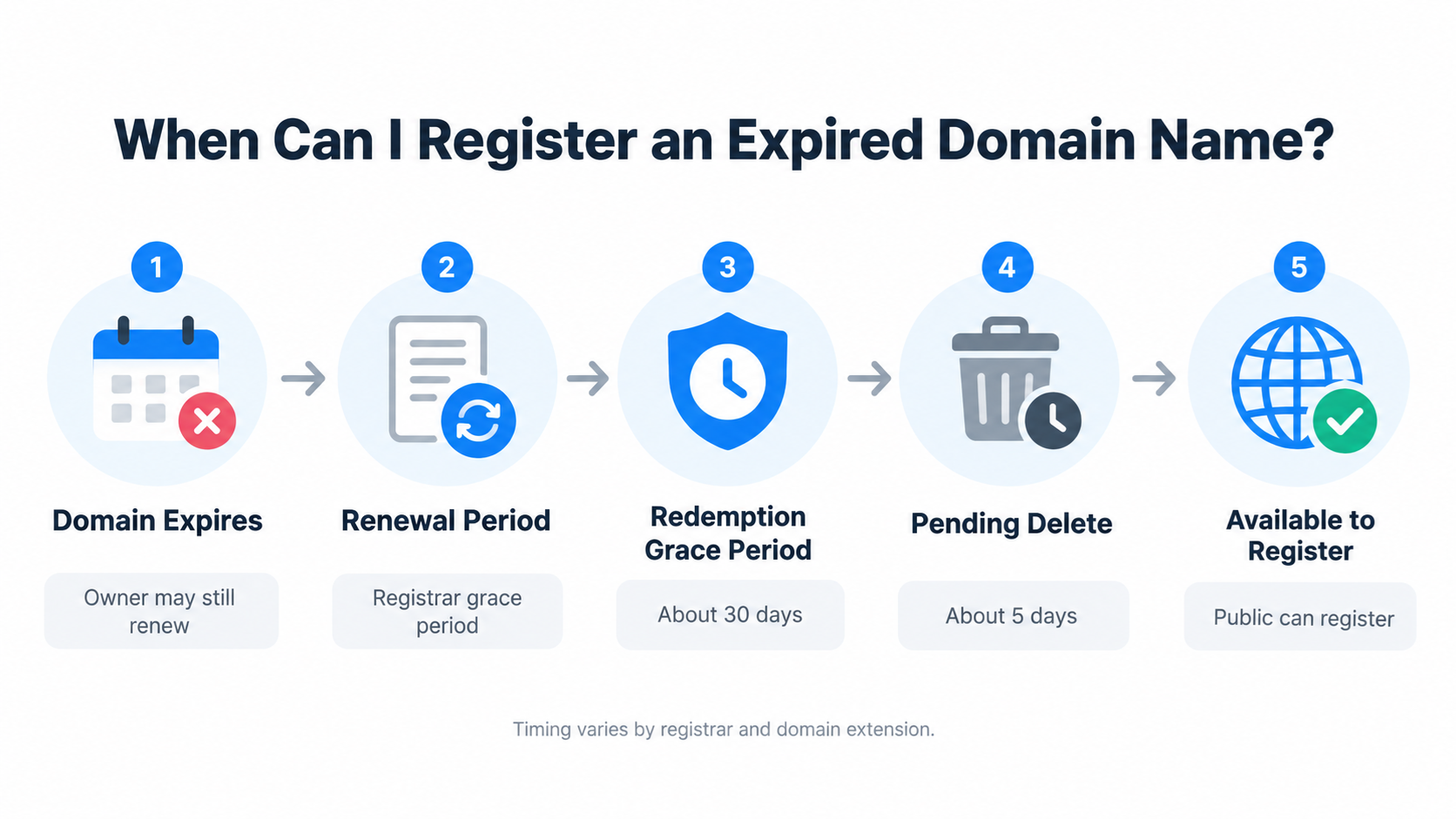
If a domain name expires, it does not usually become available for someone else to register immediately.
In most cases, an expired domain goes through several stages before it is finally released to the public.
Understanding this process is important if you are waiting for a domain name that someone else has allowed to expire.
A Domain Does Not Become Available Immediately After Expiration
Suppose a domain name expires today. You normally cannot simply go to a registrar tomorrow and register it.
The previous owner is usually given time to renew the domain. The exact process depends on the domain extension, the registry, and the registrar that manages the domain.
For common generic top-level domains such as .com, .net, and .org, the process may include an expiration or renewal period, a Redemption Grace Period, and a Pending Delete period before the domain is released.
Stage 1: The Domain Expires
When the registration expiration date arrives, the domain enters an expired state if the owner has not renewed it.
The website and email associated with the domain may stop working, or the registrar may replace the website with an expiration notice or parking page.
However, the original registrant may still have an opportunity to renew the domain.
This means that seeing an expired website does not necessarily mean that the domain is available for you to register.
Stage 2: Post-Expiration Renewal Period
Many registrars provide a period after expiration during which the previous registrant can still renew the domain.
The length of this period varies by registrar and domain extension. Some registrars may also auction expired domains during part of this period, depending on their terms and procedures.
Because registrar policies differ, you should not assume that every expired domain follows exactly the same number of days before deletion.
ICANN notes that registrars may have different procedures for handling domains after expiration, and an expired domain may sometimes be offered to another party before it reaches the final deletion stages.
Stage 3: Redemption Grace Period
If the registrar eventually deletes the domain from its active registration, many generic top-level domains enter what is called the Redemption Grace Period, or RGP.
For most ICANN-governed generic top-level domains, this Redemption Grace Period lasts 30 days.
During this period, the previous registrant still has an opportunity to recover the domain through the registrar that deleted it. The registrar may charge an additional restoration or redemption fee.
You cannot normally register the domain as a new registrant while it is in Redemption Grace Period.
A WHOIS or RDAP lookup may show a status similar to:
redemptionPeriod
If you see this status, the domain is getting closer to deletion, but it is still not available for normal registration.
Stage 4: Pending Delete
If the previous owner does not restore the domain during the Redemption Grace Period, the domain may move into Pending Delete.
For .com domains, the Pending Delete period is normally five calendar days.
During Pending Delete, the previous owner can no longer renew or restore the domain through the normal redemption process. The registrar also cannot simply transfer or renew it.
After the Pending Delete period ends, the registry removes the domain from its database.
You may see the following domain status:
pendingDelete
For someone trying to acquire an expired domain, this is an important status because the domain is approaching its final release.
Stage 5: The Domain Is Released
After the registry deletes the domain, it can become available for registration again.
At that point, anyone may attempt to register it through a domain registrar.
For example, if ExampleDomain.com has completed its Redemption Grace Period ,Pending Delete period and is finally removed from the .com registry, you may be able to register it just like a new domain.
However, there is an important catch.
You might not be the only person waiting for it.
Good Expired Domains Can Be Registered Within Seconds
Valuable expired domains are often monitored by domain investors, businesses, and specialized domain-catching services.
When an attractive domain is deleted, automated systems may attempt to register it immediately.
Therefore, waiting until you manually see the domain marked “Available” may be too late.
A domain that becomes available at the registry could be registered by somebody else within seconds.
What Is a Domain Backorder?
A domain backorder is a service that attempts to register a domain for you when it is released.
Instead of manually checking the domain every day, you place a backorder with a company that monitors the domain and attempts to acquire it automatically.
A backorder does not guarantee that you will get the domain.
Multiple companies may be trying to acquire the same domain, and several customers may also have backorders for it.
If the domain is valuable, the successful backorder service may sometimes place the domain into an auction among interested customers.
Can I Register a Domain During Redemption Period?
Normally, no.
A domain in Redemption Grace Period has already been deleted from the registrar’s normal active registration system, but the previous registrant still has the right to request restoration during the applicable redemption period.
ICANN requires most generic top-level domain registries to provide a 30-day Redemption Grace Period after deletion.
You generally have to wait until the redemption process and subsequent Pending Delete period have finished.
Can I Register a Domain During Pending Delete?
Not yet.
Pending Delete generally means that the domain is scheduled for final deletion and can no longer be restored through the normal redemption process.
For .com, this stage normally lasts five days. Afterward, the domain is purged from the registry and may become available for a new registration.
This is often the point when people interested in the domain begin watching it very closely or use a backorder service.
How Long After Expiration Does a Domain Become Available?
There is no single number that applies to every expired domain.
You may sometimes hear statements such as:
“An expired domain becomes available after 75 days.”
That can be a useful rough estimate for some domain lifecycles, but it should not be treated as a universal rule.
The registrar may keep the domain renewable for a period after expiration. The domain may then enter a 30-day Redemption Grace Period after deletion, followed by Pending Delete, which for .com is normally five days. Registrar auctions and registry-specific policies can also affect what happens before final deletion.
Therefore, the safest approach is to check the current domain status rather than simply counting days from the expiration date.
How Can I Check an Expired Domain’s Status?
You can perform a WHOIS or RDAP lookup for the domain.
Pay particular attention to the domain status.
For example:
Active or expired but still registered: The domain still belongs to the current registrant.
redemptionPeriod: The domain has entered the Redemption Grace Period. The previous owner may still restore it.
pendingDelete: The domain is close to final deletion.
Available: The domain has been released and may be registered.
Checking the status is usually more useful than looking only at the expiration date.
What If the Registrar Is Auctioning the Domain?
Some registrars auction expired domains before they are finally released by the registry.
This creates an important distinction between an expired domain and a deleted domain.
A domain may have expired, but it may still be controlled through the existing registrar’s expiration process.
If the registrar successfully transfers the expired domain to an auction buyer according to its policies, the domain may never reach Pending Delete and may never become publicly available for normal registration.
Therefore, if you want a particular expired domain, check whether its current registrar operates an expired-domain auction system.
Can the Original Owner Still Get the Domain Back?
It depends on the stage.
During the registrar’s post-expiration renewal period, the original registrant may normally still be able to renew the domain.
During the Redemption Grace Period, the registrant may normally request restoration, although additional fees may apply. ICANN requires applicable gTLD registries to provide a 30-day Redemption Grace Period after deletion.
Once the domain reaches Pending Delete, restoration is generally no longer possible through the normal process.
After final deletion, the former owner usually has no special priority. The domain can be acquired by whoever successfully registers it first.
What Is the Best Way to Get an Expired Domain?
If the domain is not particularly important, you can simply monitor its status and try to register it after it becomes available.
If the domain is valuable or important to your business, relying on manual registration is much riskier.
You should monitor its RDAP or WHOIS status, determine which registrar currently manages it, check whether it is being auctioned, and consider using a reputable backorder or drop-catching service.
Most importantly, do not assume that the expiration date is the date when you can register the domain.
Final Answer
So, when can you register an expired domain name?
You can normally register it only after the previous registration has completed the registrar’s expiration process, any applicable Redemption Grace Period, and Pending Delete period, and the registry has finally released the domain.
For many common generic domains, the Redemption Grace Period itself is 30 days, and .com domains normally have an additional five-day Pending Delete period after redemption.
But the entire period from the original expiration date to public availability varies because registrar policies differ.
If there is a particular expired domain you want, check its current WHOIS or RDAP status instead of relying only on the expiration date.
Once the status reaches Pending Delete, the domain is approaching release — and if it is a desirable name, other buyers may already be waiting for it too.