
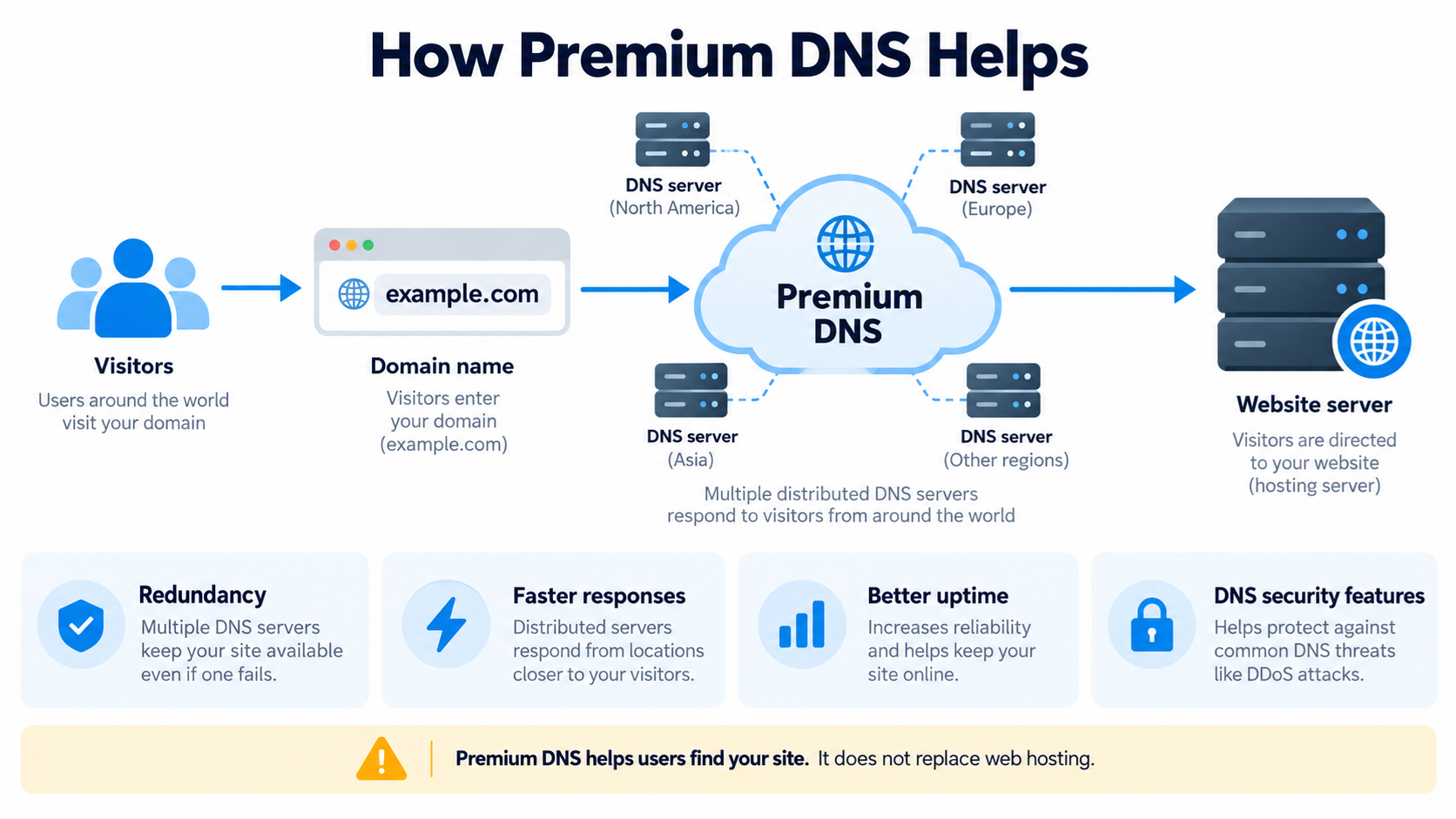
Your website may be online and your hosting server may be working perfectly, but visitors still depend on DNS to find it.
If DNS is unavailable, slow, or incorrectly configured, people may have trouble reaching your website even though nothing is wrong with the website itself.
Premium DNS is designed to provide a more robust DNS service for domain owners who want improved reliability, performance, management features, and protection compared with basic DNS services.
It does not replace your web hosting, domain registration, or SSL certificate.
Instead, Premium DNS helps make sure that internet users can reliably find the servers and services associated with your domain name.
What Is Premium DNS?
DNS stands for Domain Name System.
DNS translates easy-to-remember domain names such as example.com into technical information that computers use to locate websites, email servers, and other internet services.
Premium DNS is an enhanced DNS hosting service.
A basic DNS service may be perfectly adequate for many websites.
Premium DNS generally adds infrastructure and management capabilities intended for websites and businesses that place greater importance on DNS availability, performance, security, and control.
The exact features vary between DNS providers, so you should always check what is included with a particular Premium DNS service before purchasing it.
Why Is DNS So Important?
Before a visitor can connect to your website, the visitor’s device normally needs to determine where the website is located.
Suppose someone types example.com into a browser. The browser needs DNS information that eventually allows it to determine the appropriate destination for that domain.
If the DNS system returns the correct information, the browser can continue connecting to the website server.
If DNS cannot provide an answer, the visitor may not be able to reach the website at all.
This means DNS can become an important part of website availability.
Premium DNS Does Not Host Your Website
One common misunderstanding is that DNS hosting and web hosting are the same thing.
They are not.
Your web hosting provider stores and serves your website files, databases, images, and applications.
Your DNS provider publishes records that tell internet users and services where resources associated with your domain are located.
You can therefore have an operational web server while still having a DNS-related problem that prevents visitors from finding it.
Premium DNS improves the DNS side of this relationship. It does not replace the server that actually hosts your website.
How Premium DNS Can Improve Reliability
DNS reliability matters because a DNS server must be available when users need information about your domain.
Premium DNS providers may operate multiple DNS servers across distributed infrastructure rather than depending on a single location.
If one server or location experiences a problem, other DNS servers may still be able to answer requests.
This redundancy can reduce the possibility that one infrastructure failure makes your domain unreachable.
The exact redundancy architecture differs among providers, but the general idea is simple: avoid depending on one DNS server or one physical location whenever possible.
Geographic Distribution Can Help
Visitors may access your website from many different cities and countries.
A DNS provider with geographically distributed infrastructure can answer DNS requests from multiple locations around the world.
Some providers use technologies such as Anycast, which allow the same DNS service address to be announced from multiple network locations.
Network routing can then direct queries toward an appropriate available location.
This can improve resilience and may also reduce DNS response latency for geographically distributed users.
However, DNS speed is only one small part of total website loading time.
Premium DNS will not automatically make a slow website dramatically faster if the real problem is your web server, application, database, images, or network connection.
Premium DNS Can Help Reduce Single Points of Failure
A single point of failure is a component whose failure can interrupt an entire service.
If all DNS requests depend on one server and that server stops responding, users may have difficulty locating your website.
A properly designed DNS service uses redundancy so that multiple servers can provide authoritative DNS information.
Premium DNS services often emphasize this redundancy as one of their major advantages.
For businesses that depend heavily on their websites, reducing unnecessary single points of failure can be valuable.
What Happens If a DNS Server Goes Down?
Domains normally use multiple authoritative name servers.
If one DNS server is unavailable, DNS resolvers may try another authoritative server for the domain.
A robust DNS infrastructure therefore does not depend entirely on a single server.
Premium DNS providers may operate authoritative DNS systems across multiple servers, networks, or geographic locations to provide additional resilience.
This does not mean that downtime becomes impossible, but it can reduce the risk associated with individual server or network failures.
Premium DNS and DNS Performance
DNS lookups usually happen very quickly, but DNS response time still contributes to the process of reaching an internet service.
A well-designed DNS network can help answer queries efficiently.
Premium DNS providers may use distributed networks, optimized routing, caching strategies, and high-capacity infrastructure to improve DNS performance.
For a small website serving mostly local visitors, the difference may not always be noticeable.
For larger websites with international visitors, a widely distributed DNS infrastructure may be more valuable.
Premium DNS and Website Traffic
As a website becomes more popular, the number of DNS queries associated with its domain may also increase.
A professional DNS platform is designed to handle large numbers of DNS requests without requiring the website owner to operate DNS servers manually.
This can be useful for businesses, online stores, software services, media websites, and other sites where uninterrupted access is important.
However, DNS traffic and website traffic are not exactly the same thing.
A single DNS answer may be cached and reused for many connections, so one website visit does not necessarily generate a fresh authoritative DNS query.
Premium DNS and DDoS Resilience
DNS infrastructure can be targeted by Distributed Denial-of-Service attacks, commonly called DDoS attacks.
A DDoS attack attempts to overwhelm a system with large volumes of traffic or requests.
Some Premium DNS services include infrastructure designed to absorb or mitigate certain types of DNS-related attacks.
Distributed infrastructure and large network capacity can make DNS systems more resilient against some attacks than a small standalone DNS server.
However, no service should be described as completely immune to attacks. The level of DDoS protection depends on the provider and the service being offered.
Premium DNS and DNSSEC
Some Premium DNS services support DNSSEC.
DNSSEC stands for Domain Name System Security Extensions.
DNSSEC uses cryptographic signatures to help DNS resolvers verify that certain DNS information is authentic and has not been unexpectedly altered.
DNSSEC does not encrypt website traffic and does not replace an SSL certificate or HTTPS.
HTTPS protects communication between a browser and a website server. DNSSEC helps protect the authenticity and integrity of DNS information.
They solve different security problems.
Premium DNS and Better DNS Management
Premium DNS services may provide more sophisticated DNS management tools than very basic DNS services.
Depending on the provider, these tools may include easier record management, DNSSEC support, monitoring, API access, traffic management, logging, or advanced configuration options.
These features can be useful when a domain connects to many different services.
A business domain might have DNS records for its website, email, cloud applications, verification services, subdomains, and security systems.
As the DNS configuration becomes more complex, good management tools become increasingly useful.
Common DNS Records Managed by Premium DNS
Premium DNS manages the same basic types of DNS records used by other DNS hosting services.
An A record points a hostname to an IPv4 address.
An AAAA record points a hostname to an IPv6 address.
A CNAME record makes one hostname refer to another hostname.
An MX record specifies which mail servers receive email for a domain.
A TXT record can store verification information and is commonly used with email technologies such as SPF, DKIM, and DMARC.
An NS record identifies authoritative name servers for a DNS zone.
Premium DNS does not change the basic purpose of these records. It provides infrastructure and management services for publishing them.
Premium DNS Can Help When You Change Hosting Providers
Moving a website from one hosting provider to another usually requires changes to DNS.
For example, your website may currently point to one IP address, while your new hosting provider gives you another IP address.
You can update the appropriate DNS record so that the same domain begins directing visitors toward the new server.
Premium DNS does not eliminate the need to make this change correctly, but good DNS management tools can make the process easier to control.
Before changing any record, make sure you understand what it does.
DNS Caching Still Applies
Premium DNS does not eliminate DNS caching.
DNS resolvers around the internet may temporarily store DNS information so they do not need to request the same information repeatedly.
DNS records include a TTL value, or Time To Live, that influences how long the information may be cached.
If you change a DNS record, some users may temporarily receive the previous value until cached information expires.
This behavior is commonly called DNS propagation.
Using Premium DNS does not mean every DNS change becomes visible everywhere instantly.
Premium DNS Cannot Fix Every Website Problem
Premium DNS can improve the DNS portion of your infrastructure, but many website problems have nothing to do with DNS.
If your web server is offline, Premium DNS cannot bring the server back online.
If WordPress has a software error, Premium DNS cannot repair WordPress.
If your database stops working, Premium DNS cannot restore the database.
If your SSL certificate is expired, Premium DNS does not automatically renew it.
If a page contains extremely large images and loads slowly, faster DNS will not solve the main performance problem.
DNS should therefore be viewed as one part of a larger website infrastructure.
Common Problems Premium DNS May Help Reduce
A reliable Premium DNS service may help reduce problems caused by unavailable authoritative DNS servers, overloaded DNS infrastructure, poor geographic distribution, inadequate redundancy, or limitations in basic DNS management.
It may also provide additional protection or monitoring features that make DNS-related problems easier to detect and manage.
However, Premium DNS cannot protect against every possible outage because website availability depends on many different systems.
Your registrar, DNS provider, hosting server, network connection, application, database, and third-party services can all affect whether a website works correctly.
When Is Premium DNS Worth Considering?
Premium DNS may be worth considering if your website is important to your business and DNS availability matters financially or operationally.
It can also make sense when you operate several websites, receive visitors from many countries, manage complicated DNS configurations, require DNSSEC, need API-based DNS management, or want more resilient DNS infrastructure.
An online store, SaaS platform, business website, customer portal, or heavily visited content website may place a higher value on DNS reliability than a small personal website.
The decision should depend on the actual requirements of the site rather than simply choosing a service because it contains the word “Premium.”
Does Every Website Need Premium DNS?
No.
Many websites work perfectly well using standard DNS services supplied by their registrar, hosting provider, or another reputable DNS provider.
A small personal blog or low-traffic website may not require advanced DNS capabilities.
The most important requirement is that the DNS service is reliable, correctly configured, and suitable for your needs.
Premium DNS becomes more attractive when the cost of DNS-related downtime is greater or when you need capabilities that your existing DNS service does not provide.
Premium DNS Does Not Replace Good DNS Management
Even the best DNS infrastructure cannot compensate for incorrect DNS records.
If you point your A record to the wrong IP address, users may reach the wrong server.
If you delete your MX records, email may stop working.
If you incorrectly configure a CNAME record, a subdomain may stop resolving.
If you replace your name servers without copying the required records to the new DNS provider, multiple services may fail at once.
Premium DNS provides better infrastructure, but the DNS configuration still needs to be correct.
Be Careful When Changing Name Servers
Changing name servers is a major DNS change because it can transfer authority for the entire DNS zone to another provider.
Before changing name servers, make sure the new DNS provider has all of the records your domain requires.
Do not copy only your website’s A record.
Check email records, TXT records, verification records, subdomains, CNAME records, and any other services that depend on DNS.
A website may continue working after an incomplete DNS migration while email silently stops functioning.
Preparing the DNS zone before changing name servers can reduce this risk.
Keep Your DNS Account Secure
Because DNS controls where users are directed, your DNS management account should be treated as an important security account.
Use a strong and unique password.
Enable multi-factor authentication when available.
Limit administrative access to people who genuinely need it.
Be cautious with unexpected emails asking you to log in and change domain or DNS settings.
Regularly review important DNS settings, particularly after website migrations or changes to email services.
Protecting DNS access is just as important as choosing reliable DNS infrastructure.
Premium DNS as Part of a Reliable Website
Website reliability depends on several layers working together.
Your domain must remain registered.
DNS must correctly identify your services.
Your hosting server must remain available.
Your website application must operate properly.
Your database must work correctly.
Your SSL certificate must remain valid.
Your network connections must function.
Premium DNS strengthens one important layer of this system: DNS.
It should therefore be considered part of an overall reliability strategy rather than a complete solution by itself.
Standard DNS vs Premium DNS
The main difference is not that Premium DNS uses a different version of DNS.
Both services use the same Domain Name System and the same familiar record types.
The difference is generally in the infrastructure and additional capabilities provided around DNS.
A Premium DNS service may offer stronger redundancy, wider geographic distribution, improved monitoring, DNSSEC support, advanced management tools, API access, or additional security features.
Exactly what is included depends on the provider.
Always compare the actual features rather than assuming every service labeled “Premium DNS” offers the same capabilities.
A Simple Way to Think About Premium DNS
Think of your domain name as the name of a business and your DNS system as the directory that tells people how to find it.
Your website server may be operating normally, but visitors still need reliable directions to reach it.
Standard DNS provides those directions.
Premium DNS aims to make the directory infrastructure more resilient, manageable, secure, and responsive.
The website still lives on your hosting server, but DNS helps visitors find that server.
Conclusion
Premium DNS can make it easier to reduce common DNS-related problems that may prevent people from accessing your website.
By using more resilient DNS infrastructure and, depending on the provider, features such as distributed servers, DNSSEC, monitoring, advanced management tools, and additional security capabilities, Premium DNS can strengthen an important part of your website’s infrastructure.
It is not a replacement for reliable web hosting, SSL, backups, website security, or proper server management.
Instead, Premium DNS helps ensure that when someone enters your domain name, the DNS system can reliably provide the information needed to reach the correct website, email server, or other online service.
For websites where availability matters, that seemingly small part of the internet can be extremely important.