
Every computer processor executes instructions.
These instructions tell the CPU to perform calculations, move data, compare values, and control the execution of programs.
But how does software communicate with the hardware inside a processor?
The answer is the Instruction Set Architecture (ISA).
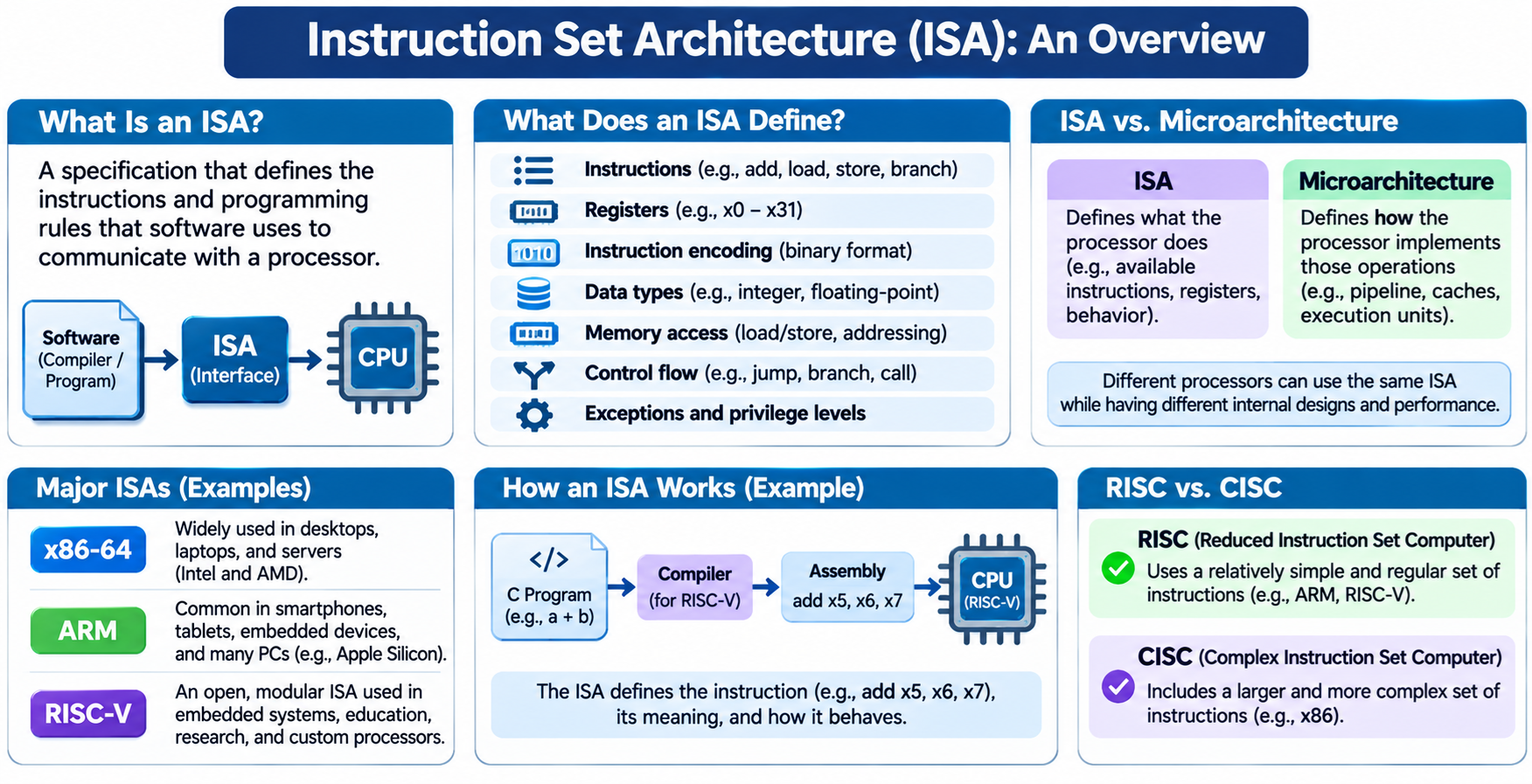
An ISA defines the instructions and programming rules that software uses to communicate with a processor.
It forms the interface between software and hardware, allowing programs to run on processors that implement the same architecture.
Understanding ISA is essential for learning CPU design, assembly language, operating systems, and modern processor technologies such as x86, ARM, and RISC-V.
What Is an Instruction Set Architecture?
An Instruction Set Architecture, or ISA, is a specification that defines how a processor appears to software at the machine-instruction level.
It describes which instructions a CPU supports, how those instructions are encoded, what registers are available, and how instructions interact with memory and processor state.
For example, an ISA may define instructions for adding two numbers, loading data from memory, storing results, and jumping to another location in a program.
The ISA specifies what these instructions must accomplish, but it does not necessarily specify how the processor must implement them internally.
Two processors can use the same ISA while having very different internal designs.
This separation allows processor manufacturers to improve performance and power efficiency without requiring every application to be rewritten.
Why Does a CPU Need an ISA?
Software is written using programming languages such as C, C++, Rust, Python, and Java. However, processors ultimately execute machine instructions represented by binary patterns.
A compiler translates many types of programs into machine code designed for a particular ISA.
For example, a C program compiled for x86-64 produces machine instructions intended for processors that support the required x86-64 features.
The same program may also be compiled for ARM64 or RISC-V, but the resulting machine code will be different.
The ISA provides a standardized set of operations that compilers, operating systems, and other software can target.
Without a defined instruction architecture, software developers would need to understand the internal circuit design of every processor.
What Does an ISA Define?
An ISA typically specifies several important aspects of processor behavior.
Instructions: The operations a processor can perform, such as addition, subtraction, comparisons, branches, and memory access.
Registers: The programmer-visible storage locations used to hold values, addresses, and intermediate results.
Instruction Encoding: The binary format used to represent machine instructions.
Data Types: The sizes and representations of values that instructions operate on, such as integers and floating-point numbers.
Memory Access: Rules for loading and storing data, memory addressing, and ordering of memory operations.
Control Flow: Instructions that allow programs to jump, branch, call functions, and return from functions.
Exceptions and Privilege Levels: Architectural rules for handling exceptional conditions and, where defined, operating-system-level operations.
Not every ISA organizes these features in the same way. Some features may be defined in optional extensions or related architectural specifications.
How Does an ISA Work?
Consider a simple calculation:
5 + 3 = 8
A program might request that two values be added together.
The compiler generates machine instructions appropriate for the target processor architecture.
For example, a RISC-V processor can execute an instruction such as:
add x5, x6, x7
This instruction tells the CPU to add the values stored in registers x6 and x7 and place the result into register x5.
The ISA defines the meaning of the instruction and its machine-code encoding.
Inside the processor, instruction decoding hardware recognizes the operation and directs the required work to execution hardware such as an Arithmetic Logic Unit (ALU).
The ALU performs the arithmetic calculation, and the result becomes available in the destination register.
The ISA defines the required behavior, while the processor’s internal hardware determines how that behavior is implemented.
ISA vs. Microarchitecture: What Is the Difference?
ISA and microarchitecture are closely related, but they describe different aspects of processor design.
The ISA defines what a processor does from the software’s perspective.
The microarchitecture defines how the processor implements those operations internally.
For example, two processors may support the same x86-64 ISA but use different pipeline designs, cache structures, execution units, and branch prediction systems.
One processor might execute instructions using a relatively simple pipeline, while another uses an advanced out-of-order execution engine.
Both processors can produce the same architectural results while delivering different performance and power consumption.
This distinction is one reason CPUs with the same ISA can have very different speeds.
Clock frequency, instructions per cycle, cache efficiency, and execution hardware are primarily microarchitectural characteristics rather than definitions of the ISA itself.
What Are the Major Instruction Set Architectures?
Several instruction set architectures are widely used in modern computing.
x86 and x86-64
x86 originated with Intel’s 8086 processor and became the dominant architecture for IBM PC-compatible computers.
Modern desktop and server processors commonly use x86-64, which extends the architecture to support 64-bit computing.
Intel and AMD manufacture processors that implement x86-64.
The architecture includes a large collection of instructions and maintains substantial compatibility with earlier software.
x86 processors are widely used in desktop computers, laptops, workstations, and servers.
ARM
ARM is an instruction set architecture family widely used in smartphones, tablets, embedded devices, and increasingly personal computers and servers.
ARM processors are designed by many different companies using licensed architecture specifications or processor designs.
Modern 64-bit ARM processors commonly implement the AArch64 execution state of the Arm architecture.
ARM-based processors are found in Apple Silicon computers, smartphones, networking equipment, and many embedded systems.
Different ARM implementations may have very different internal designs while supporting compatible architectural instructions.
RISC-V
RISC-V is an open-standard instruction set architecture based on Reduced Instruction Set Computer principles.
Unlike proprietary ISAs that generally require architectural licensing, the RISC-V specifications are openly available for implementation.
RISC-V uses a modular design consisting of a base instruction set and optional extensions.
For example, RV32I defines a basic 32-bit integer instruction set, while RV64I provides a 64-bit integer architecture.
Additional extensions support features such as multiplication, atomic operations, floating-point arithmetic, and vector processing.
RISC-V is used in embedded systems, microcontrollers, research processors, and increasingly sophisticated computing applications.
Its open and modular design makes it particularly attractive for education, experimentation, and custom processor development.
What Is RISC vs. CISC?
Instruction set architectures are often discussed using two traditional design philosophies: RISC and CISC.
RISC (Reduced Instruction Set Computer) emphasizes relatively simple instructions, regular instruction formats, and efficient implementation.
CISC (Complex Instruction Set Computer) traditionally includes more complex instructions and a wider variety of instruction formats and addressing modes.
ARM and RISC-V are commonly described as RISC architectures, while x86 is commonly described as CISC.
However, modern processors blur this distinction.
For example, many modern x86 processors translate architectural instructions into simpler internal micro-operations before executing them.
Similarly, modern RISC processors can contain highly sophisticated pipelines and execution engines.
Therefore, the RISC-versus-CISC distinction is useful historically, but it does not by itself determine processor performance.
What Is an ISA Extension?
An ISA extension adds new instructions or architectural capabilities to an existing instruction set.
Extensions allow processor designers to introduce functionality without replacing the entire architecture.
For example, x86 processors support various SIMD extensions, such as SSE and AVX, which allow certain operations to process multiple data elements simultaneously.
ARM architectures also provide extensions for SIMD and other specialized operations.
RISC-V explicitly organizes many features as standardized extensions.
Examples include:
- M Extension: Integer multiplication and division.
- A Extension: Atomic memory operations.
- F Extension: Single-precision floating-point operations.
- D Extension: Double-precision floating-point operations.
- C Extension: Compressed instruction encodings.
- V Extension: Vector operations.
Not every RISC-V processor supports every extension.
Software must be compiled or configured for the architectural features available on the target processor.
This is also true for x86 and ARM processors that differ in their supported instruction extensions.
How Does ISA Affect Software Compatibility?
Instruction set compatibility is one of the most important reasons ISAs matter.
A machine-code program compiled for one architecture generally cannot execute directly on a processor with a different ISA.
For example, an x86-64 executable normally cannot run natively on an ARM64 processor.
The operating system or software environment may provide emulation or binary translation to execute programs designed for another architecture.
Another solution is to recompile the source code for the target ISA.
However, sharing an ISA alone does not guarantee complete software compatibility.
Programs also depend on operating-system interfaces, executable formats, calling conventions, libraries, and other elements collectively associated with the software’s Application Binary Interface (ABI).
The ISA defines the processor-level instruction interface, while the ABI defines additional rules that allow compiled software to interact correctly with its execution environment.
What Is the Relationship Between ISA and Assembly Language?
Assembly language is a human-readable representation of machine instructions.
Instead of writing binary instruction encodings directly, programmers use instruction mnemonics such as ADD, SUB, LOAD, and STORE.
Different ISAs use different instruction names, register conventions, and operand formats.
For example, a RISC-V addition instruction may be written as:
add x5, x6, x7
In x86-64 assembly using Intel syntax, an addition operation might be written as:
add rax, rbx
Both instructions perform addition, but they use different registers and operand conventions.
Assembly language is closely tied to an ISA, although assemblers may also provide macros and other conveniences beyond the underlying machine instructions.
Learning assembly language helps explain how software controls CPU registers, memory access, and execution flow.
Why Is ISA Important for Operating Systems?
Operating systems depend on architectural features beyond basic arithmetic instructions.
A modern operating system needs mechanisms for handling interrupts, exceptions, memory protection, and privileged operations.
For example, the processor must provide ways to distinguish ordinary application execution from privileged operating-system operations.
Many architectures also define memory-management and address-translation facilities used by operating systems.
These mechanisms help the operating system manage virtual memory, protect processes, and coordinate access to hardware.
Linux, Windows, and other operating systems can support multiple ISAs, but they generally require architecture-specific code for low-level processor operations.
This is why operating-system kernels contain code tailored to x86-64, ARM64, RISC-V, and other supported architectures.
Why Is ISA Important for FPGA and Processor Design?
An FPGA can be configured to implement a processor using programmable logic resources.
Such a processor is commonly called a soft processor or soft CPU.
For example, engineers can implement a RISC-V processor core inside an FPGA.
The ISA defines the instructions that the soft processor must execute.
The designer then creates the hardware required to fetch, decode, and execute those instructions.
This may involve implementing registers, an ALU, control logic, memory interfaces, and instruction decoding circuits.
Different FPGA-based processors can implement the same ISA while using different hardware designs.
One implementation may prioritize simplicity and low resource consumption, while another may prioritize higher performance.
This makes ISA an important starting point for learning computer architecture and building custom digital processors.
Conclusion
An Instruction Set Architecture defines the fundamental interface between software and processor hardware.
It specifies the instructions, registers, instruction encodings, and architectural behavior that software can rely on.
The ISA determines what a processor must do, while the microarchitecture determines how the processor performs those operations internally.
Major architectures such as x86-64, ARM, and RISC-V provide different instruction sets and architectural capabilities, but all serve the same basic purpose: allowing software to control computing hardware through defined machine instructions.
Understanding ISA also provides a foundation for learning assembly language, compilers, operating systems, CPU design, and FPGA-based processors.
The ISA is the contract between software and hardware.
It allows different processor implementations to execute compatible machine instructions while leaving designers free to improve the internal hardware.