
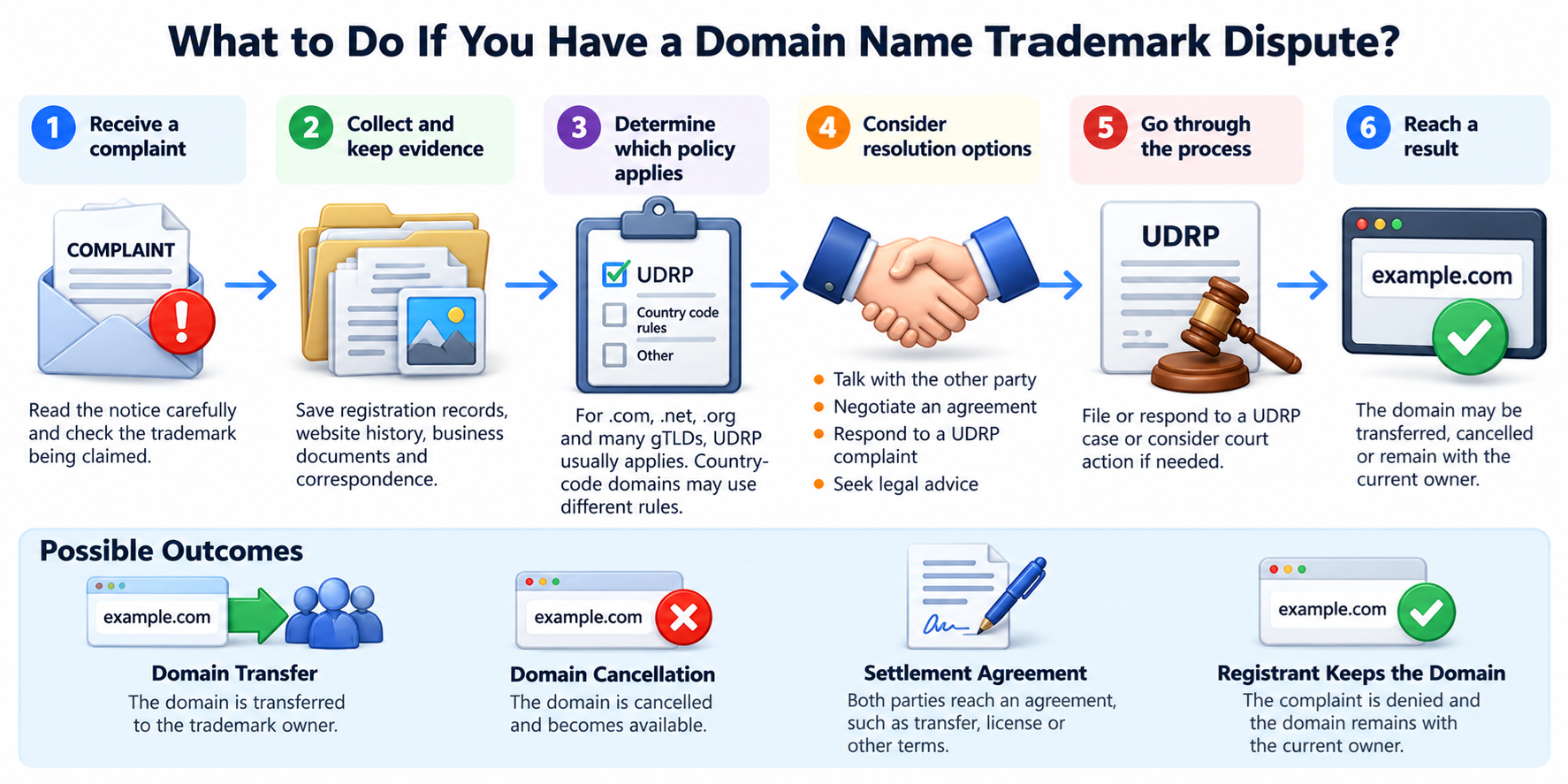
A domain name trademark dispute can arise when one party believes that a registered domain name infringes, misuses, or unfairly takes advantage of its trademark.
For example, a company may discover that someone has registered a domain name that is identical or very similar to its brand name.
On the other hand, a domain registrant may receive a complaint claiming that a domain it legitimately registered violates another party’s trademark rights.
These disputes can become legally complicated, so you should not assume that owning a trademark automatically gives someone ownership of every similar domain name, or that registering a domain name automatically gives the registrant unlimited rights to use it.
If you are involved in a trademark-related domain dispute, the first step is to understand exactly what is being claimed and which dispute-resolution rules apply.
Do Not Ignore a Trademark Complaint
If you receive a trademark complaint, demand letter, UDRP complaint, or other formal notice concerning your domain name, do not ignore it.
Read the notice carefully and determine who sent it, which trademark is being claimed, which domain name is involved, and what action the sender is requesting.
Some complaints simply ask the domain owner to stop using a particular name.
Others may demand transfer of the domain, monetary compensation, or other remedies.
A formal domain-name dispute proceeding may also include strict response deadlines.
Missing a deadline can seriously affect your ability to present your side of the dispute.
Keep Copies of Everything
Preserve documents and evidence relating to the domain name.
This may include your original domain registration information, purchase records, invoices, website screenshots, archived versions of the website, business registration documents, advertising materials, emails, trademark documents, and correspondence with the other party.
It may also be useful to keep evidence showing why and when you registered the domain and how you have actually used it.
In a domain dispute, the history of the registration and use of the domain can be extremely important.
Determine Which Domain Dispute Policy Applies
For many generic top-level domains such as .com, .net, and .org, trademark-related cybersquatting disputes may be handled under the Uniform Domain-Name Dispute-Resolution Policy, commonly called the UDRP.
ICANN requires accredited registrars handling applicable generic top-level domains to follow the UDRP.
Under that policy, trademark-based domain disputes may be resolved through agreement, court proceedings, or an approved administrative dispute-resolution process.
Country-code domains may use different rules.
Some country-code top-level domains have adopted the UDRP, while others use their own dispute-resolution procedures or modified versions of the UDRP.
Before taking action, identify the policy that applies to the particular domain extension.
What Is the UDRP?
The UDRP is an administrative procedure designed primarily to deal with abusive domain-name registrations, commonly known as cybersquatting.
It is not intended to resolve every possible business, contract, trademark, or ownership dispute involving a domain name.
A trademark owner using the UDRP generally must prove three elements.
First, the disputed domain name must be identical or confusingly similar to a trademark or service mark in which the complainant has rights.
Second, the domain registrant must have no rights or legitimate interests in the domain name.
Third, the domain name must have been registered and used in bad faith.
The complainant generally needs to establish all three elements to succeed under the UDRP.
What Does “Confusingly Similar” Mean?
The first issue normally examines whether the domain name is identical or sufficiently similar to a trademark.
For example, if a company owns a trademark for a distinctive brand and someone registers the exact brand as a .com domain, this element may be relatively straightforward.
A domain does not necessarily have to be exactly identical to create a dispute.
Minor spelling changes, additional descriptive words, or other variations may still be considered similar depending on the circumstances.
However, this is only the first part of a UDRP case.
Similarity by itself does not automatically mean that the trademark owner will win the domain.
What Are Rights or Legitimate Interests?
A registrant may have a legitimate reason for using a domain name even when the domain resembles someone else’s trademark.
For example, the registrant may have been genuinely known by the name, may have used the domain for a legitimate business before receiving notice of the dispute, or may have another lawful basis for using it.
The exact analysis depends heavily on the facts.
This is one reason domain disputes cannot normally be decided simply by asking who owns the trademark.
The history and purpose of the domain registration matter as well.
What Does Bad Faith Mean?
Bad faith is a major issue in UDRP disputes.
Examples may include registering a domain primarily to sell it to the trademark owner for an excessive amount, registering domains to prevent trademark owners from using their marks, disrupting a competitor’s business, or intentionally attracting users by creating confusion with another party’s trademark.
The evidence surrounding the registration and use of the domain is therefore extremely important.
WIPO specifically recommends that complainants gather evidence supporting bad-faith registration and use, such as website screenshots, fraudulent emails, correspondence, and other relevant material.
What If I Registered the Domain Before the Trademark Existed?
Timing can be extremely important.
If a domain name was registered before the complainant acquired trademark rights, proving that the domain was originally registered in bad faith toward that later trademark may be difficult in many UDRP situations.
However, trademark disputes are highly fact-specific, and issues such as later transfers, ownership changes, trademark history, or unusual circumstances may affect the analysis.
Do not rely on registration date alone without reviewing the complete history.
What If the Domain Contains a Common Word?
Trademark rights do not necessarily give a company complete control over every use of an ordinary dictionary word.
If the disputed domain consists of a generic or descriptive word and the registrant is using the domain for its ordinary meaning rather than trying to target a trademark owner, that may be relevant to whether the registrant has a legitimate interest and whether bad faith exists.
However, a common word can still function as a trademark in particular industries.
The way the domain is being used therefore matters.
Avoid Making the Situation Worse
Once a dispute has started, avoid making sudden changes that could be interpreted negatively.
For example, changing a normal website into a page filled with advertisements targeting the trademark owner’s competitors could potentially affect how the domain’s use is viewed.
Similarly, immediately offering to sell the domain to the complainant for a very large amount may become part of the evidence considered in a dispute.
Preserve your records and consider obtaining legal advice before making significant changes.
Be Careful About Offering to Sell the Domain
Selling domain names is not automatically illegal.
However, in a trademark dispute, the circumstances surrounding an offer to sell can become important.
If evidence suggests that a domain was registered primarily to sell it to a trademark owner or competitor for more than the registrant’s documented costs, that can potentially support an allegation of bad faith under the UDRP.
If you receive an unsolicited purchase request while a trademark dispute is developing, consider the legal implications before responding.
What If Someone Is Using My Trademark in a Domain?
If you are the trademark owner, begin by collecting evidence.
Document the disputed domain, the website appearing on it, the registration information that is publicly available, misleading emails if any exist, and other evidence showing how the domain is being used.
Also gather documents establishing your trademark rights, including trademark registration certificates where applicable.
WIPO recommends that complainants provide evidence of their trademark rights and evidence supporting the allegations of bad-faith registration and use.
Consider Contacting the Domain Owner
Some disputes can be resolved without formal proceedings.
You may be able to contact the domain registrant and explain your concerns.
Possible outcomes can include transferring the domain, changing the way it is used, entering into a licensing arrangement, or reaching another agreement.
However, direct contact is not always appropriate.
If there is suspected fraud, impersonation, phishing, evidence destruction, or a risk that the domain may quickly be transferred to another person, obtaining legal advice before contacting the registrant may be safer.
Filing a UDRP Complaint
If informal efforts do not resolve the dispute and the situation appears to involve abusive domain registration, a trademark owner may consider filing a UDRP complaint with an approved dispute-resolution provider.
WIPO is one of the major providers of UDRP dispute-resolution services.
Its procedure generally involves filing a complaint, allowing the registrant to submit a response, appointing a panel, issuing a decision, and, where appropriate, implementing a transfer or cancellation of the domain.
WIPO provides model complaint and response documents to help parties prepare their submissions.
What Can a UDRP Panel Do?
A UDRP proceeding is primarily designed to determine control of the domain name.
If the complainant succeeds, the usual remedies are cancellation of the domain or transfer of the domain to the complainant.
A UDRP panel does not normally award monetary damages.
If a party seeks damages, broader trademark remedies, injunctions, or resolution of other legal claims, court proceedings may be necessary.
How Long Does a UDRP Case Take?
According to WIPO, a normal UDRP proceeding without unusual procedural complications can generally be completed within approximately two months after the complaint is received.
The actual timing may vary depending on the provider, procedural issues, extensions, panel composition, or other circumstances.
Because response periods can be short, anyone receiving a formal complaint should act promptly.
How Much Does a UDRP Case Cost?
Fees depend on the dispute-resolution provider, the number of domains involved, and whether a single-member or three-member panel is requested.
For example, WIPO currently lists a fee of USD 1,500 for a standard case involving between one and five domain names decided by a single panelist.
Legal representation, if used, would be a separate expense.
Fees and procedures can change, so always check the current provider rules before filing.
Do I Need a Lawyer?
You are not necessarily required to have a lawyer to file or respond to a UDRP proceeding.
WIPO provides model documents, and parties may represent themselves.
However, trademark and domain disputes can involve complicated questions concerning trademark rights, legitimate interests, bad faith, jurisdiction, evidence, and procedural strategy.
If the domain has significant financial or business value, or if you receive a formal legal demand or lawsuit, consulting an attorney experienced in intellectual property and domain-name disputes can be very important.
A Registrar Usually Does Not Decide Who Owns the Trademark
Your domain registrar normally is not a court and does not independently determine complicated trademark ownership disputes.
Under the UDRP framework, most trademark-based disputes must be resolved through agreement, an appropriate dispute-resolution proceeding, or court action before the registrar implements remedies such as transfer or cancellation.
Therefore, simply asking your registrar to decide which party is legally correct may not resolve the dispute.
Do Not Transfer the Domain During a Formal Dispute
If formal proceedings have begun, special restrictions may apply to transferring the domain.
Do not attempt to transfer, sell, or move ownership of a disputed domain merely to avoid the proceeding.
Such actions can complicate the case and may be viewed negatively.
Follow the applicable dispute policy and the instructions issued by the registrar or dispute-resolution provider.
Court Action May Still Be Possible
The UDRP does not completely replace national court systems.
Either party may have the ability to pursue appropriate court proceedings depending on the circumstances and jurisdiction.
WIPO describes the UDRP as an administrative procedure that operates without preventing parties from seeking relief in competent courts.
Court proceedings may be more appropriate when a dispute involves complex trademark infringement allegations, contracts, ownership disagreements, damages, or issues extending beyond cybersquatting.
Watch Out for Fake Trademark or Domain Dispute Notices
Domain owners sometimes receive misleading or fraudulent notices designed to look like official legal documents.
If you receive a suspicious email claiming that someone has filed a domain dispute, verify the sender independently.
Do not immediately click unfamiliar links, provide account passwords, or transfer your domain.
WIPO specifically warns about fraudulent communications and recommends verifying suspicious messages through its official resources.
Protect Your Domain Account
During any dispute, make sure your registrar account is secure.
Use a strong and unique password and enable multi-factor authentication if available.
Confirm that the registrant contact information is current and that you can receive important notices.
Do not give anyone your registrar password or authorization codes simply because they claim to represent a trademark owner.
A legitimate dispute-resolution process does not require you to surrender your account password.
A Practical Checklist
If you receive a trademark complaint concerning your domain, preserve the notice, collect your registration and usage history, identify the trademark being claimed, determine which dispute policy applies, and note all deadlines.
Avoid deleting evidence or making drastic changes to the website.
If the domain is valuable or the claim appears serious, speak with an experienced intellectual-property attorney before responding.
If you believe someone has registered a domain to misuse your trademark, gather evidence of your trademark rights, document the domain’s registration and use, and evaluate whether negotiation, a UDRP complaint, or court action is the most appropriate solution.
Conclusion
A domain-name trademark dispute should be taken seriously, but receiving a complaint does not automatically mean that you must surrender your domain.
Likewise, owning a trademark does not automatically give you ownership of every domain containing similar words.
The outcome usually depends on the trademark rights involved, the domain’s registration history, whether the registrant has a legitimate interest, how the domain is being used, and whether there is evidence of bad faith.
For many .com, .net, .org, and other generic top-level domains, the UDRP provides a relatively streamlined procedure for resolving clear cases of abusive registration.
More complicated trademark and business disputes may require negotiation or court proceedings.
Because domain-name disputes can affect valuable business assets and legal rights, preserve your evidence, observe all deadlines, and obtain qualified legal advice when the dispute is significant.