
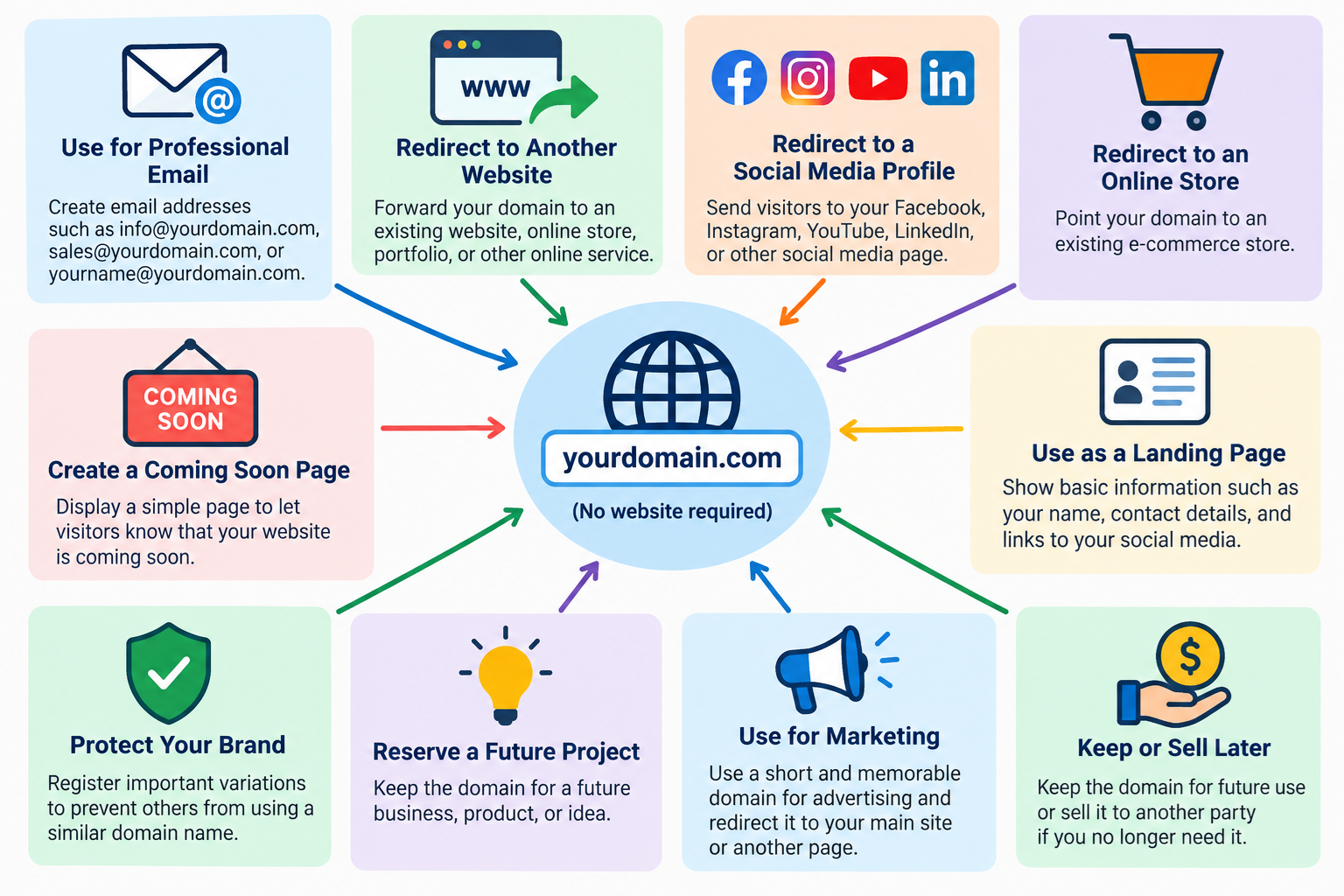
Registering a domain name does not mean that you must immediately build a website.
Many people register domain names long before they are ready to launch a website.
Others buy domains to protect a business name, create professional email addresses, reserve a future project, redirect visitors to another website, or simply keep an important name from being registered by someone else.
If you already own a domain name but do not want to create a website, you still have several useful options.
Keep the Domain Name for Future Use
The simplest option is to keep the domain name registered and do nothing with it for now.
You may have an idea for a future business, product, blog, online store, or personal project, but you may not be ready to build it yet.
By registering the domain name early, you reserve that address while it is still available.
For example, you might register:
myfuturebusiness.com
even if you do not plan to launch the business until next year.
As long as you continue renewing the domain, you can keep control of it until you are ready to use it.
This can be especially useful if the domain name is closely connected to your company name, product name, or personal brand.
Use the Domain for Professional Email
You do not need a website in order to use a domain name for email.
For example, if you own:
examplebusiness.com
you may be able to create email addresses such as:
info@examplebusiness.com
sales@examplebusiness.com
support@examplebusiness.com
or
yourname@examplebusiness.com
Using your own domain for email can look more professional than using a free email address from a general email provider.
For example:
john@examplebusiness.com
may look more business-oriented than:
john12345@examplemail.com
To use domain-based email, you normally need an email hosting service or another email provider that supports custom domains.
Your domain’s DNS records must then be configured so that email messages are delivered to the correct mail servers.
You still do not need to build a website.
Redirect the Domain to Another Website
A domain name can also be redirected to another website.
For example, suppose you own:
mycompany.ca
but your main website is:
mycompany.com
You can configure mycompany.ca so that visitors are automatically sent to mycompany.com.
This is commonly called domain forwarding or URL forwarding.
You might also redirect a domain to:
a company website,
an online store,
a product page,
a portfolio,
a social media page,
a booking page,
or another online service.
This allows you to use the domain as a simple, memorable address even if the actual content is hosted somewhere else.
Redirect the Domain to a Social Media Profile
If you do not have a website, you can use your domain name to send visitors to your social media page.
For example, you could redirect:
mybrand.com
to your Facebook page, LinkedIn profile, YouTube channel, Instagram account, or another public profile.
This can be useful when you want a professional web address but do not yet need a full website.
Instead of telling customers to remember a long social media URL, you can simply give them your domain name.
Later, if you decide to build your own website, you can stop the redirect and point the domain to your new site.
Redirect the Domain to an Online Store
You may also use your domain name with an existing online store.
For example, your products might currently be sold through an e-commerce platform or marketplace.
You could register a memorable domain name and redirect it to your store.
This gives customers a simpler address to remember and can help you maintain a more consistent brand.
Some e-commerce platforms also allow you to connect a custom domain directly to your store rather than simply forwarding it.
The exact setup depends on the platform you use.
Use the Domain for a Landing Page
You may not need a full website.
Sometimes a single page is enough.
A simple landing page could contain:
your business name,
contact information,
a short description of your services,
an email address,
a phone number,
social media links,
or a message saying that a new website is coming soon.
This is sometimes called a holding page, placeholder page, or coming-soon page.
A one-page site can be much easier to maintain than a complete website and still gives visitors useful information.
Create a Coming Soon Page
If you plan to launch a website later, you can display a simple “Coming Soon” page.
For example:
“Example Business is launching soon. Contact us at info@examplebusiness.com.”
This tells visitors that the domain is active and that something will eventually appear there.
It can also prevent visitors from assuming that the domain is abandoned or broken.
Some hosting services, website builders, and domain providers offer simple tools for creating temporary pages.
Use the Domain for Contact Information
A domain can also serve as a very simple online business card.
Instead of creating a large website, you could create one page that includes only essential information.
For example:
your name,
company name,
email address,
phone number,
business hours,
physical location,
and social media links.
For a small local business or independent professional, this may be all that is needed initially.
You can always expand the site later.
Protect Your Business or Brand Name
You may want to keep a domain name even if you never plan to build a website on it.
For example, if your company uses:
example.com
you might also register:
example.net
example.ca
or another important variation.
The additional domains can help prevent confusion and reduce the chance that another person or business registers a similar name.
You can simply keep those domains registered or redirect them to your primary domain.
This is commonly part of a broader brand-protection strategy.
Reserve a Product or Project Name
Companies often register domain names before a product is officially launched.
Suppose your business is developing a product called:
Project Nova
You might register:
projectnova.com
before the product is announced.
Even if the domain displays nothing for several months, owning it can preserve your options.
When the product launches, you can decide whether to build a separate website, redirect the domain to a product page, or use it for marketing.
Use the Domain as a Shorter Marketing Address
Sometimes your main website address is long or difficult to remember.
A shorter domain can be used for advertising.
For example, your primary website might be:
internationalbusinesshostingsolutions.com
but you could register:
ibhost.com
and redirect it to the longer address.
The shorter domain may be easier to use in:
business cards,
printed advertisements,
videos,
podcasts,
trade shows,
signs,
or spoken conversations.
The domain becomes a simple gateway to your main online presence.
Point the Domain to a Different Server Later
You do not have to decide immediately where your domain will eventually be hosted.
A domain name and a hosting account are separate services.
You can register the domain today and choose a hosting provider later.
When you are ready, you can update the domain’s DNS settings or nameservers to point it to your new hosting service.
This gives you flexibility.
You are not required to purchase hosting simply because you registered a domain.
Use Subdomains Without Building a Main Website
A domain can also be used for subdomains.
For example, if you own:
example.com
you could potentially use:
mail.example.com
shop.example.com
portal.example.com
app.example.com
or
support.example.com
even if the main address example.com does not contain a traditional website.
Different subdomains can point to different services or servers.
This is common for businesses that use separate systems for email, customer portals, cloud applications, documentation, or internal tools.
Use the Domain for a Web Application
A domain does not have to point to a traditional website made up of informational pages.
It can point to an online application instead.
For example:
portal.example.com
could point to a customer login system.
app.example.com
could point to a software service.
files.example.com
could point to a file-sharing system.
The domain simply provides a human-readable address for the service.
Keep the Domain Parked
Another option is to leave the domain parked.
A parked domain is registered but is not being used for a full website.
Depending on your registrar or hosting provider, a parked domain might display:
a simple placeholder page,
a domain registration message,
a blank page,
or another default page.
If you plan to keep the domain unused for a while, parking it can be a simple temporary solution.
However, you should review what your provider displays on parked domains because you may not want unrelated advertisements or messages appearing under your domain name.
Can You Sell the Domain Later?
Yes, in many cases a domain name can be transferred or sold to another party.
Some people register domains because they believe another person or company may eventually want them.
However, domain investing carries risks.
A domain may never increase in value, and you still need to pay renewal fees while you own it.
You should also avoid registering names that may infringe on another company’s trademark or brand rights.
A domain name is not automatically valuable simply because it is short or sounds interesting.
Can You Let the Domain Expire?
Yes, but you should do this carefully.
If you decide that you no longer want a domain, you can usually stop renewing it.
After the domain expires and passes through the applicable expiration and redemption processes, it may eventually become available for someone else to register.
Once that happens, you may lose control of the domain permanently.
Before allowing a domain to expire, make sure that it is not being used for:
email,
website redirects,
business cards,
marketing materials,
customer accounts,
login recovery,
or other important services.
Losing a domain that is still connected to email or business accounts can create serious problems.
Be Careful With Email Before Giving Up a Domain
This is especially important if you have used the domain for email.
Suppose you previously used:
admin@example.com
for important accounts.
If you later allow example.com to expire, someone else might eventually register the domain.
Depending on how external accounts are configured, that could create security or account-recovery risks.
Before giving up an old domain, review any email addresses, online accounts, password recovery settings, and services connected to it.
You Do Not Need Hosting Just to Own a Domain
A common misunderstanding is that buying a domain requires buying web hosting at the same time.
It does not.
A domain name is your internet address.
Web hosting is the server space used to store and deliver a website.
You can register and maintain a domain name without purchasing a traditional web hosting plan.
You only need hosting when you want to run a website or another service that requires server resources.
Keep Your Contact Information Updated
Even if you are not using the domain for a website, you should still manage it carefully.
Make sure your domain account contains current contact information.
You should also keep your payment method updated if you use automatic renewal.
Important domain names should not be forgotten simply because they do not currently host websites.
A domain may still be valuable for your business, email, branding, or future plans.
Enable Automatic Renewal for Important Domains
If a domain is important to you, enabling automatic renewal can reduce the risk of accidentally losing it.
Domain registrations normally need to be renewed periodically.
If you forget to renew a domain, it may eventually expire.
For business-critical domains, automatic renewal is usually a sensible precaution, as long as your payment information remains current.
You should still periodically review your domain portfolio and confirm that you want to keep each domain.
Final Thoughts
You do not need to build a website just because you own a domain name.
You can keep the domain for future use, create professional email addresses, redirect it to another website or social media page, use it for a landing page, protect your brand, reserve a future product name, or connect it to another online service.
A domain name is simply an internet address that you control while the registration remains active.
What you do with that address is up to you.
If you are not ready to build a website today, you can keep the domain registered and decide how to use it later.