
Click to WordPress Web Hositng from $7.47 per month
When you start a website, you usually need only one primary domain name.
For example, if your business is called Example Hosting, you might register examplehosting.com and use it for your website, email addresses, and marketing.
However, registering only one domain name is not always the best long-term strategy.
Depending on your business, brand, target market, and future plans, owning several related domain names can help protect your brand, reduce customer confusion, support marketing campaigns, and prevent competitors or unrelated parties from registering names that are very similar to yours.
You do not need to register every possible domain extension or every variation of your company name.
The goal is to register the domain names that are most important to your business.
Protect Your Brand Name
One of the main reasons to register more than one domain name is brand protection.
Suppose your company owns example.com, but you do not register example.net or example.ca. Someone else may be able to register those domain names.
That person might have no connection with your company, but visitors who see a similar domain name could still assume that the website belongs to you.
For a growing business, this can create confusion.
Customers may visit the wrong website, send email to the wrong domain, or believe that another company is associated with your brand.
Registering a few important variations of your domain name can reduce this risk.
Prevent Competitors From Registering Similar Names
In some situations, another business may register a domain name that looks similar to yours.
For example, imagine that you operate:
greatcomputerhosting.com
A competitor might register:
greatcomputerhosting.net
or another closely related variation if it is still available.
That does not automatically mean the competitor is doing anything illegal.
Domain names are generally registered on a first-come, first-served basis, subject to applicable trademark laws and domain-name dispute policies.
From a business perspective, however, allowing important variations of your brand to remain available can create unnecessary risk.
If a domain name is important to your brand, it may be easier and less expensive to register it early than to deal with confusion later.
Register Common Domain Extensions
The .com extension is widely recognized, but it is not the only domain extension businesses use.
Depending on your company and target audience, you might also consider registering extensions such as:
.net
.org
.ca
.co.uk
.com.au
or another country-code or industry-related extension.
For example, a Canadian company that primarily uses example.com might also want to register example.ca.
The business could continue using the .com domain as its primary website while redirecting the .ca domain to the same website.
This allows customers who naturally type the Canadian version of the domain to reach the correct destination.
Protect Common Misspellings
People make typing mistakes.
If your domain name is long, contains words that are commonly misspelled, or has several possible spellings, registering a few common misspellings can be useful.
Suppose your primary domain name is:
excellentcomputers.com
Some visitors might accidentally type a similar spelling.
If you own the most common mistaken version, you can redirect it to your main website.
This does not mean you should register every possible spelling mistake. There could be hundreds or thousands of combinations.
Instead, focus on obvious mistakes that customers are reasonably likely to make.
Register Versions With and Without Hyphens
Some domain names can be written with or without hyphens.
For example:
great-web-hosting.com
and
greatwebhosting.com
are two completely different domain names.
If your brand could reasonably be typed either way, registering both versions may be useful.
You can choose one domain as your primary domain and redirect the other one to it.
In most cases, businesses prefer the simpler version without hyphens because it is easier to remember and easier to say aloud.
However, owning both versions can help prevent confusion.
Protect Singular and Plural Versions
Singular and plural versions of a domain name can also be different.
For example:
computerpart.com
and
computerparts.com
are separate domain names.
A customer might easily remember one when your business actually uses the other.
If both versions are important to your brand and are still available, registering both can make sense.
Again, you do not need to build separate websites. One domain can simply redirect visitors to the main domain.
Protect Different Versions of Your Company Name
Companies are often known by more than one name.
Your official company name might be:
Northern Technology Solutions Inc.
but customers may simply call the company:
Northern Tech
In this case, the business might want domain names related to both the official company name and the shorter brand name.
This becomes particularly important if you later decide to change your branding.
Owning both the long and short versions gives you more flexibility.
Use Different Domains for Different Products
Sometimes a company operates several products, services, or brands.
Instead of putting everything under one domain name, the company may register separate domains for major products.
For example, a hosting company might use one primary corporate domain while registering additional names for a website builder, cloud service, security product, or specialized hosting service.
Whether these domains should become independent websites depends on the business strategy.
In many cases, the additional domain simply redirects to a product page on the main website.
Use Domains for Marketing Campaigns
A shorter or more memorable domain name can sometimes be useful for advertising.
Imagine that your company’s main website is:
advancedbusinesshostingservices.com
That domain may accurately describe the business, but it is difficult to remember.
The company might register a shorter domain specifically for advertising and redirect it to the main website.
Short promotional domains can be useful in printed advertisements, videos, podcasts, trade shows, business cards, and other situations where customers need to remember the address.
Protect Your Brand in Different Countries
If your business operates internationally, country-code top-level domains may become important.
A country-code top-level domain, often called a ccTLD, is a domain extension associated with a particular country or territory.
Examples include:
.ca for Canada
.uk for the United Kingdom
.de for Germany
.jp for Japan
If your company expects to operate in several countries, you may consider registering the most important country-specific versions of your brand.
You may not need to build websites on all of them immediately. Registering them can simply preserve your options for the future.
Keep in mind that some country-code domains have local presence, documentation, or eligibility requirements, so registration rules can vary.
Register a Domain Before You Need It
Sometimes you have an idea for a future product, company, or project but are not ready to launch it.
If the domain name is particularly important and available, you may decide to register it before building the website.
Registering the domain gives you control of that name for the registration period, as long as you continue renewing it.
However, buying large numbers of speculative domain names can become expensive. Domain registration and renewal fees add up quickly.
It is usually better to focus on names that have a realistic connection to your future business plans.
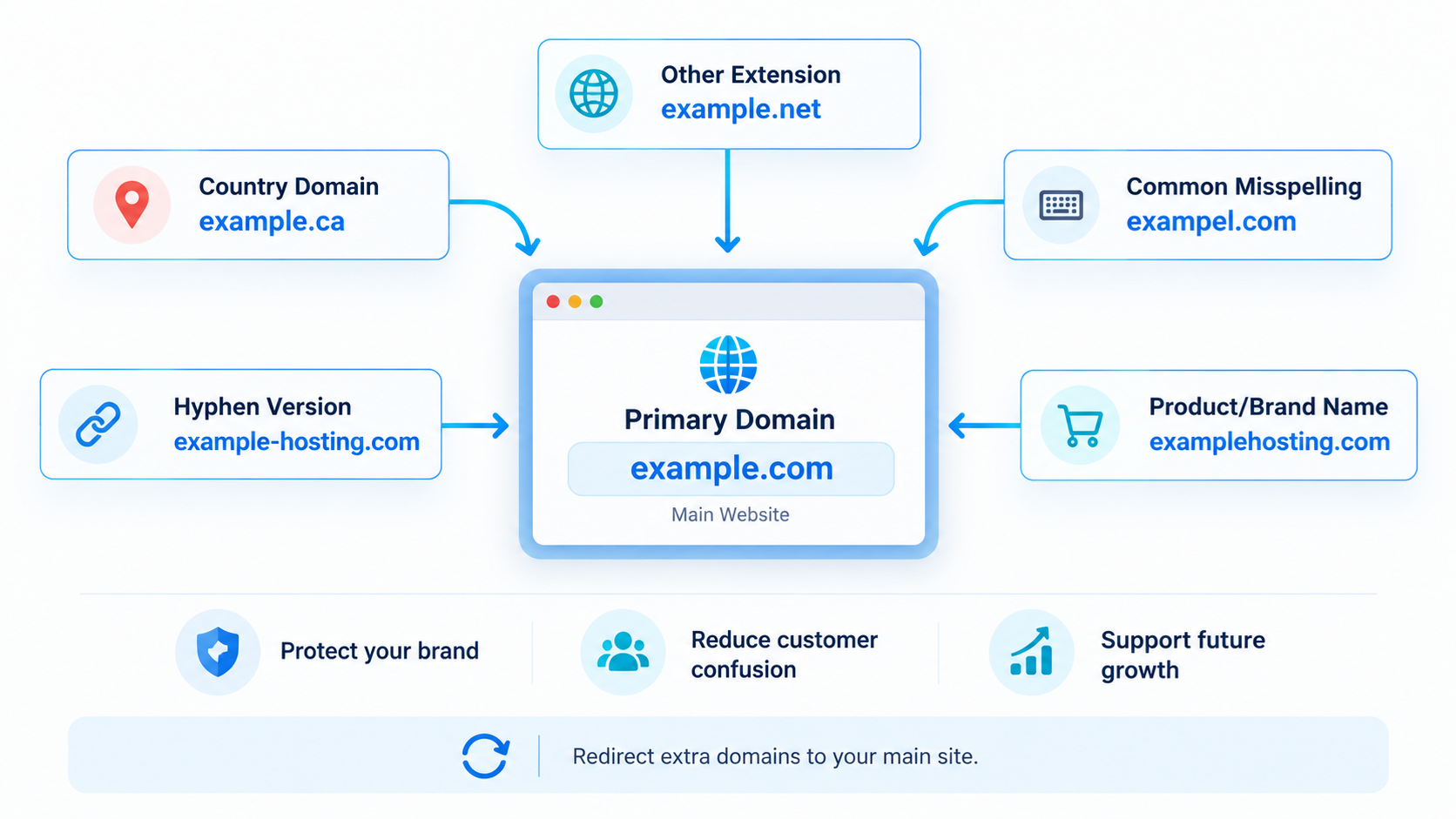
Redirect Additional Domains to Your Main Website
Owning several domains does not mean that you need several websites.
In many cases, you should have one primary domain and redirect the additional domains to it.
For example, your main website might be:
example.com
You could also own:
example.net
example.ca
examplehosting.com
Visitors who enter any of these addresses could be redirected automatically to example.com.
This keeps your website management simple while still allowing you to protect important domain-name variations.
Avoid Duplicate Websites
If you own several domain names, it is usually unnecessary to create identical copies of your website under every domain.
Maintaining multiple identical websites can create technical and search-engine optimization complications.
A cleaner approach is usually to choose one primary domain name and permanently redirect your secondary domains to the primary domain.
This gives customers multiple ways to find you while keeping one main website address.
Do You Need Every Domain Extension?
No.
There are hundreds of domain extensions available, and registering every extension would usually be unnecessary and expensive.
A small business generally does not need to own every possible version of its name.
Instead, consider which domains are most important.
For many businesses, this might include the primary .com, an important country-code domain, and perhaps one or two obvious variations or common misspellings.
Large international companies with valuable trademarks may register many more domains because they have greater brand-protection requirements.
Your strategy should match the size and importance of your brand.
What About Trademark Protection?
Registering multiple domain names can help protect a brand, but domain registration is not the same as trademark protection.
A domain name gives you control over that particular domain while the registration remains valid.
A trademark may provide broader legal protection for a brand name, logo, or other identifier, depending on the jurisdiction and circumstances.
Similarly, owning a trademark does not automatically mean that every matching domain name will immediately belong to you.
Domain disputes can involve trademark law, registration history, the registrant’s actions, and specific dispute-resolution policies.
Businesses with valuable brands should consider domain management and trademark protection as related but separate issues.
Do Not Forget Domain Renewals
Owning multiple domain names also creates additional responsibility.
Every domain must be renewed.
If you forget to renew an important domain, it may eventually expire and become available for someone else to register.
For important business domains, enabling automatic renewal can reduce the chance of accidental expiration.
You should also make sure that the registrant email address and payment information associated with your domain account remain current.
The more domains you own, the more important good domain management becomes.
Keep Your Domain Portfolio Simple
It is easy to become enthusiastic and start registering dozens of domain names.
Usually, that is not necessary.
Every additional domain costs money to register and renew. A domain that serves no clear purpose may simply become another expense.
A practical domain portfolio might include your main brand, one or two important extensions, common spelling variations, and names connected to important future products.
The objective is not to own every possible domain name.
The objective is to own the domain names that matter.
Final Thoughts
Registering more than one domain name can be a simple way to protect your brand and make it easier for customers to find your business.
Your primary domain should remain the main address of your website, while additional domains can protect important extensions, common misspellings, alternative company names, product names, and country-specific versions of your brand.
You do not need hundreds of domains. Start with the names that customers are most likely to associate with your business.
A few carefully selected domain names can provide useful protection today while also giving your business more flexibility in the future.