
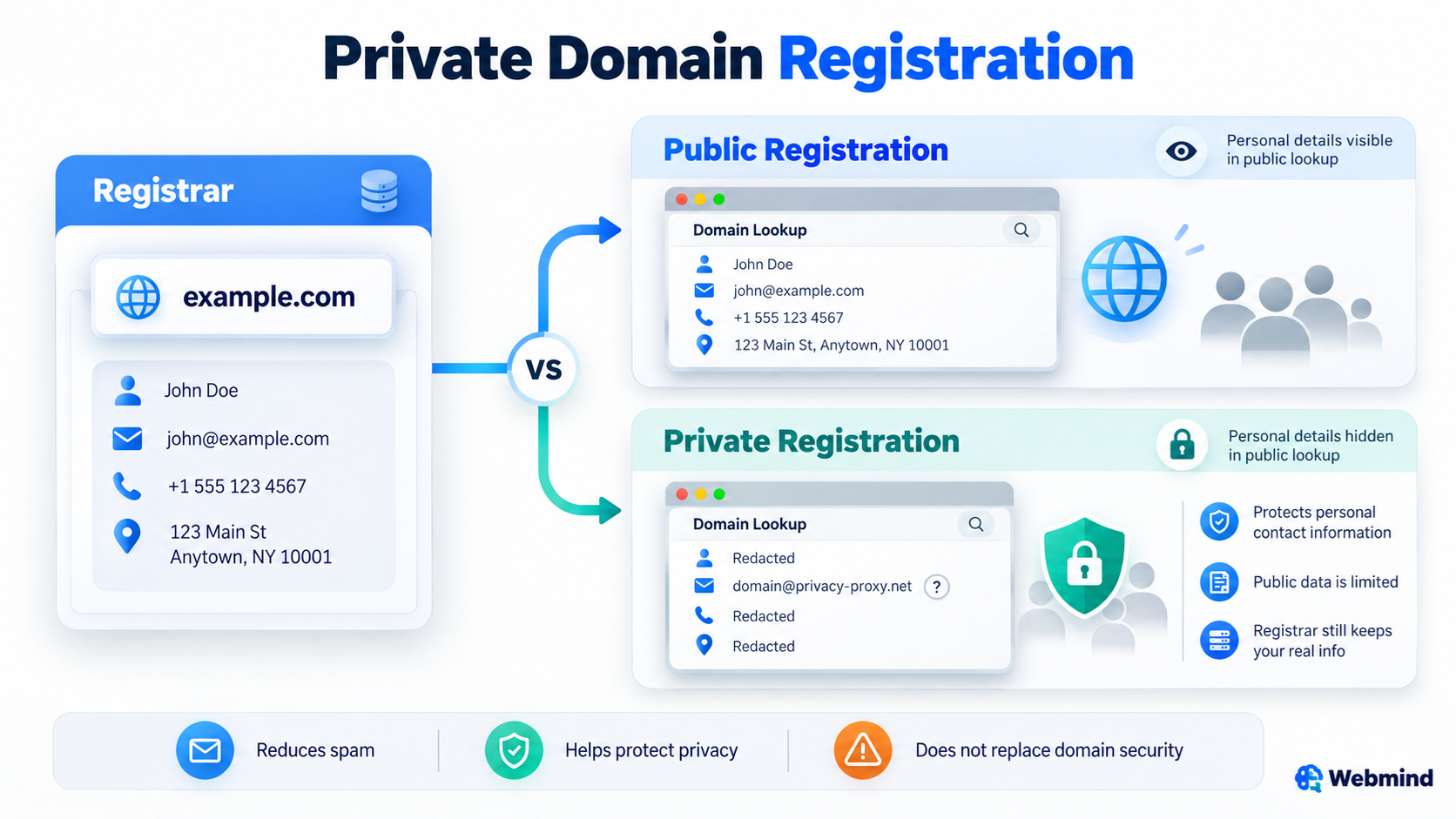
When you register a domain name, the registrar collects certain information associated with the registration.
This may include information about the person or organization responsible for the domain, contact details, registration dates, registrar information, and technical information related to the domain.
In the past, much of this information was commonly visible through public WHOIS searches.
Today, privacy laws, ICANN policies, and changes to domain registration systems have significantly reduced the amount of personal information that is automatically displayed publicly for many domain names.
However, you may still see services described as:
Private Domain Registration
Domain Privacy
WHOIS Privacy
Privacy Protection
Proxy Registration
These services are designed to reduce the amount of a registrant’s personal contact information that appears in publicly accessible domain registration data.
What Is Private Domain Registration?
Private Domain Registration is a service that helps protect a domain owner’s personal information from being displayed publicly in domain registration lookup services.
Instead of showing personal contact details, a privacy service may publish alternative contact information or redact certain information from public view.
Depending on the registrar, registry, domain extension, and privacy service, this may help protect information such as:
Personal email address
Telephone number
Mailing address
Other contact information
The exact information hidden or replaced depends on the domain and service provider.
Why Is Domain Registration Information Collected?
When a domain name is registered, the registrar must collect or generate certain registration information.
The domain name system needs reliable information about who is responsible for the registration and how the registrar can contact that person or organization when necessary.
This information may be needed for:
Account administration
Domain renewal
Security notifications
Legal requirements
Domain disputes
Abuse investigations
Technical problems
Registrar communications
The fact that information is collected does not necessarily mean that all of it is publicly visible.
What Was WHOIS?
WHOIS is a name historically used for systems that allowed people to look up information associated with domain names, IP addresses, and other Internet resources.
For many years, entering a domain name into a WHOIS lookup tool could reveal information such as:
Registrant name
Organization
Address
Telephone number
Email address
Registrar
Registration date
Expiration date
Nameservers
This created privacy concerns because personal contact information could sometimes be collected automatically by marketers, scammers, spammers, and other parties.
The domain registration system has changed considerably since then.
What Is RDAP?
RDAP stands for Registration Data Access Protocol.
It is a newer protocol designed to provide access to domain registration information in a more standardized way.
RDAP was developed as a modern replacement for the traditional WHOIS protocol.
For generic top-level domains, registries and registrars are now required to provide RDAP services.
RDAP can provide public registration information while also supporting different levels of access to nonpublic registration data.
For website owners, the practical idea is simple:
Domain registration data still exists, but not all of it is necessarily visible to everyone on the Internet.
Is WHOIS Completely Gone?
The term WHOIS is still widely used by domain registrars, hosting companies, and website owners.
You may still see buttons labeled:
WHOIS Lookup
WHOIS Privacy
Private WHOIS
However, modern domain registration data increasingly uses RDAP and newer ICANN registration data policies.
For most website owners, you do not need to understand the technical differences in detail.
The important point is that domain registration data can now be divided into public and nonpublic information.
What Information May Still Be Public?
Even when personal information is protected, some domain information normally remains publicly available.
Depending on the domain extension and registrar, public registration data may include:
Domain name
Registrar
Registration status
Creation date
Expiration date
Nameservers
DNSSEC information
Certain technical or administrative information
The specific fields vary.
Private Domain Registration does not make a domain invisible.
It primarily protects personal or contact information.
How Does Domain Privacy Work?
A privacy service can work in different ways.
One method is to keep the domain registered in your name while replacing some publicly displayed contact information with alternative contact details.
For example, your private email address might not appear publicly.
Instead, the privacy provider might supply an email forwarding address.
Messages sent to that address can then be forwarded to you without revealing your personal email address.
Other contact details may also be redacted or replaced depending on the service.
What Is a Privacy Service?
Under ICANN terminology, a privacy service allows the customer to remain the registered domain name holder while alternative contact information is published instead of certain personal contact information.
For example, the registrant may still be the actual domain owner, but a forwarding email address may be shown instead of the registrant’s personal email address.
This helps reduce public exposure while allowing legitimate communications to reach the domain owner.
What Is a Proxy Service?
A proxy service is different.
With a proxy service, the proxy provider may appear as the registered domain name holder rather than the customer.
The provider then allows the customer to use the domain.
This creates a different legal relationship because the proxy provider is the registrant of record.
For this reason, website owners should understand whether a service is a privacy service or a proxy service before using it.
The terms are sometimes used loosely in marketing, but technically they are not exactly the same.
Why Would Someone Use Private Domain Registration?
There are several reasons a domain owner may want privacy protection.
The most obvious reason is to reduce the amount of personal information exposed publicly.
Without appropriate privacy protection, publicly available contact information could potentially be collected by:
Spammers
Marketing companies
Scammers
Data collection services
Automated bots
Fraudsters
Other third parties
Reducing unnecessary public exposure can improve privacy and reduce unwanted contact.
Reducing Spam
One of the traditional reasons for using WHOIS privacy was to reduce spam.
Automated systems could collect publicly displayed email addresses from domain registration records.
Those addresses could then receive:
Advertising
Phishing messages
Fake renewal notices
Hosting offers
SEO solicitations
Domain purchase offers
Other unwanted email
Modern registration data policies already reduce much of this exposure, but privacy services may provide an additional layer depending on the domain and registrar.
Reducing Unwanted Phone Calls
Publicly visible telephone numbers can also attract unwanted calls.
These may include:
Marketing calls
Fake technical support
Domain renewal scams
Website development offers
SEO sales calls
Other unsolicited contact
Privacy protection can reduce public exposure of a personal telephone number when the registry and registrar support that protection.
Protecting a Home Address
Small business owners and individuals sometimes register domains using a home address.
Publishing that address publicly may be undesirable.
Private registration can help reduce public exposure of that information.
This can be particularly useful for:
Freelancers
Home-based businesses
Bloggers
Independent developers
Small business owners
Individuals running personal websites
However, whether the address is hidden depends on the domain extension and applicable registration policies.
Does Private Registration Mean You Can Use Fake Information?
No.
Private registration does not mean that you should provide false information to your registrar.
The registrar may still require accurate registration information.
Privacy protection controls what information is displayed publicly.
It does not eliminate your responsibility to maintain accurate information with the registrar.
Providing incorrect information can create problems with account recovery, legal notices, domain disputes, transfers, or domain ownership.
Always provide accurate information to your registrar when required.
Can the Registrar Still See Your Information?
Yes.
Even when your registration information is not publicly displayed, the registrar normally still has the information required to manage the domain registration.
Privacy protection is not the same as anonymity from your registrar.
The registrar may need registration information for:
Account administration
Legal compliance
Security
Disputes
Lawful disclosure requests
Abuse investigations
Other legitimate purposes
Your information may be nonpublic, but it is not necessarily nonexistent.
Can Law Enforcement Obtain Private Registration Data?
Private Domain Registration does not prevent lawful access to registration information.
Under appropriate legal or policy processes, registrars may receive requests for nonpublic registration data.
ICANN currently provides processes that can be used by parties with legitimate interests to request disclosure of certain nonpublic generic top-level domain registration data.
Law enforcement agencies may also make lawful requests through applicable procedures.
Therefore, domain privacy should not be understood as a way to hide illegal activity.
It is a privacy service, not a guarantee of anonymity.
What Is the Registration Data Request Service?
ICANN operates the Registration Data Request Service, commonly called RDRS.
RDRS provides a standardized way for certain requesters to submit requests for access to nonpublic registration data for participating generic top-level domain registrars.
Potential requesters can include:
Law enforcement
Cybersecurity professionals
Consumer protection organizations
Intellectual property professionals
Government officials
Other parties with a legitimate interest
This illustrates an important principle:
Registration data can be nonpublic without being completely inaccessible.
Does Private Domain Registration Hide the Website Owner Completely?
No.
Private registration only affects certain registration data.
A website owner may still reveal their identity through:
Website contact information
Business registration
Email addresses
Social media
Payment information
Terms of service
Privacy policies
Corporate records
SSL certificate information in some specialized cases
Other public information
Domain privacy should therefore be considered one component of privacy rather than complete anonymity.
Does Domain Privacy Protect the Website From Hackers?
No.
Private Domain Registration is primarily a privacy feature.
It is not a website security system.
It does not replace:
Strong passwords
Multi-factor authentication
Website malware protection
Firewalls
Web Application Firewalls
Software updates
SSL/TLS
Backups
Server security
Security monitoring
Hiding public contact information may reduce some unwanted attention, but it does not protect vulnerable website software from attack.
Does Domain Privacy Protect Against Domain Theft?
Not by itself.
Domain theft, sometimes called domain hijacking, occurs when someone gains unauthorized control of a domain name.
Protecting a domain from hijacking requires stronger account security.
Important measures include:
Strong registrar passwords
Multi-factor authentication
Registrar lock
Secure email accounts
Accurate recovery information
Careful handling of transfer authorization codes
Protection against phishing
Domain privacy performs a different function.
What Is Registrar Lock?
Registrar lock is a security feature that helps prevent unauthorized domain transfers.
A locked domain normally cannot be transferred to another registrar until the lock is removed.
Many registrars enable some form of transfer lock automatically.
This feature is important because domain ownership is extremely valuable.
If an attacker gains control of your registrar account, they may attempt to transfer the domain away.
Registrar lock adds another obstacle.
Protect the Email Address Used for Your Domain
The email account associated with your domain registrar is extremely important.
If an attacker compromises that email account, they may be able to reset your registrar password.
This could lead to domain hijacking.
Protect your registrar email account using:
A strong unique password
Multi-factor authentication
Updated recovery information
Phishing awareness
Do not assume that Domain Privacy protects your registrar account.
These are separate security issues.
Is Private Domain Registration Necessary Today?
This depends on the domain extension, registrar, and your personal circumstances.
Modern registration data policies already restrict public access to much personal information for many generic top-level domains.
As a result, private registration may not create as dramatic a difference as it did many years ago.
However, privacy services can still be useful because they may provide:
Alternative contact information
Email forwarding
Additional redaction
Consistent privacy treatment
Reduced public exposure
Convenient privacy management
The value of the service depends on what your registrar already provides automatically.
Some Registrars Include Privacy for Free
Many registrars now include privacy protection with eligible domain registrations at no additional charge.
Others may charge a separate annual fee.
Before purchasing privacy protection, check whether your domain already includes similar protection.
You may discover that personal registration information is already redacted under the registrar’s current policy.
Do not pay for a service until you understand what additional protection it actually provides.
Not Every Domain Extension Supports the Same Privacy Rules
Domain extensions are operated under different policies.
A generic top-level domain such as:
.com
.net
.org
may operate under rules that differ from those of a country-code domain such as:
.ca
.uk
.de
.au
Other specialized extensions can also have different requirements.
Some registries may require certain information to remain available.
Others may provide extensive privacy protection.
Always check the rules for the specific domain extension you are registering.
Country-Code Domains Can Be Different
Country-code top-level domains, commonly called ccTLDs, are associated with countries or territories.
Examples include:
.ca
.uk
.de
.fr
.au
.cn
These domains are often governed by their own registry policies.
Privacy rules can therefore differ from the rules that apply to generic domains such as .com.
Do not assume that a privacy feature available for one extension will work exactly the same way for another.
Private Registration and Business Domains
Businesses sometimes assume that domain privacy is unnecessary because their company information is already public.
That may be true in some cases.
For example, a corporation may already publish:
Business name
Office address
Telephone number
Customer service email
In that situation, hiding domain registration information may provide less benefit.
However, privacy protection can still help prevent unnecessary exposure of personal employee information or private administrative contact details.
The decision depends on how the domain is registered and what information is already public.
Private Registration for Personal Websites
Privacy protection may be more valuable for an individual running a personal website.
For example, a blogger may not want a home address or personal telephone number associated publicly with the domain registration.
A privacy service can help separate personal contact information from public website information.
This can be useful even when the website itself identifies the person by name.
Privacy is not always about hiding identity.
Sometimes it is simply about limiting unnecessary exposure of private contact information.
Private Registration and Email Forwarding
Some privacy services provide an email forwarding address.
Instead of displaying your actual email address, the registration record might use an address associated with the privacy provider.
Messages sent to that address can then be forwarded to you.
This allows legitimate people to contact the registrant while protecting the registrant’s real email address from public exposure.
The exact forwarding system varies by provider.
Can You Still Receive Important Domain Notices?
Yes.
Your registrar should still be able to communicate with you even when privacy protection is enabled.
Important notices may include:
Renewal reminders
Transfer notifications
Account security alerts
Registration verification messages
Policy notices
Ownership-related messages
Make sure the contact information stored in your registrar account remains accurate.
Privacy protection should not prevent you from receiving important account communications.
What Happens When You Turn Privacy Off?
If you disable privacy protection, additional registration information may become publicly available depending on the registrar, registry, domain extension, and applicable privacy rules.
However, this does not always mean every piece of personal information will suddenly become public.
Modern registration data policies may still require certain information to remain nonpublic.
The effect of disabling privacy therefore depends on the domain.
Can Private Registration Affect Domain Transfers?
Normally, privacy protection should not prevent you from transferring a domain when the transfer requirements are satisfied.
However, you may need access to the email address associated with the registration or registrar account during the transfer process.
You may also need:
The domain to be unlocked
An authorization code
Access to the registrar account
Appropriate confirmation
Specific transfer procedures vary by registrar and domain extension.
Follow the instructions from the losing and gaining registrars carefully.
Can Private Registration Affect Domain Ownership?
A properly implemented privacy service should not remove your rights as the registrant.
However, proxy registration requires more careful understanding because the proxy provider may appear as the registrant of record.
This is why you should read the provider’s terms.
Make sure you understand:
Who is listed as the registrant
Who has legal control of the domain
How the domain can be transferred
What happens if the privacy service ends
How disputes are handled
How you can prove your rights to the domain
This is particularly important for valuable business domains.
Keep Records of Your Domain Registration
Regardless of whether you use privacy protection, keep your own records.
Important records may include:
Registrar name
Domain name
Registration date
Renewal date
Payment receipts
Account email address
Registrant information
Transfer history
Authorization records
Invoices
Keeping good records can help resolve ownership or billing problems later.
Enable Automatic Renewal Carefully
Domain privacy does not prevent a domain from expiring.
Make sure important domains are renewed on time.
Automatic renewal can reduce the risk of accidental expiration.
However, keep your payment information current and monitor renewal notices.
A domain can be one of the most important assets associated with a website or business.
Do not rely entirely on one reminder email.
Watch for Fake Domain Renewal Notices
Domain owners frequently receive misleading renewal or marketing messages.
A message may look like an invoice and contain language such as:
Domain Expiration Notice
Domain Renewal Service
Urgent Registration Notice
Search Engine Registration
Website Listing Renewal
Some of these messages are advertisements rather than legitimate notices from your registrar.
Always verify renewal notices by logging directly into your registrar account.
Do not use links in suspicious messages.
Private Registration Does Not Replace Good Domain Management
Domain privacy is useful, but responsible domain management is more important.
Protect your registrar account.
Use strong authentication.
Keep your contact information current.
Enable transfer protection.
Monitor renewal dates.
Keep records.
Protect the associated email account.
These practices help protect actual control of the domain.
Private Registration vs. Website Privacy
Domain privacy and website privacy are different concepts.
Domain privacy controls exposure of registration information.
Website privacy concerns how the website collects, stores, and uses visitor information.
A website may still need a privacy policy explaining how it handles:
Cookies
Analytics
Contact forms
Customer information
User accounts
Advertising
Tracking technologies
Domain Privacy does not replace a website privacy policy.
Private Registration vs. SSL
Private Domain Registration and SSL also perform completely different jobs.
Private registration helps protect domain registration information.
SSL/TLS helps protect information traveling between visitors and the website.
For example:
Domain Privacy protects registration contact information.
SSL protects network communication.
Neither one replaces the other.
Private Registration vs. Website Security
Website security services protect website files, applications, and servers from malicious activity.
Private registration does not scan for malware or block website attacks.
A complete website strategy may include:
Domain privacy
Registrar security
SSL/TLS
Website security
Backups
Software updates
Strong passwords
Multi-factor authentication
Each layer solves a different problem.
Should You Buy Private Domain Registration?
Before paying for a privacy service, check your current domain registration.
Look up your domain’s public registration data and see what information is actually visible.
If your registrar already hides your personal information automatically, an additional paid service may provide little benefit.
If personal contact information is visible and you do not want it published, a privacy service may be useful.
Also consider whether the service provides additional features such as:
Email forwarding
Proxy registration
Additional privacy controls
Identity protection
Administrative convenience
Evaluate the actual features instead of purchasing solely because the product is labeled “private.”
A Simple Example
Suppose you register:
example.com
You provide your real name, email address, telephone number, and mailing address to the registrar.
Without appropriate privacy controls, some registration information might potentially be available through public registration services depending on current policy.
With privacy protection, the public lookup may instead show limited registration information or alternative contact details.
Your registrar still maintains the information necessary to administer the domain.
The public simply sees less of your personal information.
Is Domain Privacy Worth It?
For many individuals and small businesses, reducing unnecessary exposure of personal information is worthwhile.
The decision becomes especially easy when the registrar includes privacy protection at no additional cost.
If the registrar charges extra, compare what the service actually adds beyond the privacy already provided under current registration data policies.
You may decide the additional features are valuable.
Or you may find that your information is already sufficiently protected.
Final Thoughts
Private Domain Registration helps reduce the amount of personal contact information associated with a domain that is visible through public registration data services.
Historically, this type of service was often called WHOIS Privacy.
Today, domain registration data increasingly uses RDAP and modern privacy rules, and much personal registration information may already be treated as nonpublic.
However, privacy and proxy services can still provide useful additional protection.
Remember that domain privacy does not make you anonymous.
Your registrar still maintains necessary registration information, and nonpublic data may be disclosed through appropriate legal or policy processes.
Domain privacy also does not protect your website from malware, secure your passwords, prevent domain theft, or encrypt website traffic.
For stronger domain protection, combine privacy with secure registrar credentials, multi-factor authentication, transfer locking, accurate account information, careful renewal management, and good website security practices.
The simplest way to remember it is:
Private Domain Registration helps protect your personal registration information.
Registrar security helps protect control of your domain.
SSL protects communication with your website.
Website security protects the website itself.
Each one protects a different part of your online presence.