
When you look at a domain name such as example.com, example.co.uk, or example.com.au, the structure may appear simple.
However, domain names are organized into different levels, and understanding those levels is useful when registering domains, configuring DNS, managing websites, or choosing the right domain for a business.
Two terms that often confuse beginners are second-level domain, commonly abbreviated as SLD, and country-code second-level domain, commonly abbreviated as ccSLD.
Although the names sound similar, they refer to slightly different ideas.
What Is a Second-Level Domain?
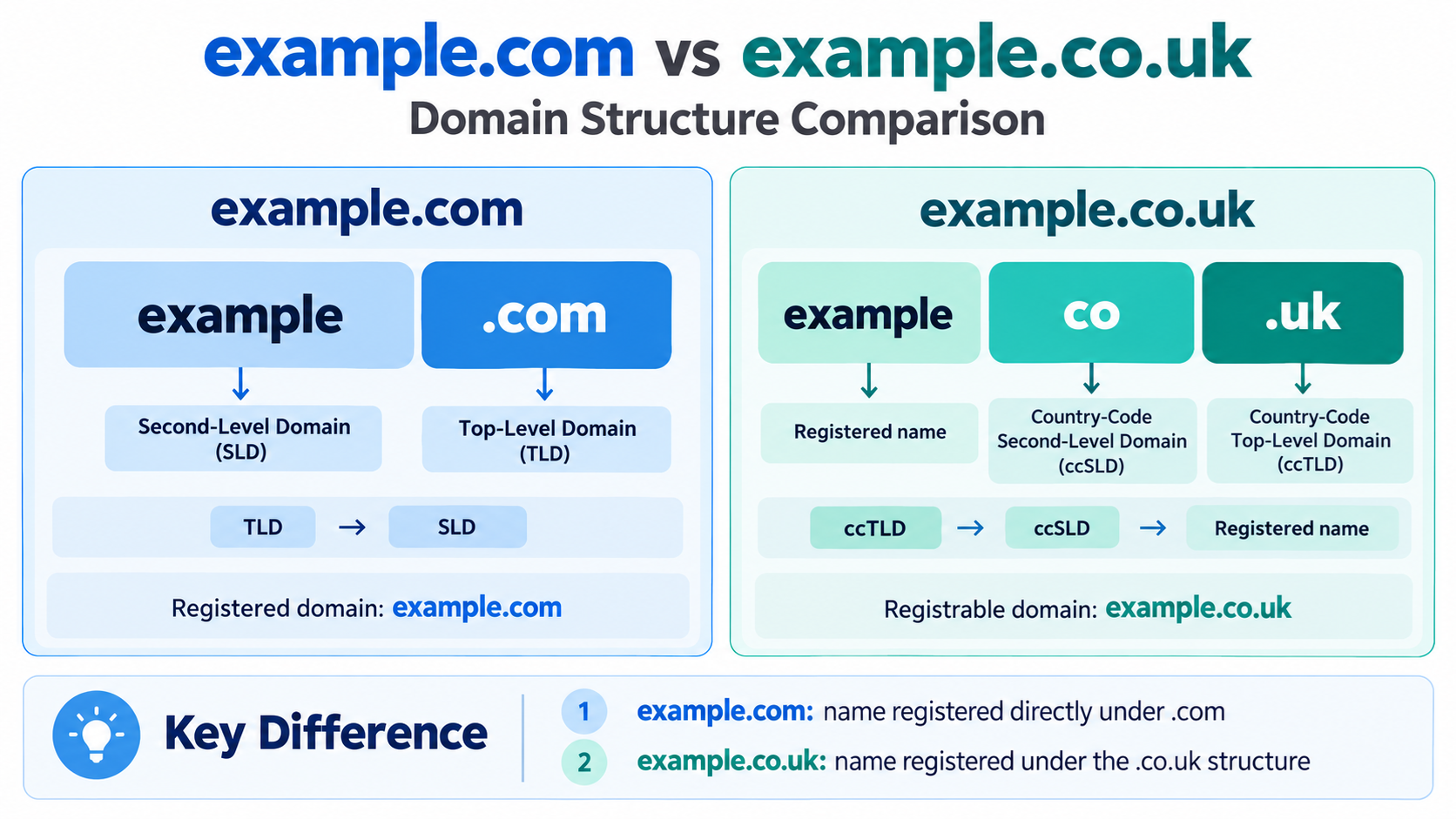
A second-level domain is generally the part of a domain name that appears immediately to the left of the top-level domain.
For example, consider: example.com
In this domain name:
.com is the top-level domain, or TLD.
example is the second-level domain, or SLD.
The second-level domain is usually the name chosen by the person, company, organization, or website owner when registering the domain.
If you register: mybusiness.com
then “mybusiness” is the second-level domain and “.com” is the top-level domain.
The combination of the second-level domain and top-level domain creates the familiar registered domain name.
What Is a Top-Level Domain?
To understand second-level domains, it helps to understand top-level domains first.
A top-level domain is the portion at the far right of a domain name.
Common examples include:
.com
.net
.org
.info
.ca
.uk
.de
.jp
Some top-level domains are generic, while others are associated with particular countries or territories.
Generic top-level domains are commonly called gTLDs. Examples include .com, .net, and .org.
Country-code top-level domains are commonly called ccTLDs. Examples include .ca for Canada, .uk for the United Kingdom, .de for Germany, and .jp for Japan.
How Domain Levels Work
Domain names are read from right to left when looking at their DNS hierarchy.
For example:
shop.example.com
The structure is:
.com — top-level domain
example — second-level domain
shop — third-level domain or subdomain
The farther you move to the left, the deeper you move into the domain hierarchy.
This is why www.example.com is technically not the same level as example.com. “www” is normally a subdomain under example.com.
Is an SLD the Same as the Domain Name?
People often use “domain name” and “second-level domain” interchangeably in everyday conversation, but technically they are not exactly the same thing.
In:
example.com
“example” is the second-level domain.
“example.com” is the full registered domain name.
This distinction becomes especially important when working with country-code domains that use additional levels.
What Is a Country-Code Top-Level Domain?
A country-code top-level domain, or ccTLD, is a two-letter domain extension associated with a country, territory, or geographic area.
Examples include:
.ca for Canada
.uk for the United Kingdom
.au for Australia
.jp for Japan
.nz for New Zealand
.cn for China
.de for Germany
.fr for France
These country-code extensions can have different registration rules depending on the registry that operates them.
Some are widely available internationally, while others require the registrant to have a connection to the country or region.
What Is a Country-Code Second-Level Domain?
A country-code second-level domain, often abbreviated as ccSLD, is a second-level category used underneath a country-code top-level domain.
For example:
example.co.uk
In this structure:
.uk is the country-code top-level domain.
.co is a second-level category beneath .uk.
example is registered beneath .co.uk.
The complete registration is therefore example.co.uk.
The “co” portion is commonly associated with commercial organizations.
This structure is different from a simple domain such as example.com, where “example” itself is directly under the .com top-level domain.
Why Do Some Countries Use ccSLDs?
Some country-code domain systems historically organized registrations into categories.
Instead of allowing every organization to register directly under the country-code extension, they created second-level categories for different types of users.
For example, a country might use categories for:
commercial businesses
government organizations
educational institutions
nonprofit organizations
network providers
individuals
These categories can help organize the country’s domain namespace.
However, not every country uses this system, and registration policies differ from one country to another.
Example: .co.uk
One of the most familiar examples of a country-code second-level domain is:
.co.uk
Here:
.uk is the country-code top-level domain for the United Kingdom.
.co is a second-level category commonly associated with commercial organizations.
A company might register:
mycompany.co.uk
In everyday conversation, people often describe “.co.uk” as the domain extension, even though technically it contains both a second-level component and the .uk country-code top-level domain.
Example: .org.uk
Another example is:
.org.uk
Historically, this namespace has commonly been associated with organizations.
A domain could look like:
charityname.org.uk
The structure is:
.uk — country-code top-level domain
.org — second-level category
charityname — registered name
Again, the complete registered domain is charityname.org.uk.
Example: .ac.uk
The United Kingdom also uses:
.ac.uk
The “ac” portion is associated with academic institutions.
For example, universities and higher-education institutions may use domains under .ac.uk.
This demonstrates why country-code second-level domains can be useful: they can indicate the general type of organization using the domain.
Example: Australia
Australia has also traditionally used second-level categories beneath the .au country-code domain.
Examples include:
.com.au
.net.au
.org.au
.edu.au
.gov.au
A business might use:
example.com.au
In this case:
.au is the country-code top-level domain.
.com is the second-level category.
example is the registered name.
The complete domain is example.com.au.
Australia has also introduced direct registrations under .au, so the exact options available depend on current registry rules.
Example: Japan
Japan uses several structured domain categories under .jp.
Examples include categories historically associated with companies, organizations, academic institutions, and government organizations.
A domain structure might include:
example.co.jp
Here:
.jp is the country-code top-level domain.
.co is the second-level category.
example is the registered name.
Different categories may have different eligibility requirements.
SLD vs ccSLD
The main difference is that an ordinary second-level domain is typically the name registered directly under a top-level domain.
For example:
example.com
Here, “example” is the second-level domain.
A country-code second-level domain is a category beneath a country-code top-level domain.
For example:
example.co.uk
Here, “co” is a second-level category beneath .uk, while “example” is registered one level deeper.
This is why domain terminology can become confusing. The domain that a customer registers is not always technically located at the same DNS level.
Why Does example.co.uk Look Like a Third-Level Domain?
Technically, it is.
In the DNS hierarchy:
.uk is the top-level domain.
.co is the second-level domain.
example is the third-level label.
However, from a registration perspective, example.co.uk is commonly treated as the registrable domain.
This is an important distinction.
The DNS hierarchy and the commercial registration structure are related, but they are not always described in exactly the same way.
What Is a Registrable Domain?
A registrable domain is the portion of a domain name that a user can normally register through a registrar.
For example:
example.com
The registrable domain is example.com.
For:
example.co.uk
the registrable domain is normally example.co.uk.
You usually cannot separately register co.uk because that level is reserved as part of the registry structure.
This concept is especially important for browsers, security systems, cookies, hosting platforms, and domain-management software.
Why Public Suffixes Matter
A public suffix is a domain suffix under which Internet users can register names.
Examples may include:
.com
.ca
.co.uk
.com.au
The concept is important because software needs to know where the registrable portion of a domain begins.
For example, a browser must distinguish between:
example.com
shop.example.com
and:
example.co.uk
shop.example.co.uk
Without understanding public suffixes, software might incorrectly treat co.uk as if it belonged to a single private organization.
Is .co.uk a TLD?
Strictly speaking, no.
The actual top-level domain is:
.uk
The “co” portion is beneath .uk.
However, many hosting companies, domain registrars, and website owners informally refer to .co.uk as a domain extension because that is the practical suffix used when registering domains.
This informal usage is common and usually understood.
Technically, however, .uk is the TLD.
Are All Two-Letter Domains Country Codes?
Most two-letter top-level domains are country-code top-level domains, but their practical use may differ.
Some country-code domains have become popular internationally and are marketed more like generic domain extensions.
Examples include domains that technology companies or startups use because the letters have another meaning in English or in the technology industry.
Even when used globally, they may still technically be country-code top-level domains.
Can You Register Directly Under a Country-Code TLD?
It depends on the country.
Some country-code registries allow direct registrations.
For example:
example.ca
Here, “example” is directly beneath .ca.
Other registries have historically relied heavily on second-level categories.
Some countries now support both models.
Because registry policies change, always check the current registration rules before purchasing a country-code domain.
Why Are ccSLDs Important When Buying a Domain?
Understanding ccSLDs helps prevent confusion when comparing domain names.
For example, these domains are structurally different:
example.com
example.ca
example.co.uk
example.com.au
Although all of them may appear to be ordinary website addresses, their registry structures are different.
This can affect registration rules, pricing, eligibility, transfer policies, expiration procedures, and DNS management.
Does a ccSLD Affect SEO?
The domain structure itself does not automatically make a website rank better simply because it contains more domain levels.
However, country-code domains may provide geographic signals about the intended audience of a website.
For example, a domain strongly associated with a particular country may be useful for businesses targeting visitors in that country.
Search performance still depends on many other factors, including website quality, content relevance, technical SEO, backlinks, page performance, and user experience.
Does a Longer Domain Structure Make the Website Slower?
No meaningful performance difference exists simply because a domain contains an additional label such as .co.uk rather than .com.
DNS resolution may involve hierarchical lookups, but modern DNS infrastructure and caching make the practical difference extremely small.
Website speed is much more affected by hosting performance, server location, caching, content delivery networks, website code, database performance, and page size.
Can You Create Subdomains Under a ccSLD Domain?
Yes.
Suppose you own:
example.co.uk
You can create subdomains such as:
shop.example.co.uk
blog.example.co.uk
mail.example.co.uk
In this case, your registered domain remains example.co.uk, while “www,” “shop,” “blog,” and “mail” are subdomains that you control through DNS.
Who Controls Country-Code Domain Rules?
Each country-code top-level domain is operated by a registry or designated organization.
That registry establishes the policies governing registrations under its namespace.
These policies can include:
who can register a domain
what documentation is required
which second-level categories are available
how long domains can be registered
how transfers work
what happens when a domain expires
whether local presence is required
Registrars then provide registration services to customers according to those registry rules.
What Is the Difference Between a Registry and a Registrar?
A registry operates the database and infrastructure for a top-level domain or domain namespace.
A registrar is a company that sells and manages domain registrations for customers.
For example, a registry may operate a country-code domain, while many different registrars allow customers to register domains under it.
The registrar is normally the company the customer interacts with, while the registry operates the underlying domain system.
A Simple Way to Remember SLD and ccSLD
The easiest way to remember the difference is to look at the right side of the domain.
For:
example.com
.com is the top-level domain.
example is the second-level domain.
For:
example.co.uk
.uk is the country-code top-level domain.
.co is the country-code second-level category.
example is the name registered beneath that structure.
In practical terms, example.com and example.co.uk can both function as the main domain name of a website, even though their technical DNS structures are different.
Final Thoughts
A second-level domain, or SLD, is normally the portion of a domain name immediately to the left of the top-level domain.
In example.com, “example” is the second-level domain and “.com” is the top-level domain.
A country-code second-level domain, or ccSLD, is a second-level category used beneath a country-code top-level domain.
In example.co.uk, “.uk” is the country-code top-level domain, “co” is the second-level category, and “example” is the registered name beneath it.
Some countries use second-level categories extensively, while others allow domains to be registered directly beneath their country-code extension.
The easiest way to understand the structure is to remember that DNS domain names are hierarchical and are read from right to left:
Top-level domain → second-level domain → lower-level domain or subdomain.
Once you understand that hierarchy, domain structures such as example.com, example.ca, example.co.uk, and example.com.au become much easier to understand.