
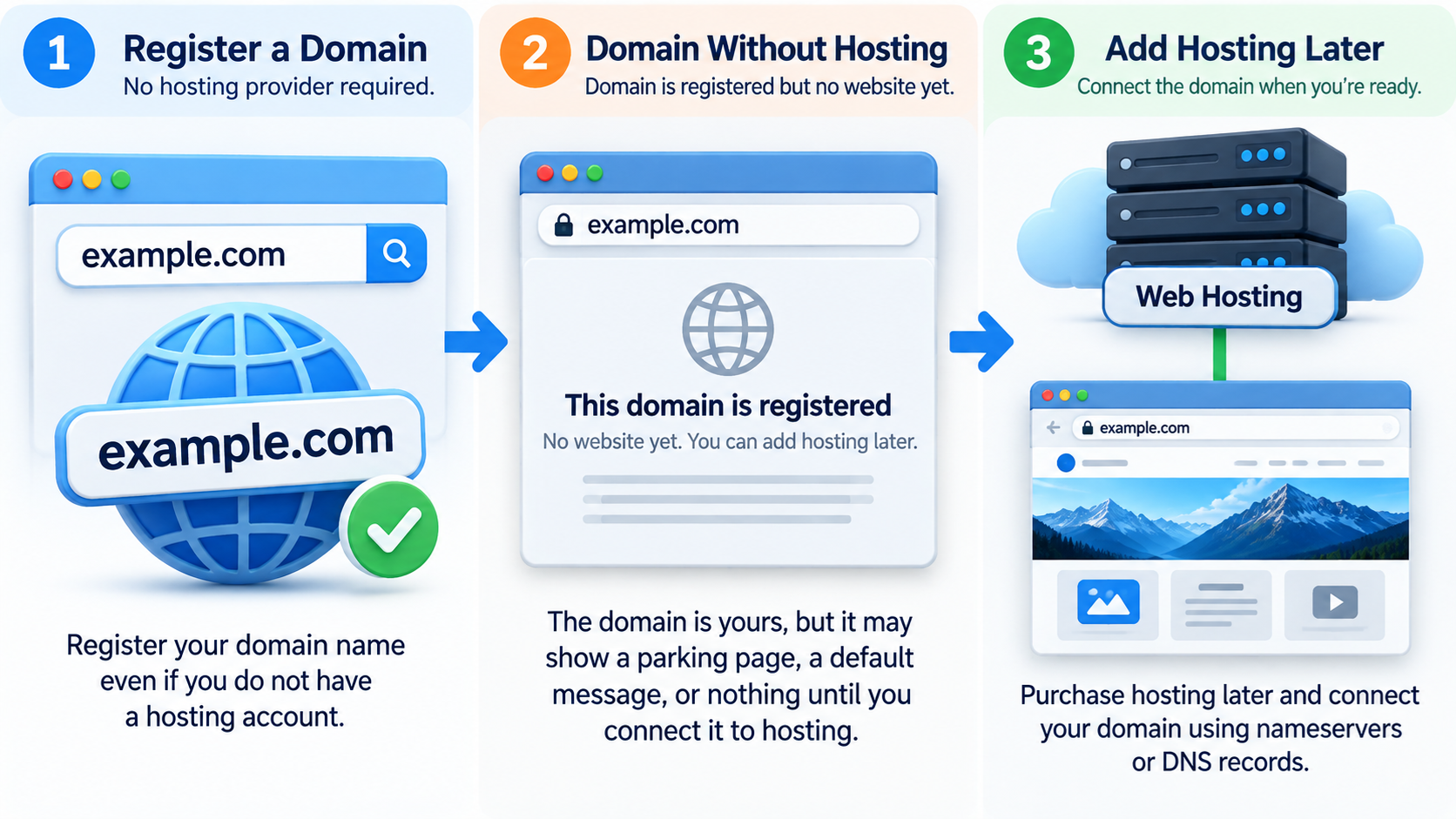
Yes. You can register a domain name even if you do not have a web hosting provider.
Domain registration and web hosting are two different services.
A domain name gives you an Internet address, while web hosting provides the server space where your website files are stored.
This means you can register a domain first and decide what to do with it later.
What Happens If You Register a Domain Without Hosting?
If you register a domain name but do not connect it to a hosting account, the domain still belongs to you for the duration of the registration period.
However, the domain will not automatically display a complete website.
Depending on the registrar, visitors may see a parking page, a default registrar page, an error message, or nothing useful until you configure the domain.
The important point is that the domain registration itself does not require a hosting account.
Domain Registration and Web Hosting Are Separate
A domain name and a hosting account perform different jobs.
The domain name is the address people use to find your website.
The hosting account is the server where your website files, images, databases, and applications are stored.
For example, you could register:
example.com
without purchasing any hosting service.
Later, when you are ready to build a website, you can purchase hosting and connect example.com to the hosting server.
Why Would Someone Register a Domain Before Buying Hosting?
There are several reasons to register a domain before purchasing hosting.
One common reason is to secure a good domain name before someone else registers it.
Good domain names can disappear quickly, especially short names, business names, product names, and common keywords.
If you already know the name you want, registering it first can protect that name while you decide how to build the website.
Another reason is that you may not be ready to launch the website yet.
You might still be planning the business, designing the site, writing content, or comparing hosting providers.
In that case, you can register the domain now and purchase hosting later.
Can I Keep a Domain Without Ever Building a Website?
Yes.
A domain name does not have to be connected to a website.
Some people register domains simply to protect a business name or brand.
Others register domains for future projects.
A domain can also be used for email, redirects, DNS services, or other Internet services even if there is no traditional website.
For example, you might register example.com and later use an email address such as:
However, email service normally requires additional configuration and an email provider or mail server.
Can I Register a Domain and Use It Later?
Yes.
This is very common.
You can register a domain today and leave it unused until you are ready.
When you later purchase web hosting, you simply connect the domain to the new hosting account by changing the nameservers or DNS records.
The domain does not have to be transferred just because you choose a different hosting provider.
Do I Need a Website to Keep the Domain?
No.
As long as you continue renewing the domain registration, you can keep the domain whether or not a website exists.
The domain registrar does not normally require you to have an active website.
Your responsibility is simply to maintain the registration and follow the applicable registrar and registry rules.
Can I Use a Domain Registrar Without Using Its Hosting Service?
Yes.
Many domain registrars also sell web hosting, email, SSL certificates, website builders, and other services, but you are not usually required to purchase those additional products.
You can register only the domain name.
Later, you can use another company for hosting.
For example:
Your domain may be registered with Company A.
Your website may be hosted by Company B.
Your email may be handled by Company C.
DNS connects these services together.
What Are Nameservers?
Nameservers are part of the Domain Name System, or DNS.
They help direct Internet traffic to the correct services for your domain.
When you purchase web hosting, the hosting provider may give you nameservers such as:
ns1.examplehost.com
ns2.examplehost.com
You would then log in to your domain registrar and change the domain’s nameservers to the ones provided by the hosting company.
This allows the domain to use the DNS system associated with your hosting account.
Can I Leave the Registrar’s Default Nameservers?
Yes.
If you do not have hosting yet, you can usually leave the registrar’s default nameservers in place.
The registrar may provide basic DNS management, domain forwarding, or a parking page.
Later, when you purchase hosting, you can either change the nameservers or modify individual DNS records.
There is no need to make these changes immediately after registration.
What Is Domain Parking?
Domain parking means keeping a registered domain without running a full website on it.
A parked domain may display a simple page created by the registrar, a temporary message, advertising, or a custom holding page.
For example, a business might register a domain months before launching its website and display a simple “Coming Soon” page until the site is ready.
Domain parking is optional and depends on the features provided by the registrar.
Can I Forward the Domain to Another Website?
Yes.
Many registrars provide domain forwarding.
This allows one domain to send visitors to another website.
For example, if you register:
mynewbrand.com
you could temporarily redirect it to an existing website.
Later, when the new website is ready, you can remove the redirect and connect the domain to the new hosting server.
Can I Use the Domain for Email Without Web Hosting?
Yes, but you still need an email service.
Web hosting and email hosting are not necessarily the same service.
You can register a domain and then use a separate email provider.
The email provider will normally give you DNS records, especially MX records, that must be added to your domain.
MX stands for Mail Exchange.
MX records tell other mail servers where email for your domain should be delivered.
So you could use:
example.com
for professional email even if you do not host a website on that domain.
Can I Build a Website Later?
Yes.
When you are ready, you can purchase hosting from almost any compatible hosting provider.
The hosting provider will normally give you instructions for connecting your domain.
You may need to change the nameservers or update DNS records such as the A record.
An A record connects a domain name to an IPv4 address.
For example:
example.com → web server IP address
Once DNS is configured correctly, visitors who enter the domain in a browser will be directed to your web server.
Do I Have to Transfer the Domain to My Hosting Provider?
No.
A domain transfer is normally not necessary just because you purchase hosting somewhere else.
You can keep the domain with the original registrar and simply point it to the new hosting provider.
This is a very common setup.
Some people prefer keeping domains and hosting with different companies because it gives them more flexibility.
Others prefer keeping everything with one company because it can be easier to manage.
Both approaches can work.
Is It Better to Register the Domain Before Buying Hosting?
In many cases, yes, especially if you have already found a domain name you really want.
Domain availability can change at any time.
A domain that is available today may be registered by someone else tomorrow.
If the name is important to your business or project, registering it first can be a sensible step.
You can then take your time choosing the right hosting provider.
Do I Need to Pay for Hosting While I Am Not Using the Domain?
No.
If you only register the domain, you normally pay only for the domain registration and any optional services you choose.
You do not have to pay for a web hosting account until you actually need one.
This can be useful if you are still planning a project and do not want to start paying for hosting too early.
What Should I Do After Registering a Domain Without Hosting?
After registering the domain, make sure the registration information is correct.
Keep access to the email address associated with the domain.
Enable account security features such as two-factor authentication if available.
You may also want to enable automatic renewal so the domain does not accidentally expire.
If the registrar provides domain locking, consider enabling it. Domain locking helps prevent unauthorized transfers.
You can then leave the domain parked until you are ready to use it.
Can the Domain Expire If I Do Not Use It?
Yes.
A domain name can expire whether or not it has a website.
Using the domain does not automatically renew it.
You must continue renewing the registration before the expiration date.
If the domain is important, keep your contact information and payment method current.
Losing a domain because of a missed renewal can be much more expensive and complicated than renewing it on time.
What Happens When I Finally Purchase Hosting?
Once you purchase hosting, your hosting provider will usually provide the information needed to connect your domain.
This may include nameservers or server IP addresses.
You then log in to the registrar where the domain is registered and update the DNS settings.
The basic process is:
Register the domain → Keep it parked or unused → Purchase hosting later → Update DNS or nameservers → Upload or build the website → Website becomes available through the domain
This process does not require you to register the domain again.
Final Thoughts
You do not need a hosting provider to register a domain name.
Domain registration and web hosting are independent services.
You can register a domain now, keep it parked, use it for email or forwarding, and purchase hosting later when you are ready to build a website.
The most important thing is to keep the domain registration active, maintain access to the registrar account, and renew the domain before it expires.
When you eventually choose a hosting provider, you can connect the domain by changing its DNS records or nameservers.
In simple terms:
Register the domain first → Keep it until you are ready → Purchase hosting later → Connect the domain to the hosting server.
This gives you the flexibility to secure the domain name you want without committing to a hosting provider immediately.