
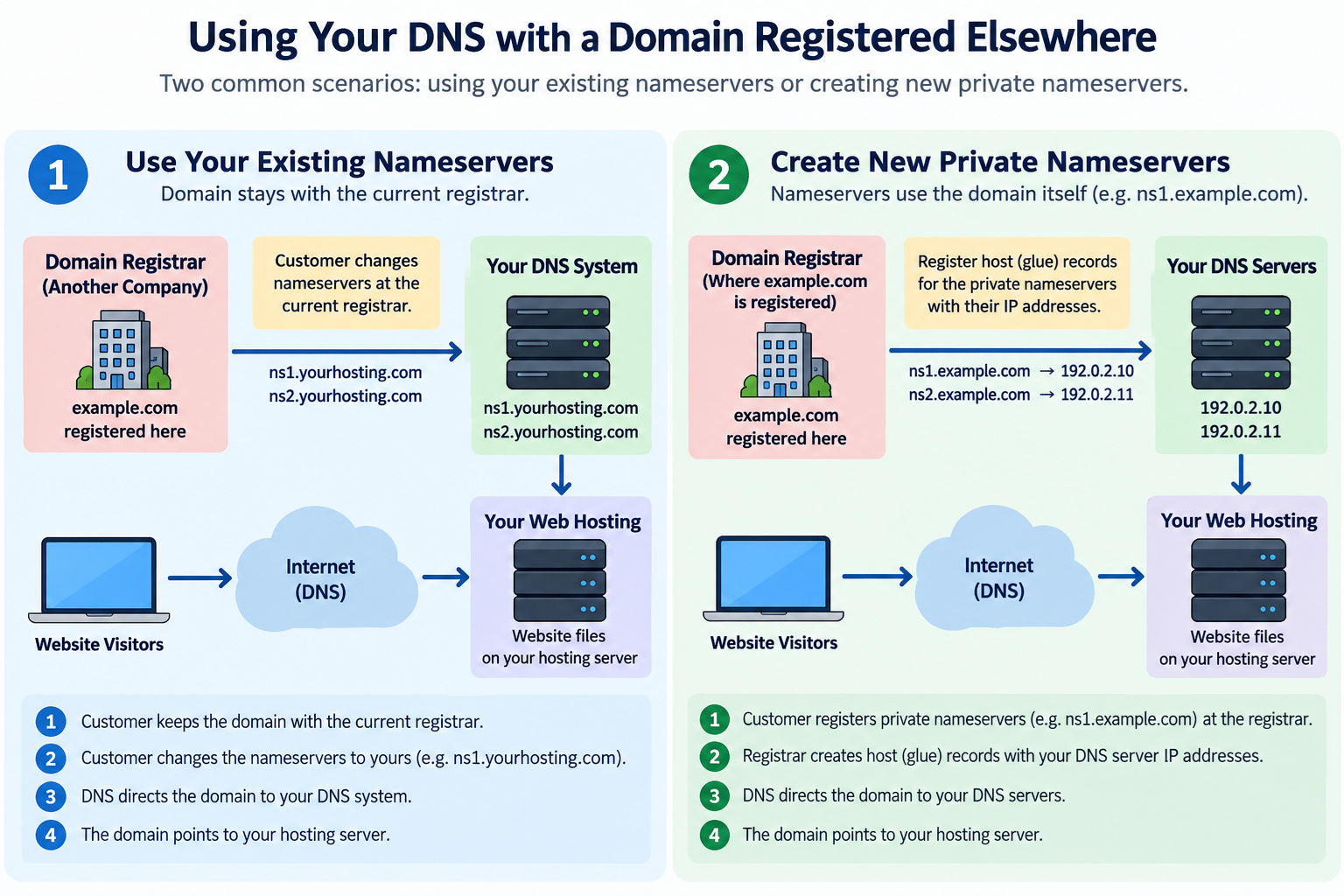
Yes, a domain name registered with another registrar can usually use your hosting or DNS system, but there is an important difference between using existing nameservers and creating new private nameservers.
If you only want the domain to use your nameservers, the domain does not normally need to be transferred to your company.
The customer can keep the domain registered with the current registrar and simply change the domain’s nameserver settings there.
For example, if your hosting company provides nameservers such as ns1.yourhosting.com and ns2.yourhosting.com, the customer can log in to the registrar where the domain is currently registered and replace the existing nameservers with yours.
Once the nameserver change takes effect, DNS queries for that domain will be directed to your DNS system.
Using Your Nameservers with a Domain Registered Elsewhere
Suppose a customer registered example.com with another domain registrar but wants to use your web hosting service.
You first create the hosting account or DNS zone for example.com on your system. Your system then provides the nameservers that should be used.
The customer goes back to the original registrar and changes the domain’s nameservers to the ones you provided.
The basic process is:
Domain registered with another registrar → Change nameservers at that registrar → Point the domain to your DNS system → Connect the domain to your hosting server
The registration company and the hosting company do not have to be the same company.
This is very common on the Internet.
What If the Customer Wants to Create New Private Nameservers?
This is a different situation.
Sometimes a customer wants to create nameservers using the domain itself.
For example:
ns1.example.com
ns2.example.com
These are often called private nameservers, custom nameservers, child nameservers, or host records.
To create them, the domain registrar normally needs to associate each nameserver with an IP address.
For example:
ns1.example.com → 192.0.2.10
ns2.example.com → 192.0.2.11
These records are commonly called host records or glue records.
In most cases, these private nameservers must be registered through the registrar where example.com itself is registered.
Your hosting system may provide the DNS servers and IP addresses, but the actual registration of ns1.example.com and ns2.example.com usually takes place at the domain registrar.
Why Are Glue Records Needed?
Without glue records, a DNS lookup can sometimes create a circular dependency.
Imagine that example.com uses ns1.example.com as its nameserver.
To find example.com, the Internet needs to contact ns1.example.com.
But to find ns1.example.com, it may first need DNS information from example.com.
Glue records solve this problem by storing the IP address of the nameserver at the parent registry level.
That allows DNS resolvers to find the nameserver without first asking the domain itself.
Can the Domain Stay with the Existing Registrar?
Yes.
The customer does not normally have to transfer the domain to your registrar or hosting company just to use your DNS or hosting services.
The domain can stay registered with the existing registrar while using your nameservers.
For example:
Registrar A manages the domain registration.
Your company manages DNS.
Your hosting server hosts the website.
An email provider may handle email.
DNS allows all of these services to work together.
Who Controls What?
The registrar controls the domain registration and normally controls which nameservers are assigned to the domain.
The DNS provider controls the DNS zone and records such as A, AAAA, CNAME, MX, and TXT records.
The hosting provider stores and serves the website.
These can all be separate companies.
For beginners, this can sometimes be confusing because domain registration, DNS, and web hosting are related, but they are not the same service.
What Information Does the Customer Need?
If the customer only wants to use your existing nameservers, you normally need to provide the nameserver addresses.
For example:
ns1.yourhosting.com
ns2.yourhosting.com
The customer then enters those nameservers at the current registrar.
If the customer wants to create private nameservers, you may also need to provide the IP addresses of your DNS servers.
For example:
ns1.example.com → your DNS server IP address
ns2.example.com → your second DNS server IP address
The customer would normally register those host records through the current registrar.
Do Nameserver Changes Take Effect Immediately?
Not always.
After nameservers are changed, DNS information may remain cached by Internet service providers, DNS resolvers, browsers, and other systems.
Some users may begin reaching the new DNS servers quickly, while others may continue using previously cached information for a period of time.
This process is often referred to as DNS propagation.
During this period, it is possible for different users to see different results.
Do You Need to Transfer the Domain?
Usually, no.
A domain transfer changes which registrar manages the domain registration.
Changing nameservers only changes which DNS servers are authoritative for the domain.
These are two different operations.
If the customer is satisfied with the current registrar, the domain can remain there while using your DNS and hosting services.
A transfer is only necessary if the customer actually wants your company to become the new registrar for the domain.
In Simple Terms
If a domain is registered somewhere else, it can usually still use your DNS and hosting system.
If the customer wants to use nameservers that already belong to your hosting company, the customer simply changes the domain’s nameservers at the current registrar.
If the customer wants to create private nameservers such as ns1.example.com and ns2.example.com, those nameservers normally need to be registered as host or glue records through the registrar where example.com is registered.
The important distinction is simple:
Using your existing nameservers usually only requires changing the nameserver settings.
Creating brand-new private nameservers usually requires registering host or glue records at the current domain registrar.
Once the nameservers and DNS records are configured correctly, the domain can use your hosting system even though the domain registration remains with another company.