
When you register a domain name, your registrar collects information about the person or organization responsible for that domain.
This information may include your name, email address, telephone number, mailing address, organization name, registrar information, registration dates, and other technical details.
In the past, much of this information was commonly visible through public WHOIS searches.
Today, modern domain registration policies, privacy laws, and services such as RDAP have changed how much information is publicly displayed.
For many domains, personal registration data may already be hidden or redacted.
However, you may still see a service called Private Registration, Domain Privacy, WHOIS Privacy, or Privacy Protection.
The purpose of Private Registration is simple:
It helps reduce the amount of your personal contact information that is visible to the public.
What Is Private Registration?
Private Registration is a domain privacy service that helps protect the personal information associated with your domain registration.
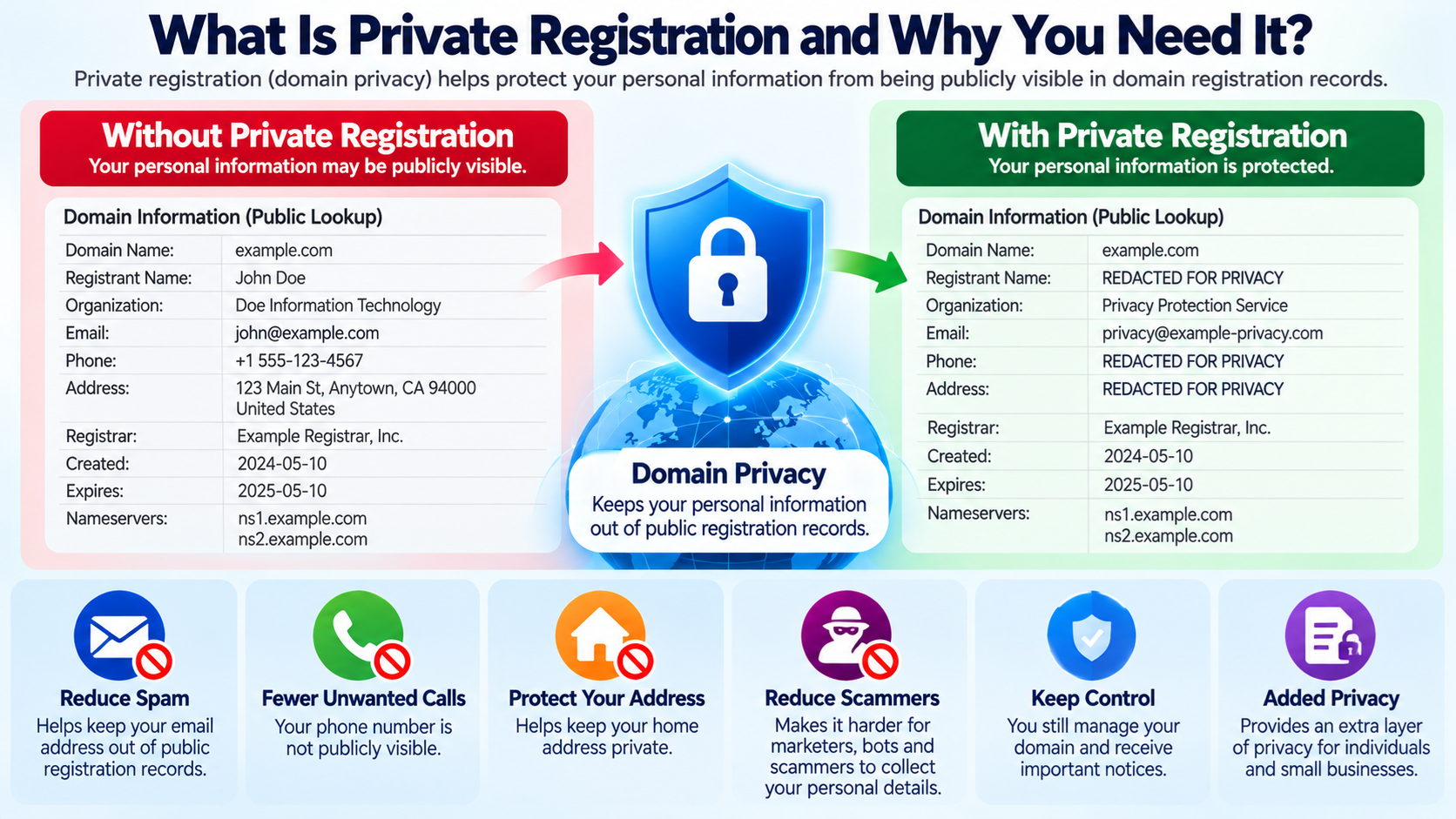
Instead of showing your personal email address, telephone number, or mailing address in public registration data, the service may hide, redact, or replace some of that information.
For example, instead of displaying your personal email address, the public record may show a privacy-related forwarding address.
Instead of displaying your home address, the record may show redacted information or information associated with the privacy provider.
The exact method depends on the registrar, registry, domain extension, and privacy service.
Why Is Registration Information Collected?
A domain registrar needs certain information in order to create and maintain a domain registration.
This information can be used for:
Account administration
Domain renewal
Security notices
Domain disputes
Legal requirements
Abuse investigations
Technical issues
Ownership verification
Registrar communication
The important point is that information may still be collected even if it is not publicly displayed.
Private Registration does not mean that the registrar knows nothing about you.
It means that certain information may not be openly available to everyone on the Internet.
What Is WHOIS?
WHOIS is the traditional name for systems used to look up information associated with domain registrations.
For many years, a WHOIS lookup could reveal information such as:
Registrant name
Organization
Email address
Telephone number
Mailing address
Registrar
Registration date
Expiration date
Nameservers
This created obvious privacy concerns.
Automated systems could collect large amounts of contact information from public registration records.
That information could then be used for spam, marketing, scams, or other unwanted activity.
What Is RDAP?
RDAP stands for Registration Data Access Protocol.
It is a newer system designed to provide structured access to registration data.
For many generic top-level domains, RDAP has become the modern standard for accessing domain registration information.
You may still hear people use the term WHOIS because it is familiar, but the underlying system has changed significantly.
For most website owners, the most important thing to understand is this:
Not all registration data is necessarily public anymore.
Why Private Registration Still Matters
You may wonder why Private Registration is still useful if many registrars already hide personal information.
The answer depends on the registrar and domain extension.
Private Registration may still provide useful features such as:
Additional redaction
Alternative public contact information
Email forwarding
Consistent privacy handling
Reduced exposure of personal details
Administrative convenience
Some registrars include these features automatically.
Others may offer them as a separate service.
Protect Your Personal Email Address
One of the biggest benefits of Private Registration is protecting your personal email address.
If your real email address is publicly visible, automated bots may collect it.
This can lead to:
Spam
Fake domain renewal notices
SEO offers
Hosting solicitations
Phishing messages
Domain purchase offers
Scam messages
By hiding or replacing your email address, privacy protection can reduce unnecessary exposure.
Protect Your Telephone Number
A public telephone number may attract unwanted calls.
These might include:
Marketing calls
Fake hosting support
Domain renewal scams
SEO sales calls
Website development offers
Other unsolicited calls
Keeping your personal number out of public registration data can help reduce this type of contact.
Protect Your Home Address
Many individuals and small business owners register domains using a home address.
This is especially common for:
Freelancers
Bloggers
Independent developers
Home-based businesses
Consultants
Small business owners
Publishing a home address may be undesirable.
Private Registration can help reduce public exposure of that information where supported.
Private Registration Is Not the Same as Fake Information
You should still provide accurate information to your registrar when required.
Private Registration does not mean that you should enter false information.
Your registrar may need correct information for ownership, billing, recovery, legal compliance, and account administration.
Privacy protection affects what is publicly visible.
It does not remove your responsibility to maintain accurate registration information.
Can the Registrar Still See Your Information?
Yes.
Your registrar generally keeps the information required to manage the domain.
That information may still be used for:
Account verification
Ownership questions
Legal requests
Abuse complaints
Security problems
Billing
Renewal
Domain recovery
Private Registration hides information from the public.
It does not hide information from your registrar.
Privacy Does Not Mean Complete Anonymity
Private Registration should not be confused with complete anonymity.
Your identity may still be discoverable through other sources.
For example:
Your website may contain your company name.
Your contact page may list your email address.
Your business may have public corporate records.
Your social media accounts may identify you.
Your website may have legal or regulatory requirements to display contact information.
Private Registration simply reduces unnecessary public exposure of domain registration data.
What Is a Privacy Service?
A privacy service generally allows you to remain the registered domain holder while using alternative contact information in public registration data.
For example, your personal email address may be replaced by a forwarding address.
Messages can still reach you without revealing your actual email address publicly.
This can provide privacy while still allowing legitimate communication.
What Is a Proxy Service?
A proxy service is somewhat different.
With a proxy service, the proxy provider may appear as the registered domain holder.
The customer is then allowed to use the domain under the terms of the proxy service.
This creates a different legal and administrative relationship.
Before using a proxy service, make sure you understand:
Who is listed as the registrant
Who legally controls the domain
How the domain can be transferred
What happens if the proxy service ends
How ownership disputes are handled
Privacy services and proxy services are often discussed together, but they are not exactly the same.
Does Private Registration Protect You From Hackers?
No.
Private Registration is primarily a privacy feature.
It does not protect your website from malware.
It does not patch WordPress.
It does not block brute-force attacks.
It does not replace a firewall.
It does not replace SSL.
It does not stop someone from stealing your registrar password.
It does not protect against every form of domain hijacking.
Domain privacy is one security layer, but it is not complete website security.
Private Registration vs. Domain Security
Private Registration protects personal information.
Domain security protects control of the domain itself.
To protect your domain, you should also use:
A strong registrar password
Multi-factor authentication
Registrar lock
Secure email
Accurate account recovery information
Careful transfer procedures
Protection against phishing
These controls are often more important for preventing domain theft.
What Is Domain Hijacking?
Domain hijacking occurs when an attacker gains unauthorized control of a domain.
For example, an attacker may steal your registrar password and change:
Nameservers
DNS records
Account email
Transfer settings
Ownership information
They may even try to transfer the domain to another registrar.
Private Registration alone does not prevent this.
You still need strong account security.
Use Multi-Factor Authentication
Multi-factor authentication adds another layer of protection to your registrar account.
Instead of relying only on a password, the account also requires another form of verification.
This may include:
An authenticator app
A hardware security key
A one-time code
Another approved method
If your registrar supports multi-factor authentication, it is a good idea to enable it.
Use Registrar Lock
Registrar lock helps prevent unauthorized domain transfers.
When a domain is locked, it normally cannot be transferred to another registrar until the lock is removed.
This makes it more difficult for an attacker to steal the domain through an unauthorized transfer.
Private Registration and registrar lock serve different purposes.
Privacy protects information.
Registrar lock protects transfer control.
Protect the Email Account Connected to Your Registrar
Your registrar email account is extremely important.
If an attacker gains access to your email, they may be able to reset your registrar password.
That can lead to domain theft.
Protect that email account with:
A strong unique password
Multi-factor authentication
Secure recovery information
Phishing awareness
Private Registration does not replace email security.
Private Registration May Reduce Spam
One of the most practical benefits of domain privacy is reduced unwanted contact.
If your personal contact information is exposed publicly, it may be collected automatically.
This can lead to large amounts of unsolicited email and phone calls.
Privacy protection reduces the amount of personal information available for automated collection.
It cannot eliminate all spam, but it can reduce one source of exposure.
Be Careful With Fake Domain Renewal Notices
Domain owners frequently receive messages that look like renewal invoices.
Some are legitimate.
Others are advertisements or scams.
A message may say:
Domain Renewal Notice
Final Expiration Warning
Search Engine Registration
Domain Listing Invoice
Urgent Renewal Required
Do not assume a message is legitimate because it contains your domain name.
Always verify your domain status by logging directly into your registrar account.
Private Registration and Business Domains
A business may already publish certain information publicly.
For example, a company website may show:
Business name
Office address
Telephone number
Support email
In that case, Private Registration may provide less privacy than it would for an individual.
However, it can still help prevent unnecessary exposure of personal employee information or private administrative contacts.
Private Registration for Personal Websites
Private Registration can be especially useful for individuals.
Suppose you operate a personal blog.
You may want readers to know your name.
However, you may not want your home address and personal telephone number published in registration data.
Domain privacy can help separate public website information from private registration information.
Privacy does not always mean hiding who you are.
Sometimes it simply means controlling which personal details are publicly exposed.
Does Every Domain Support Private Registration?
No.
Different domain extensions can have different policies.
For example:
.com
.net
.org
.ca
.uk
.de
.au
.cn
may all have different registration requirements.
Some registries provide strong privacy protections.
Others may require certain information to remain visible.
Always check the rules for the specific domain extension you are registering.
Country-Code Domains Can Be Different
Country-code top-level domains, commonly called ccTLDs, are associated with countries or territories.
Examples include:
.ca
.uk
.de
.fr
.au
Each registry may have its own policies.
A privacy service available for a .com domain may not work the same way for a .ca or .de domain.
Do not assume that all domain extensions follow identical privacy rules.
Some Registrars Include Privacy for Free
Many registrars now include privacy protection with eligible domain registrations.
Others charge an additional fee.
Before purchasing a separate privacy service, check what your registrar already provides.
You may already have:
Redacted registration data
Private email forwarding
Masked contact information
Automatic privacy settings
If the same protection is already included, paying extra may not provide much additional value.
Check What Is Actually Public
A good way to evaluate Private Registration is to look up your domain’s public registration data.
Check whether your personal information is visible.
If you see only limited information and your personal details are already hidden, you may already have sufficient privacy protection.
If your personal email, phone number, or address is publicly displayed, additional privacy protection may be useful.
Can Private Registration Affect Domain Transfers?
Usually, Private Registration does not prevent legitimate transfers.
However, the transfer process may still require:
Registrar account access
An authorization code
Domain unlocking
Email confirmation
Ownership verification
Different registrars and domain extensions may use different procedures.
Always make sure you still have access to the email and account associated with the domain.
Keep Your Domain Information Current
Even if your information is hidden publicly, keep your registrar account accurate.
Update information when:
Your email changes
Your company changes
Your address changes
Your payment method changes
Your administrative contact changes
Old or incorrect information can make domain recovery more difficult.
Keep Records of Important Domains
If your domain is important to your business, keep records of:
Registrar name
Domain name
Registration date
Renewal date
Payment receipts
Account email
Registrant information
Transfer history
Authorization records
These records can be extremely useful if an ownership or account problem occurs later.
Use Automatic Renewal Carefully
Domain privacy does not prevent expiration.
If your domain expires, your website and email may stop working.
Automatic renewal can help prevent accidental expiration.
However, you should still monitor renewal dates.
Make sure your payment method is current.
Important business domains should never depend on a single reminder email.
Private Registration and SSL Are Different
Private Registration and SSL protect different things.
Private Registration protects personal registration data.
SSL/TLS protects information traveling between a visitor and the website.
For example:
Private Registration hides contact information.
SSL encrypts web traffic.
You may need both, because they solve completely different problems.
Private Registration and Website Security Are Different
Private Registration does not scan your website for malware.
It does not protect WordPress plugins.
It does not block malicious traffic.
It does not remove infected files.
Website security requires separate protections such as:
Software updates
Strong passwords
Web Application Firewalls
Malware scanning
Backups
Monitoring
SSL/TLS
Private Registration is one part of a larger security and privacy strategy.
Does Private Registration Improve SEO?
Private Registration does not automatically improve or harm your search engine ranking.
Search engines care primarily about the website itself.
Important factors include:
Content quality
Website performance
Security
Accessibility
Links
User experience
Technical structure
Whether your registration contact information is publicly visible is generally not a reason to expect an SEO advantage.
Does Private Registration Affect Email Hosting?
Normally, no.
Private Registration concerns domain registration data.
Your email service depends mainly on DNS records such as:
MX records
SPF records
DKIM records
DMARC records
Other mail-related configuration
Turning domain privacy on does not normally change your email hosting.
However, always follow the registrar’s instructions when making account or DNS changes.
Does Private Registration Affect Your Website?
Normally, Private Registration does not change where your website is hosted.
Your website still points to the same hosting server through DNS.
Privacy protection changes how registration information is presented.
It usually does not change:
Website files
Hosting server
WordPress
Email hosting
DNS destination
SSL certificate
Your website should continue operating normally.
Why You May Need Private Registration
Private Registration may be useful if you want to reduce unnecessary public exposure of your personal information.
It can be especially valuable if you:
Use a home address
Use a personal phone number
Use a personal email address
Operate a home-based business
Own personal websites
Want to reduce spam
Prefer to separate private and public information
The value depends on what your registrar already hides automatically.
Why You May Not Need to Pay Extra
You may not need to purchase a separate privacy service if your registrar already provides sufficient protection.
Modern registration policies already keep much personal information nonpublic for many domains.
Some registrars include privacy at no extra cost.
Before paying for Private Registration, ask:
What information is currently public?
What information will this service additionally hide?
Does it include email forwarding?
Does my registrar already provide this feature?
Is the service a privacy service or a proxy service?
What happens if I cancel it?
These questions help you determine whether the service provides real additional value.
A Simple Example
Suppose you register:
example.com
You provide your registrar with your real:
Name
Email address
Telephone number
Mailing address
Without privacy protection, some of this information might be visible depending on the registration policy.
With Private Registration, the public lookup may instead show:
Redacted information
A privacy email address
Limited registration data
Registrar information
Nameservers
Your registrar still has your real information.
The public simply sees less of it.
The Biggest Benefit Is Control
The real purpose of Private Registration is not secrecy.
It is control.
You decide that your personal contact information does not need to be exposed to every person, automated bot, marketing company, or scammer on the Internet.
Your registrar can still contact you.
Legitimate legal and administrative processes can still exist.
But unnecessary public exposure is reduced.
Final Thoughts
Private Registration is a privacy service designed to reduce public exposure of personal information connected with a domain registration.
It can help protect your email address, telephone number, mailing address, and other contact information from unnecessary public display.
This may reduce spam, unwanted calls, phishing attempts, and general privacy exposure.
However, Private Registration is not complete domain security.
It does not replace strong passwords, multi-factor authentication, registrar lock, secure email, website security, SSL, software updates, or backups.
It also does not make you completely anonymous.
The best way to think about it is:
Private Registration protects your personal domain registration information.
Registrar security protects control of your domain.
SSL protects communication with your website.
Website security protects the website itself.
If your registrar already includes privacy protection, you may not need to pay extra.
If your personal information is still exposed publicly, Private Registration can be a useful and practical privacy feature.