
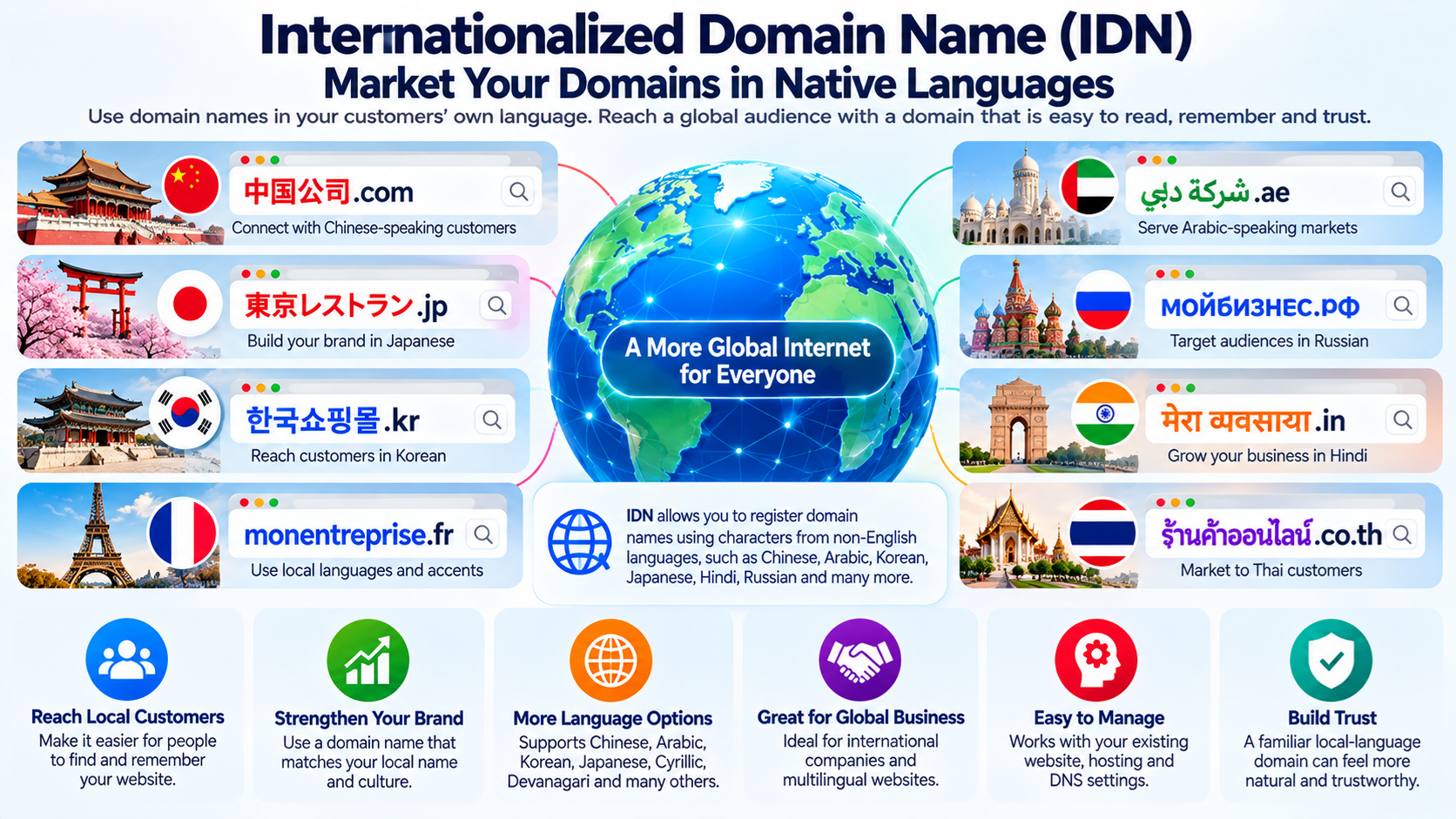
The Internet is global, but not everyone uses English as their primary language.
For many years, most domain names were limited mainly to the English alphabet, numbers, and hyphens.
That worked well for English-speaking users, but it was less natural for people who normally read and write in many other languages.
Internationalized Domain Names, commonly called IDNs, were created to make domain names more accessible to people around the world.
An IDN allows a domain name to contain characters from non-English languages and writing systems.
This means businesses can create web addresses that customers can read, remember, and type in their own language.
For companies serving international or multilingual markets, IDNs can become part of a broader localization and branding strategy.
What Is an Internationalized Domain Name?
An Internationalized Domain Name is a domain name that contains characters beyond the traditional ASCII letters A through Z, numbers zero through nine, and the hyphen.
IDNs can use characters from many writing systems.
Examples include:
Chinese characters
Arabic script
Cyrillic script
Japanese characters
Korean Hangul
Devanagari
Hebrew
Latin letters with accents
Other Unicode-supported scripts
For example, a business serving Chinese-speaking customers may want a domain name written in Chinese characters instead of requiring customers to type an English transliteration.
This can make the domain easier to understand and remember.
Why Were IDNs Created?
The original Domain Name System was designed when the Internet was much smaller and heavily centered around English-language computing.
Traditional domain names were based on a limited character set.
This meant many Internet users had to switch from their native language to Latin characters when entering a website address.
As the Internet expanded globally, this limitation became increasingly inconvenient.
IDNs were introduced so people could use domain names that better match the languages and scripts they use every day.
Today, IDNs help support a more multilingual Internet.
What Does IDN Stand For?
IDN stands for:
Internationalized Domain Name
The word internationalized refers to adapting a system so that it can support multiple languages and writing systems.
An IDN therefore allows a domain name to represent words using characters from a broader range of languages.
A Simple IDN Example
Imagine a Chinese company called:
北京科技
Instead of requiring customers to type an English domain such as:
beijingtechnology.com
the company may be able to register a domain using Chinese characters.
The exact domain availability depends on the registrar and domain extension.
For Chinese-speaking customers, a Chinese-language domain may be easier to recognize and remember.
The same principle applies to many other languages.
IDNs Use Unicode
Modern computers represent characters using standards such as Unicode.
Unicode assigns numerical values to characters used in many writing systems around the world.
It supports characters used in languages such as: Chinese,Japanese,Korean,Arabic,Russian,Greek,Hindi,French,German,Spanish ,Many others .
IDNs use Unicode-based characters so that domain names can be displayed in these scripts.
But DNS Was Originally Designed for ASCII
The Domain Name System was originally built around a smaller set of characters.
Traditional DNS labels primarily use:
A through Z
Zero through nine
Hyphen
This created a technical challenge.
How can a domain written in Chinese or Arabic be processed by a DNS system originally designed around ASCII characters?
The solution is an encoding system.
What Is Punycode?
Punycode is a method used to convert Unicode characters into an ASCII-compatible representation that DNS can process.
A user may see a domain written in their native language.
Behind the scenes, software may convert that domain into a special ASCII form.
This encoded form usually begins with:
xn--
For example, an internationalized domain that contains non-ASCII characters may have an internal representation beginning with xn--.
The browser normally handles this conversion automatically.
Most users do not need to manually type the Punycode version.
What Is an A-Label?
The ASCII-compatible version of an internationalized domain label is often called an A-label.
An A-label normally begins with:
xn--
This tells compatible software that the label represents an internationalized domain.
The user-facing Unicode version is sometimes called a U-label.
For example:
U-label = the domain as people normally see it in their native script
A-label = the encoded ASCII-compatible form used by the DNS system
Most users interact with the U-label.
The DNS infrastructure can use the corresponding A-label.
Why Use an IDN?
The biggest advantage of an IDN is localization.
If your customers speak a language that does not normally use the English alphabet, a local-language domain can make your website feel more natural and accessible.
An IDN may help:
Make your domain easier to remember
Strengthen local branding
Improve recognition
Reduce dependence on English spelling
Support multilingual marketing
Make your website more accessible to local audiences
Create a more localized customer experience
For some businesses, this can be especially valuable.
Market Your Business in Your Customers’ Language
Imagine that your company sells products in several countries.
Your main website might use:
example.com
That may work globally.
However, customers in another country may know your brand primarily by its local-language name.
An IDN allows you to register a domain that matches that local name.
This can create a more familiar experience.
Instead of asking customers to remember how your company name is spelled in English, you may give them a domain written in the language they already use.
Local Language Can Improve Memorability
A domain name is part of your brand.
Ideally, customers should be able to:
Recognize it
Remember it
Type it
Share it
If your target audience rarely uses English, an English-only domain may be more difficult to remember.
A local-language domain may feel more intuitive.
This is one reason international businesses sometimes register both an English domain and one or more IDNs.
IDNs Can Support Brand Localization
Localization is more than translation.
A localized website may adapt:
Language
Currency
Contact information
Product names
Payment methods
Images
Marketing messages
Customer support
Domain names
An IDN can become another part of that localization strategy.
For example, a company may operate:
example.com
for its international audience, while also using a local-language domain for another market.
The IDN can redirect users to the localized version of the main website or operate as a separate local website.
IDNs Can Be Used With Existing Websites
You do not necessarily need to build a completely separate website for every IDN.
An IDN can sometimes be configured to point to an existing website.
For example, a business might register:
An English domain
A Chinese IDN
A Korean IDN
A Japanese IDN
Each domain could redirect visitors to the appropriate language section of the same website.
The exact setup depends on your hosting platform, DNS configuration, and website architecture.
Redirect an IDN to Your Main Website
One common strategy is to register an IDN and redirect it to your existing domain.
For example:
Local-language domain → example.com/chinese/
or:
Local-language domain → example.com/japanese/
This allows customers to use a familiar local-language domain while the business maintains one primary website infrastructure.
However, redirects should be configured properly so visitors and search engines reach the intended destination.
You Can Also Host a Separate Local Website
Another option is to use the IDN for a completely separate website.
This can be useful when different markets require different:
Products
Prices
Regulations
Languages
Marketing
Customer support
Shipping policies
Business operations
In that situation, each localized domain can have its own website.
The best approach depends on your business strategy.
What Is a Partially Localized Domain?
A partially localized IDN uses internationalized characters in part of the domain while keeping a traditional ASCII top-level domain.
For example, the name before .com might be written in another script while the extension remains:
.com
.net
or another ASCII extension.
This gives businesses the ability to localize the recognizable domain name while keeping a familiar extension.
What Is a Fully Localized Domain?
Some domains can also use an internationalized top-level domain.
This means both the domain name and the extension may use a local script.
For users, the entire web address can appear in their language.
This creates a more complete localized experience.
Availability depends on the relevant registry and top-level domain.
Internationalized Top-Level Domains
Internationalization is not limited to the part before the final dot.
Top-level domains can also use non-Latin scripts.
For example, there are top-level domains written in scripts such as:
Arabic
Chinese
Cyrillic
Devanagari
Hangul
Other scripts
This means some web addresses can be written almost entirely in a local language.
IDNs Are Growing Globally
Internationalized Domain Names are now used across many languages and scripts.
ICANN continues to support the development of a multilingual Domain Name System.
The goal is to make the Internet easier to use for people regardless of the language or writing system they use.
This is particularly important as Internet usage continues to grow in regions where English is not the primary language.
What Is Universal Acceptance?
Universal Acceptance, commonly called UA, is the idea that all valid domain names and email addresses should work correctly in Internet applications.
This includes:
Traditional domains
New top-level domains
Internationalized Domain Names
Internationalized email addresses
For example, a valid IDN should ideally work correctly in:
Web browsers
Email systems
Forms
Mobile applications
Databases
User registration systems
Payment systems
Business software
Unfortunately, not every application handles all IDNs correctly yet.
Some Software May Still Have Compatibility Problems
Modern browsers generally support IDNs well.
However, other software may still have problems.
For example, an older website form may reject a valid IDN because the programmer assumed every domain must contain only English letters.
An old database field might not properly store international characters.
An email system might reject certain internationalized addresses.
This is why businesses should test compatibility before relying entirely on an IDN.
Test Your IDN Before Launching
Before using an IDN as your primary business domain, test it carefully.
Check whether it works with:
Major browsers
Your web hosting
DNS
SSL certificates
Contact forms
Payment systems
Analytics
Advertising platforms
Social media
Customer management systems
Mobile apps
Third-party software
You should also test how the domain appears when copied and pasted between systems.
Not Every Registrar Supports Every IDN
IDN availability depends on the registrar and registry.
A registrar may support internationalized registrations for some extensions but not others.
For example, one registrar may allow Chinese characters under a particular extension while another registrar may not offer that registration.
Always check:
Supported languages
Supported scripts
Supported extensions
Registration restrictions
Renewal rules
Transfer policies
Pricing
Do not assume that every domain extension supports every Unicode character.
Registries Control Allowed Characters
Domain registries usually define which characters may be used.
This is important for security and technical stability.
For example, a registry may maintain a language table that defines which characters are valid for a particular language.
Some characters may be prohibited.
Other characters may be treated as variants.
These restrictions help reduce ambiguity and conflicts.
What Are Character Variants?
Some writing systems contain characters that are closely related.
Chinese is a good example.
Simplified Chinese and Traditional Chinese may use different characters for the same or related words.
Registries may have special policies for these variants.
In some cases, registering one version may cause related variants to be reserved, blocked, or otherwise handled specially.
The exact behavior depends on the registry.
IDNs and Brand Protection
IDNs can also be useful for brand protection.
Suppose your company has a well-known brand name.
You may want to register the same brand in several scripts.
This can help reduce the chance that another party registers a confusingly similar local-language domain.
For example, an international company might consider registering its brand in:
English
Chinese
Japanese
Korean
Arabic
Cyrillic
The exact strategy depends on the markets where the company operates.
Do Not Register Every Possible Version Without a Strategy
Internationalized domains create many possibilities.
That does not mean you need to register hundreds of domains.
Instead, focus on important markets.
Ask:
Where are my customers?
What languages do they use?
How is my brand normally written locally?
Which domain extensions do customers trust?
Which domains are most likely to be typed directly?
Which domains help protect my brand?
A targeted strategy is usually better than registering every possible variation.
IDNs and Search Engines
Search engines can index websites using IDNs.
However, registering an IDN does not automatically improve search engine rankings.
SEO still depends on factors such as:
Content quality
Website relevance
Technical structure
Links
Performance
Mobile usability
Security
User experience
Language targeting
An IDN may improve branding and usability for local customers, but it should not be treated as an automatic SEO shortcut.
Local Content Still Matters
A local-language domain is most useful when the website itself also serves that audience.
For example, registering a Chinese domain and then showing only English content may not provide much value.
If your domain targets Chinese-speaking users, consider providing:
Chinese content
Local contact information
Relevant products
Appropriate pricing
Local payment options
Localized customer support
A local domain works best when it is part of a complete localization strategy.
IDNs and Email
IDNs can also interact with email systems.
Modern standards support internationalization in email addresses, but compatibility is not universal.
The domain portion of an email address may use an IDN.
However, some older email systems or applications may not correctly accept or process all internationalized addresses.
If email is critical to your business, test your complete email system before deploying an internationalized domain as your primary email identity.
Keep an ASCII Domain as a Backup
For many businesses, it can be useful to keep a traditional ASCII domain even when using IDNs.
For example, you may operate:
example.com
alongside one or more local-language domains.
The ASCII domain can be useful for:
International communication
Older software
Email compatibility
Technical systems
Customers who use English keyboards
Documentation
Support
This provides flexibility.
IDN Phishing and Look-Alike Risks
Internationalized domains can create security challenges because some characters from different scripts look similar.
For example, a character from one alphabet may visually resemble a Latin letter.
Attackers have sometimes used look-alike domains in phishing attempts.
This is sometimes associated with homograph attacks.
Modern browsers and registries use various protections to reduce this risk, but businesses should still be careful.
What Is a Homograph Attack?
A homograph attack uses characters that look similar to characters in a legitimate domain.
The attacker tries to create a domain that appears almost identical to the real domain.
A visitor may believe they are visiting:
example.com
when the actual domain uses visually similar characters from another script.
The purpose may be to steal:
Passwords
Payment information
Account information
Other sensitive data
Browsers may display suspicious internationalized domains differently or show their Punycode representation.
Protect Your Brand Against Look-Alike Domains
If your brand is valuable, consider monitoring domains that resemble it.
You may also register important local-language versions yourself.
Brand protection may include:
Registering important IDNs
Registering common variations
Using registrar security
Monitoring phishing reports
Using SSL/TLS
Educating customers
Watching for suspicious domains
Domain registration is only one part of brand protection.
Use SSL With an IDN
An IDN website should use HTTPS just like any other modern website.
A valid SSL/TLS certificate helps protect communication between visitors and the website.
Most modern certificate systems can support internationalized domains through their encoded representation.
Your hosting provider or certificate authority normally handles the technical conversion.
Always verify that HTTPS works correctly after configuring the domain.
IDNs Still Use DNS
An IDN may look different to the user, but it still relies on the Domain Name System.
The domain needs DNS records just like a traditional domain.
These may include:
A records
AAAA records
CNAME records
MX records
TXT records
Other DNS records
The Punycode representation allows the existing DNS infrastructure to process the internationalized name.
Hosting an IDN
Hosting an IDN is generally similar to hosting a normal domain.
You register the domain.
Configure DNS.
Add the domain to your hosting account.
Upload or create the website.
Configure SSL.
Test the domain.
However, make sure your hosting control panel supports the IDN correctly.
Some systems may display the Punycode version internally.
This is normal.
Why You May See xn-- in cPanel or DNS
Do not panic if your IDN appears in a hosting control panel as a strange-looking domain beginning with:
xn--
That is usually the Punycode representation.
For example, your browser may show the local-language domain.
The server may store the ASCII-compatible version.
Both can represent the same domain.
This conversion is part of how IDNs work with traditional DNS infrastructure.
IDNs for Chinese Markets
Chinese-language IDNs can be especially useful for businesses targeting Chinese-speaking users.
A business may use:
A Chinese brand name
A Chinese product name
A Chinese company name
A memorable Chinese phrase
This can make the web address easier to recognize.
However, pay special attention to Simplified and Traditional Chinese variants.
Registration policies may treat some character variations differently.
IDNs for Other International Markets
The same concept applies around the world.
A company targeting Arabic-speaking customers may use an Arabic-script domain.
A company targeting Korean customers may use Hangul.
A company targeting Russian-speaking customers may use Cyrillic.
A company targeting Hindi-speaking users may use Devanagari.
The main goal is the same:
Allow customers to interact with your brand in the language they naturally use.
Should You Replace Your Existing Domain?
Not necessarily.
If you already have an established English domain, you usually do not need to abandon it.
Instead, you can add an IDN.
For example:
Keep your existing .com.
Register the localized IDN.
Redirect the IDN to your main website.
Or connect it to the appropriate local-language version.
This lets you preserve your existing brand and search history while expanding your domain strategy.
Use IDNs as Additional Marketing Assets
An IDN can function as an additional marketing asset.
You might use it in:
Local advertising
Print materials
Business cards
Local-language social media
TV advertising
Radio campaigns
Outdoor advertising
Product packaging
Local search campaigns
If customers can easily recognize the domain, they may be more likely to remember it.
Keep the Domain Simple
Even though IDNs allow many characters, simplicity still matters.
A good domain should usually be:
Short
Easy to read
Easy to type
Easy to remember
Closely related to the brand
Avoid overly complicated words simply because they are available.
The same principles that make a good English domain also apply to internationalized domains.
Avoid Mixing Too Many Scripts
A domain that mixes characters from unrelated writing systems can be confusing.
For branding, readability, and security, it is often better to use a clear and consistent script.
For example, a Chinese-language domain should generally look natural to Chinese readers.
Do not create strange combinations merely to find an available domain.
Registries may also restrict mixed-script registrations.
Check Local Meaning Carefully
Before registering an IDN, ask a native speaker to review it.
A translation that appears correct in software may sound unnatural, awkward, or even offensive.
Also check:
Pronunciation
Meaning
Cultural interpretation
Traditional vs. Simplified characters
Spelling
Brand associations
Local abbreviations
A domain is a marketing asset, so language quality matters.
Check for Trademarks
Before registering an internationalized domain, consider existing trademarks and brand rights.
Using a local-language version of another company’s trademark can still create legal problems.
Do not assume that changing the script avoids trademark rules.
If the domain is important to a business, professional trademark advice may be appropriate.
Renewal and Management
An IDN must be renewed like any other domain.
Keep track of:
Renewal dates
Registrar account information
Payment methods
DNS settings
Privacy settings
Transfer lock
Contact information
Automatic renewal
Protect the registrar account with strong authentication.
A local-language domain can become just as valuable as an English domain.
Use Multi-Factor Authentication
Enable multi-factor authentication on your registrar account whenever possible.
This provides additional protection if your password is stolen.
Domain names are valuable assets.
An attacker who takes control of the registrar account may be able to change DNS or transfer the domain.
IDN security should be treated the same way as any other important domain.
IDNs and Domain Privacy
Internationalized domains may also support domain privacy depending on the registrar and extension.
Privacy services can reduce public exposure of registration information.
However, privacy rules vary by registry.
Check whether privacy protection is available for the IDN you want to register.
How to Choose an IDN
Start with your audience.
Ask:
Which language does my audience use?
Which script do they normally type?
How is my brand written locally?
Which domain extension is familiar to them?
Do they commonly use English domains already?
Would a local-language domain actually make the brand easier to remember?
These questions are more important than simply registering an IDN because the technology is available.
A Practical IDN Strategy
A business entering a new international market might use this approach:
Keep the primary global domain.
Register the most important local-language version.
Configure the IDN to point to the localized website.
Use the IDN in local advertising.
Keep both domains renewed.
Protect both registrar accounts.
Monitor brand variations.
Test browser, email, and application compatibility.
This provides localization without abandoning the existing web presence.
Are IDNs Widely Used?
Yes, internationalized domains are already established around the world.
ICANN reported that, as of June 2026, approximately 4.3 million second-level IDNs were registered, and 151 internationalized top-level domains representing 37 languages and 23 scripts had been delegated.
However, support is not perfect everywhere.
Universal Acceptance continues to improve, but some applications still have compatibility gaps.
For businesses, this means IDNs are a real and mature technology, but testing remains important.
Do You Need an IDN?
Not every website needs one.
If your customers are primarily English-speaking and your brand already uses a simple English domain, an IDN may provide little benefit.
An IDN becomes more attractive when:
You serve non-English-speaking customers
Your brand has a well-known local-language name
You advertise in another language
You operate internationally
You want to protect local-language versions of your brand
Your customers find local-language domains easier to remember
The decision should be based on your audience.
Final Thoughts
Internationalized Domain Names make it possible for people to use Internet addresses in the languages and scripts they use every day.
Instead of forcing every customer to remember an English spelling, businesses can create domains using Chinese, Arabic, Korean, Japanese, Cyrillic, Devanagari, accented Latin characters, and many other scripts.
Behind the scenes, technologies such as Unicode, IDNA, and Punycode allow these domains to work with the existing Domain Name System.
For businesses, the main benefit is localization.
An IDN can make a domain easier to recognize, easier to remember, and more relevant to customers in a particular market.
However, an IDN should be part of a broader strategy.
Test software compatibility.
Keep your existing ASCII domain when appropriate.
Protect your brand.
Use HTTPS.
Secure your registrar account.
Provide genuinely localized website content.
The simplest way to think about it is:
Your customers speak their own language.
Your website can too.
And with an Internationalized Domain Name, even your web address can speak their language.