
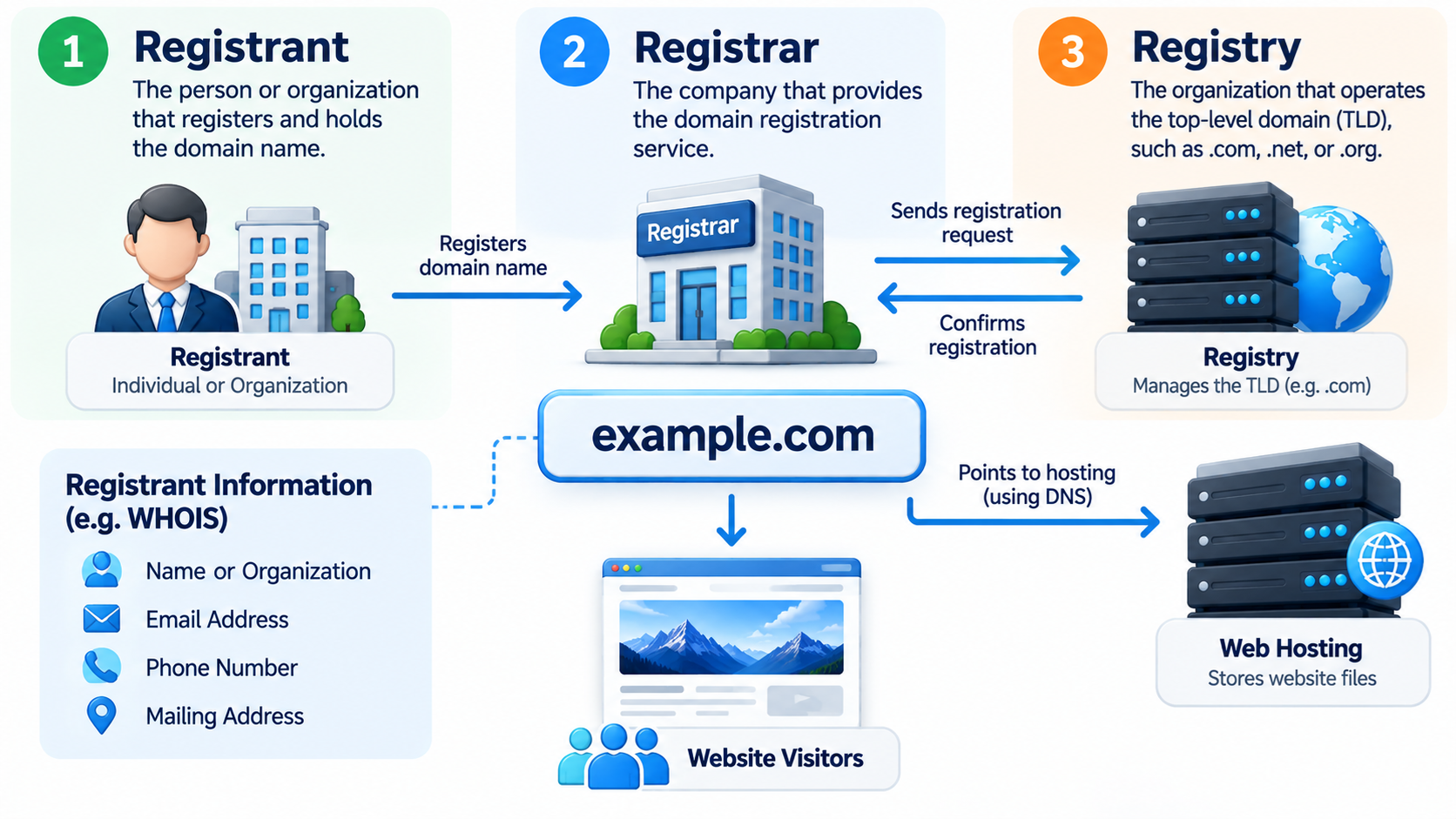
When a domain name is registered, someone must be identified as the registrant.
The registrant is the person, company, or organization that holds the rights to use and manage the domain name for the duration of the registration.
In simple terms, the registrant is the party officially associated with the domain registration.
For a personal website, the registrant may be an individual.
For a business website, the registrant should usually be the business or organization that actually owns and controls the domain.
What Does “Registrant” Mean?
A domain name registrant is the individual or organization that registers a domain name through a domain registrar.
For example, if a company called Example Technologies registers:
example.com
the company may be listed as the registrant.
The registrar is the company that provides the domain registration service, while the registrant is the customer or organization that holds the domain registration.
These two roles are different.
The registrar manages the registration service, while the registrant controls the domain according to the applicable registration rules.
What Information May Be Associated with the Registrant?
Registrant information may include details such as the registrant’s name, organization, email address, telephone number, and mailing address.
The exact information required depends on the domain extension, registrar, registry rules, and applicable privacy regulations.
Some domain registration systems historically displayed much of this information publicly through WHOIS services.
Today, personal information is often hidden, redacted, or protected by privacy services, depending on the domain and registrar.
Even if the information is not publicly visible, the registrar may still maintain registrant information internally.
Should a Business Domain Be Registered in the Company’s Name?
In many cases, yes.
If a domain name is an important business asset, the business itself should generally be clearly associated with the registration.
For example, if a company owns:
mycompany.com
the domain should ideally be controlled through an account that the company can access, rather than being registered only under the personal account of an outside contractor, web designer, or former employee.
This can help prevent problems later if the company needs to renew, transfer, sell, or recover the domain.
What If a Web Designer Registers the Domain?
This can sometimes create problems.
Suppose a business hires a web designer to build a website, and the designer registers the domain using the designer’s own account and contact information.
If the business later changes web designers, it may discover that it does not have direct access to the domain registration.
That can make transfers, DNS changes, renewals, and account recovery more difficult.
For this reason, businesses should generally maintain direct control of important domain registrations.
A web designer can still manage DNS or hosting, but the business should know which registrar holds the domain and should have access to the registration account.
What Is the Difference Between the Registrant and the Registrar?
The registrant and registrar are not the same thing.
The registrant is the person or organization associated with the domain registration.
The registrar is the company that provides the registration service.
For example:
A business may be the registrant of example.com.
A domain registration company may be the registrar.
The registrar manages the domain registration platform, while the registrant controls the domain through that platform.
What Is the Difference Between the Registrant and the Registry?
The registry is another important part of the domain name system.
A registry operates the database and technical infrastructure for a particular top-level domain or domain namespace.
For example, one registry may operate a particular top-level domain, while many different registrars sell registrations under that domain.
The relationship can be simplified as:
Registry → Registrar → Registrant
The registry operates the domain namespace.
The registrar sells and manages domain registrations.
The registrant is the person or organization that registers the domain.
Is the Registrant the Legal Owner of the Domain?
People often describe the registrant as the “owner” of a domain name, but domain names are not usually owned in exactly the same way as physical property.
A registrant normally holds contractual rights to use and manage the domain as long as the registration remains valid and the registrant follows the applicable policies and agreements.
If the domain expires and is not renewed, those rights can eventually be lost.
So, in everyday language, people often say someone “owns” a domain, but technically the registrant holds the registration rights.
Can Registrant Information Be Hidden?
Yes, depending on the domain and registrar.
Many registrars provide privacy services or automatically redact certain personal information from public WHOIS or registration data.
This can prevent a person’s home address, telephone number, or personal email address from being publicly displayed.
However, privacy protection does not necessarily change who the registrant is.
The underlying domain registration may still be associated with the actual customer or organization, even if public records do not display all of the information.
What Is WHOIS?
WHOIS is a system historically used to look up information about registered domain names.
A WHOIS lookup may provide information such as the registrar, registration date, expiration date, nameservers, and certain registration details.
Because of privacy regulations and changes in domain registration policies, much registrant information may now be redacted from public WHOIS results.
You may see entries such as:
Redacted for Privacy
Data Protected
Privacy Service
Registrant information unavailable
This does not mean that the domain has no registrant. It usually means the information is not being displayed publicly.
What Is a Domain Privacy Service?
A domain privacy service helps reduce the amount of personal registrant information exposed publicly.
Depending on the service, public registration records may display privacy-protected contact information instead of the registrant’s personal details.
This is particularly useful for individuals who do not want their personal address or phone number publicly associated with a domain.
However, the registrar still needs enough information to manage the registration according to its policies and applicable rules.
Why Is the Registrant’s Email Address Important?
The email address associated with the registration can be extremely important.
Registrars may use it for verification, security alerts, renewal notices, account recovery, transfer approvals, and other administrative messages.
If the registrant loses access to that email address, recovering control of the domain can become more difficult.
For important domains, use an email address that the registrant expects to control for a long time.
Should You Use an Email Address on the Same Domain?
This can create a potential problem.
Suppose the domain is:
example.com
and the registrant’s only contact email address is:
If the domain stops working because of a DNS problem, expiration, or account issue, the email address may also stop working.
That could make account recovery more difficult.
For an important domain, it can be useful to maintain an external recovery email address that does not depend on the domain itself.
What Happens If Registrant Information Is Incorrect?
Incorrect registrant information can cause serious problems.
The registrar may need accurate information for verification, transfers, security, or compliance purposes.
If the email address is outdated or the organization name is incorrect, the registrant may have difficulty proving control of the domain.
For important business domains, check registration information periodically and update it when necessary.
Can the Registrant Be Changed?
In many cases, yes.
A domain’s registrant information can often be updated through the registrar’s domain management system.
The exact process depends on the registrar and the domain extension.
Some changes may require email confirmation, identity verification, or additional security steps.
Certain registrant changes may also affect transfer eligibility or trigger temporary transfer restrictions, depending on applicable policies.
What Happens When a Domain Is Transferred?
A domain transfer usually moves the domain from one registrar to another.
The registrant does not necessarily change.
For example, if a business transfers example.com from Registrar A to Registrar B, the business can remain the registrant.
Only the company managing the registration changes.
This is different from transferring control of the domain to another person or company.
What Happens When a Domain Is Sold?
If a domain is sold, the registration information and account control may need to be updated so that the new buyer becomes the party controlling the domain.
This process may involve changing account ownership, registrant details, and registrar settings.
For valuable domains, both parties should make sure the transfer is handled securely and that the buyer gains full control of the registration.
Who Should Be Listed for a Company Domain?
For an important company domain, the organization should generally maintain clear control over the registration.
The company should know:
which registrar manages the domain
which account controls the registration
which email address is associated with the account
when the domain expires
whether automatic renewal is enabled
who has permission to modify DNS or transfer the domain
This information should not exist only in the personal account of one employee or contractor.
What If an Employee Leaves the Company?
This is another reason businesses should manage domains carefully.
If an employee registers an important company domain using a personal account and later leaves the company, access to the domain could become complicated.
A better approach is to use a company-controlled account and maintain internal records showing who has administrative access.
The company should also update access permissions when employees or contractors leave.
What If the Domain Uses Privacy Protection?
Privacy protection does not mean nobody controls the domain.
It simply means some registration information may not be visible publicly.
The registrar still maintains records related to the registration and account.
The registrant should continue to keep the underlying account information accurate.
Why Is the Registrant Important?
The registrant is important because domain names can become valuable business assets.
A domain may be connected to:
a company website
business email
customer accounts
online stores
DNS services
cloud applications
marketing campaigns
brand identity
If control of the domain is lost, many other services can be affected.
That is why registrant information, registrar account security, and renewal settings should be taken seriously.
How Can You Protect a Domain Registration?
For important domains, use a strong and unique password for the registrar account.
Enable two-factor authentication if the registrar provides it.
Keep the registrant email address current.
Enable automatic renewal when appropriate.
Use domain locking to help prevent unauthorized transfers.
Maintain a record of the registrar, expiration date, nameservers, account contacts, and recovery information.
For a business, make sure more than one trusted person knows how the domain is managed.
A Simple Example
Suppose Example Corporation registers:
example.com
Example Corporation is the registrant.
The company that provides the registration service is the registrar.
The organization that operates the .com registry infrastructure is the registry.
The company may then use a separate hosting provider for its website and another provider for email.
These services can all be different, but the registrant remains the organization that holds the domain registration rights.
Final Thoughts
The registrant of a domain name is the person, company, or organization associated with the domain registration and entitled to control it under the applicable registration agreement.
For personal domains, the registrant may be an individual.
For business domains, the registrant should generally reflect the organization that actually controls and depends on the domain.
It is important not to confuse the registrant with the registrar or registry.
The relationship can be remembered simply as:
Registry → operates the domain namespace
Registrar → provides domain registration services
Registrant → holds and manages the domain registration
For any important domain, keep the registrant information accurate, protect the registrar account, maintain access to the contact email address, and renew the domain before it expires.