
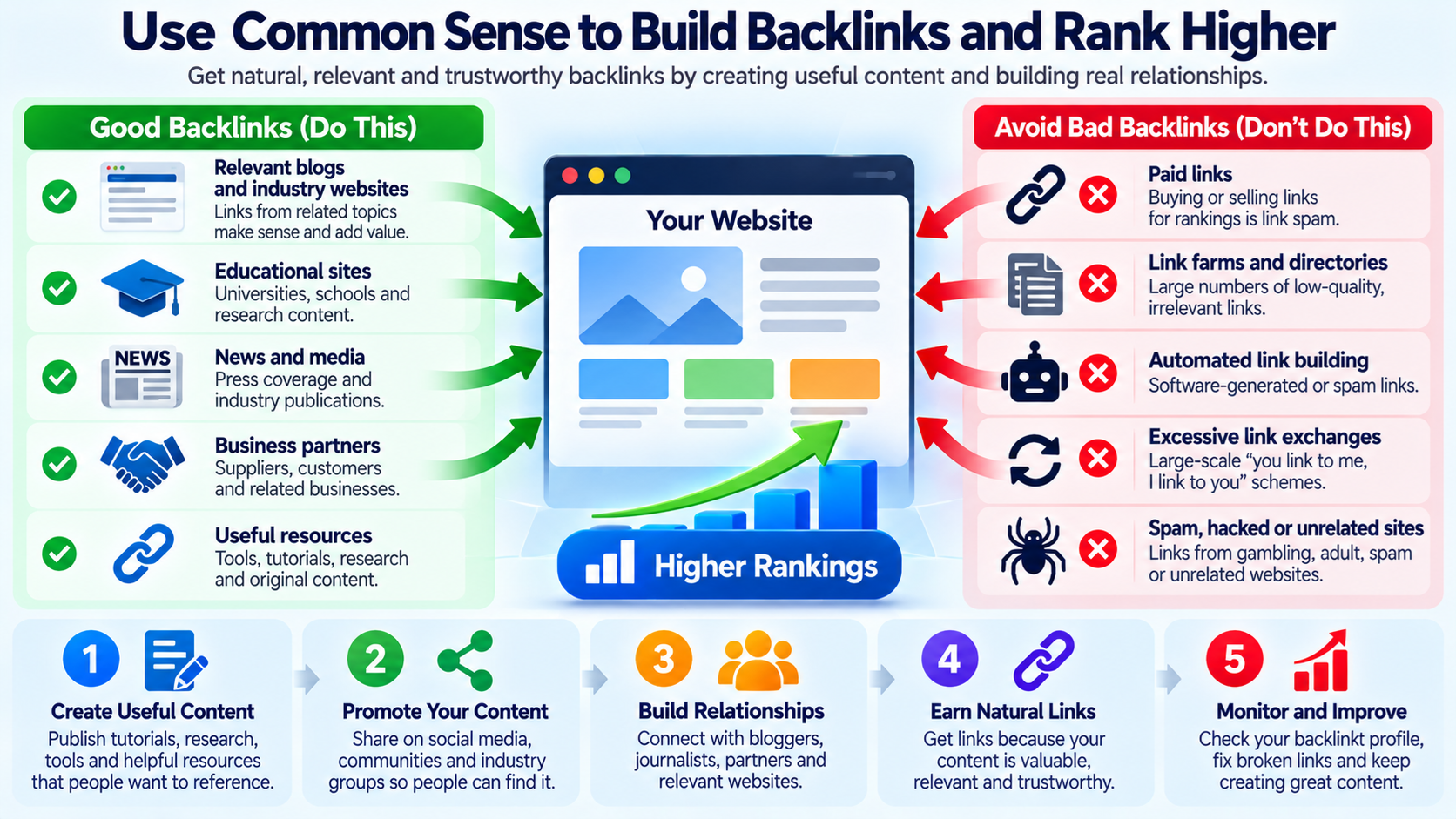
Backlinks have been an important part of search engine optimization for many years.
A backlink is simply a link from another website to your website.
If another website links to your article, product, service, tutorial, or homepage, that link may help people discover your website and may also help search engines understand how your website relates to other content on the web.
However, backlink building is often misunderstood.
Some website owners think more backlinks always mean higher rankings. That is not true.
One useful backlink from a trustworthy and relevant website can be far more valuable than hundreds or thousands of artificial links from low-quality websites.
The safest long-term strategy is surprisingly simple :
use common sense create something worth linking to.
Build relationships with relevant websites and communities.
Promote your content where real people may find it useful.
Avoid tricks designed mainly to manipulate search rankings.
Good backlink building should look like normal activity on the web.
What Is a Backlink?
A backlink is a hyperlink from another website to your website.
For example, suppose another website writes an article about web hosting and says:
For a beginner’s guide to DNS, visit example.com.
If the words link to your website, that is a backlink.
Backlinks may point to:
Your homepage
A blog article
A product page
A tutorial
A research report
A tool
A video
A documentation page
Any publicly accessible page can receive backlinks.
Why Do Backlinks Matter?
Links are one of the ways websites connect to one another.
A useful website may naturally receive links because people want to recommend it, cite it, discuss it, or send visitors to it.
Search engines can use links as one of many signals when understanding pages and relationships between websites.
However, links are not the only ranking factor.
A website also needs:
Useful content
Clear structure
Good technical SEO
Fast and reliable hosting
Mobile usability
Good page experience
Relevant information
Proper indexing
Trustworthiness
Strong backlinks cannot permanently rescue a poor website.
More Backlinks Do Not Automatically Mean Better Rankings
Imagine two websites.
Website A has 10,000 backlinks from unrelated directories, automated profile pages, spam blogs, and link networks.
Website B has 30 backlinks from universities, respected industry blogs, established businesses, and technical publications related to its subject.
Which backlink profile looks more trustworthy?
In many cases, Website B has the stronger profile.
This illustrates an important principle:
Backlink quality matters more than backlink quantity.
Do not judge SEO success simply by counting links.
What Makes a Good Backlink?
A good backlink usually makes sense even if search engines did not exist.
Ask yourself:
Would a real person find this link useful?
Is the linking website relevant to my subject?
Does the link appear naturally inside useful content?
Would I be happy to receive visitors from this website?
Would I still want the link if it had no SEO benefit?
If the answer is yes, the backlink is probably based on a healthy reason.
Relevance Matters
Suppose you operate a web hosting company.
A backlink from an article about:
Web hosting
WordPress
Linux servers
Domain names
DNS
Website security
Cloud computing
may be highly relevant.
Now imagine receiving a backlink from a random website about fishing equipment.
Unless there is a genuine relationship between the topics, that link may provide very little useful context.
Relevance does not mean every website must be in exactly the same industry.
It means the link should make sense for the content and audience.
Authority Is Useful, but Relevance Still Matters
Website owners sometimes focus entirely on metrics such as:
Domain Authority
Domain Rating
Trust Flow
Authority Score
These metrics can be useful for research, but they are created by third-party SEO companies.
They are not Google’s internal ranking scores.
A link from a small but respected specialist website may be more useful than a link from a large but completely unrelated website.
Do not chase a number while ignoring common sense.
Create Content People Actually Want to Link To
The most sustainable way to build backlinks is to publish something worth referencing.
This might include:
Detailed tutorials
Original research
Statistics
Technical guides
Case studies
Free tools
Calculators
Templates
Checklists
Reference material
Industry analysis
Useful diagrams
Original photographs
Videos
Documentation
If your page answers a question better than existing pages, people have a reason to reference it.
If your page simply repeats the same information already available everywhere else, there is less reason to link to it.
Helpful Content Comes First
Do not create content only because you hope it will attract backlinks.
Start with the user.
Ask:
What problem can I solve?
What question can I answer clearly?
What information is difficult to find?
What experience can I share?
What can I explain better than existing pages?
What useful tool could I create?
Search engines increasingly emphasize useful, reliable, people-first content rather than pages created primarily to manipulate rankings.
Backlinks work best when they support genuinely useful content.
Write Original Tutorials
Tutorials can naturally attract backlinks because other websites need useful resources to recommend.
For example, an article titled:
How DNS Works Step by Step
may be referenced by:
Students
Teachers
IT blogs
Hosting companies
Forum discussions
Technical documentation
A shallow article containing only a few generic paragraphs is less likely to earn those links.
Depth and usefulness create opportunities for natural backlinks.
Create Original Research
Original data can attract particularly strong backlinks.
Suppose you publish research about:
WordPress security incidents
Website loading speed
Web hosting technologies
Domain registration trends
Server operating systems
Cloud infrastructure
AI hardware
Other publishers may cite your findings when writing their own articles.
When they cite your research, they may link back to the original source.
That creates a natural backlink.
Publish Useful Statistics
Writers frequently search for statistics to support their articles.
If you collect, verify, organize, and explain useful data, your page can become a reference source.
Do not simply copy a list of statistics from another website.
Add value.
Explain:
Where the numbers came from
What they mean
When they were collected
How the trend changed
Why the information matters
Original interpretation makes the page more useful.
Create Free Tools
Tools can attract backlinks over a long period.
For example:
DNS lookup tools
Subnet calculators
Password generators
Website speed tools
SSL checkers
Domain tools
IP address calculators
Conversion tools
Cost calculators
If people repeatedly find the tool useful, bloggers and technical websites may link to it naturally.
A useful tool can sometimes earn backlinks for years.
Create Good Visual Resources
Original diagrams and infographics can also earn links.
For example, you might create diagrams explaining:
How DNS works
How HTTP works
Shared hosting vs. VPS
IPv4 vs. IPv6
SSL/TLS
Website security layers
CPU architecture
Network protocols
Other websites may want to reference or embed useful visual material.
Make the source clear so people know where the image came from.
Promote Your Content
Publishing good content does not guarantee that anyone will discover it.
Promotion is still necessary.
Share useful content through:
Social media
Industry communities
Newsletters
Forums
Professional groups
Relevant online communities
Existing customers
Business partners
People who already follow your work
Promotion should help real people discover useful content.
That is very different from automatically creating thousands of links.
Tell Relevant People About Your Work
Suppose you publish a detailed guide that could genuinely help a particular community.
It is perfectly reasonable to tell people about it.
For example, you could contact:
Bloggers
Teachers
Industry writers
Community managers
Website owners
Researchers
Companies referenced in your article
Keep outreach relevant.
Do not send thousands of identical messages to random websites.
Good outreach should answer the question:
Why would this particular person care about this particular page?
Personalize Outreach
Bad outreach often looks like this:
Hello Webmaster,
I saw your great website.
Please link to my amazing article.
That message is easy to ignore.
Better outreach explains why the resource is relevant.
For example:
You recently wrote about WordPress migrations. We published a visual guide explaining what happens to DNS during a hosting migration. It may be useful to your readers if you update that article.
The second message provides context.
The goal is not to trick someone into creating a link.
The goal is to show them something genuinely relevant.
Do Not Demand a Backlink
If you contact someone about your content, they do not owe you a link.
They may:
Link to it.
Mention it without linking.
Share it on social media.
Ignore the message.
That is normal.
Healthy link building involves earning recommendations rather than forcing them.
Guest Posting Can Be Useful
Writing for another relevant website can be a legitimate way to reach a new audience.
A good guest article should provide real value to the host site’s readers.
The primary purpose should be:
Sharing expertise.
Teaching something useful.
Reaching a relevant audience.
Building professional relationships.
Guest posting becomes problematic when it turns into a large-scale link-building system designed primarily to manipulate rankings.
Do Not Mass-Produce Guest Posts for Links
A warning sign is a campaign such as:
Publish 500 guest posts.
Use exactly the same keyword anchor text.
Place links in every article.
Use low-quality sites that accept anything.
The articles exist only to create backlinks.
This no longer looks like genuine publishing.
It looks like a link scheme.
Quality guest contributions are very different from mass-produced SEO guest posts.
Avoid Buying Links for Rankings
One of the most tempting shortcuts is buying backlinks.
A website may offer:
50 high-authority backlinks for $20.
500 dofollow backlinks.
Permanent SEO backlinks.
Guaranteed Google rankings.
Be skeptical.
Google’s spam policies specifically identify buying or selling links for ranking purposes as link spam.
A short-term ranking benefit is not worth creating a long-term SEO problem.
Paid Advertising Is Different
Paying for advertising is normal.
Companies have purchased advertising for centuries.
The issue is not that money changed hands.
The issue is whether a paid link is being used improperly to pass ranking credit.
Commercial links should be appropriately qualified using mechanisms such as:
rel=”sponsored”
or, where appropriate:
rel=”nofollow”
Follow current search-engine guidance for paid and sponsored links.
Avoid Automated Backlink Software
Software can generate enormous numbers of links quickly.
It may create links on:
Forums
Profiles
Blog comments
Guestbooks
Wiki pages
Directories
Fake blogs
Automatically generated websites
This may look impressive in an SEO report:
20,000 new backlinks!
But the number itself means very little.
Search engines have spent years developing systems designed to recognize manipulative link patterns.
Automated link building can create more problems than benefits.
Avoid Link Farms
A link farm is a website or network created largely for the purpose of linking to other websites.
The pages may contain huge numbers of unrelated links.
For example:
Web hosting
Shoes
Insurance
Cryptocurrency
Dentists
Travel
Casinos
Car parts
all appearing on the same low-quality website.
Ask yourself whether a real visitor would genuinely use that page.
If the only purpose appears to be manipulating rankings, stay away.
Avoid Private Blog Networks
A Private Blog Network, commonly called a PBN, is a collection of websites controlled primarily to create backlinks to other sites.
These networks sometimes use expired domains that previously had strong backlinks.
The operator then publishes new content and uses the domains to link to target websites.
This strategy tries to create the appearance of independent recommendations.
It carries significant risk because the links are intentionally created to manipulate rankings.
Be Careful With Expired Domains
Buying an expired domain is not automatically wrong.
There can be legitimate reasons to acquire one.
For example, you may buy an old business domain and continue the same business.
The problem occurs when expired domains are acquired primarily to exploit their previous reputation and manipulate search rankings.
Do not build your SEO strategy around tricks.
Avoid Excessive Link Exchanges
Normal websites sometimes link to each other.
For example:
A web designer links to a hosting company.
The hosting company links to the web designer.
That can be perfectly natural.
The problem is excessive arrangements such as:
Link to me and I will link to you.
Repeated hundreds or thousands of times.
Large-scale reciprocal linking specifically intended to manipulate rankings can be considered link spam.
Use common sense.
Business Partnerships Can Naturally Produce Links
Real business relationships frequently produce links.
A hosting company may link to:
Technology partners
Software vendors
Payment providers
Customer resources
Documentation
Security providers
Likewise, those organizations may naturally reference the hosting company.
These links exist because a real relationship exists.
That is fundamentally different from creating a fake partnership solely to exchange links.
Industry Directories Can Still Be Useful
Not every directory is bad.
A legitimate industry directory can help customers find businesses.
Examples might include:
Professional associations
Local chambers of commerce
Industry organizations
Government directories
Accreditation organizations
Specialist business directories
Ask yourself whether real customers actually use the directory.
If the answer is yes, the listing may be valuable even without SEO benefits.
Avoid Thousands of Random Directories
Submitting your website automatically to thousands of directories is different.
Many of these directories have:
No real users
No editorial review
Thousands of unrelated links
Automatically generated pages
Very little useful content
The only reason to submit may be obtaining another backlink.
That is usually not a strong strategy.
Local Backlinks Can Be Valuable
For local businesses, links from local organizations can be especially relevant.
Examples include:
Local newspapers
Business associations
Community organizations
Local events
Schools
Charities
Business partners
Local blogs
These links can help people discover your business and can reinforce local relevance.
Community Participation Can Lead to Natural Links
Participating genuinely in communities can produce backlinks indirectly.
For example, answer useful questions in:
Forums
Industry groups
Developer communities
Professional networks
Do not enter every discussion simply to drop your URL.
Help first.
If your own article genuinely answers the question in greater detail, linking to it may be appropriate.
The difference between contribution and spam is often obvious.
Blog Comments Are Not a Backlink Strategy
Years ago, some SEO campaigns posted comments on thousands of blogs.
For example:
Great article!
Visit my website: cheap-hosting-example.com
This adds no value.
It annoys website owners.
Most modern blogging platforms also automatically apply attributes that reduce the ranking value of user-generated links.
Leave comments because you have something useful to say, not because you want backlinks.
Forum Spam Is Not Link Building
The same principle applies to forums.
Creating hundreds of forum profiles simply to place a website URL is not meaningful marketing.
A useful forum contribution may lead someone to visit your site.
A spam profile usually leads nowhere.
Focus on reputation and expertise rather than link counts.
Use Natural Anchor Text
Anchor text is the clickable text in a hyperlink.
Natural websites use many different forms of anchor text.
Examples include:
HostsDepot
hostsdepot.com
this DNS guide
learn more here
the original research
website security tutorial
Artificial campaigns sometimes repeat exactly the same keyword across hundreds of backlinks.
For example:
cheap web hosting
cheap web hosting
cheap web hosting
cheap web hosting
Repeated keyword-heavy anchor text can look unnatural.
Do not try to control every backlink’s anchor text.
Natural variation is normal.
Brand Links Are Valuable
Many natural backlinks use the brand name.
For example:
HostsDepot
Webmind
Microsoft
Cloudflare
People frequently link to companies by name.
Do not believe that every backlink needs to contain a commercial keyword.
A healthy backlink profile normally includes:
Brand names
URLs
Article titles
Generic anchor text
Topic descriptions
Natural variation
Deep Links Are Useful
Not every backlink should point to the homepage.
If someone references a specific tutorial, the link should naturally point directly to that tutorial.
For example:
example.com/how-dns-works
rather than always:
example.com
These are called deep links.
A natural website often receives links to many different pages.
Link to Other Websites Too
Some website owners become so focused on receiving backlinks that they are afraid to link out.
That is unnecessary.
If another website provides valuable information, cite it.
Useful outbound links can improve an article by helping readers verify information or learn more.
A website should behave like part of the web, not like an isolated island.
Do Not Make Every External Link Nofollow
There is no need to automatically apply nofollow to every external link.
Normal editorial links can be normal links.
Use appropriate link attributes when there is a reason.
Examples include:
Sponsored links
Advertisements
Certain user-generated links
Do not use link attributes simply because you are afraid of linking to another trustworthy website.
Broken-Link Outreach Can Work
Broken-link outreach can be a legitimate technique when performed sensibly.
Suppose another website links to a resource that no longer exists.
You have a high-quality page covering the same subject.
You can politely tell the site owner:
The resource you linked to is no longer available. We have an updated guide on the same topic if you find it useful.
The website owner decides whether your resource is appropriate.
This works because you are helping solve a real problem.
Reclaim Lost Links
Sometimes another website mentions your company without linking to it.
You may politely ask whether they would consider adding a link for readers who want more information.
Similarly, old backlinks may point to pages that no longer exist.
If the content moved, create a relevant redirect.
This can recover useful traffic and make the web experience better.
Fix Your Own 404 Pages
Suppose a valuable external website links to:
example.com/old-guide
but that page now returns 404.
If you have a relevant replacement page, create a 301 redirect.
For example:
/old-guide → /new-guide
This does not create a new backlink.
It simply makes an existing link useful again.
Study Your Competitors Carefully
Competitor backlink research can reveal useful ideas.
Look at which websites link to competitors.
Then ask:
Why did that website link to them?
Did they publish research?
Did they provide a tool?
Were they interviewed?
Did they sponsor an event?
Did they contribute expert commentary?
Do not simply copy every backlink.
Understand why the backlink exists.
Then create your own reason to deserve similar coverage.
Do Not Chase Every Competitor Link
Your competitor may have:
Purchased bad links.
Used an old SEO strategy.
Acquired links through relationships you do not have.
Received links years ago.
A competitor backlink is not automatically something you need.
Look for patterns and opportunities rather than copying blindly.
Public Relations Can Build Excellent Links
Traditional public relations and SEO often overlap naturally.
If your company does something newsworthy, journalists and industry publications may write about it.
Examples include:
Launching a new product
Publishing important research
Releasing industry data
Supporting a community project
Reaching a major milestone
Making an important discovery
Providing expert commentary
News coverage can create both brand awareness and natural backlinks.
Become a Useful Expert Source
Journalists and writers need knowledgeable sources.
If you have real expertise, make yourself available.
Provide:
Clear explanations
Useful statistics
Technical insight
Original opinions backed by evidence
First-hand experience
When a publication uses your contribution, it may mention or link to your website.
Even without a backlink, the brand exposure can still be valuable.
Build Relationships, Not Just Links
This is one of the most useful backlink principles.
A good professional relationship may produce many benefits:
Referrals
Partnerships
Interviews
Collaborations
Mentions
Backlinks
Customers
Industry knowledge
If your only question is:
How do I get this person to link to me?
you may be thinking too narrowly.
Build relationships with people in your industry.
Links may follow naturally.
Backlinks Should Bring Real Visitors
One easy test for a backlink is:
Would I like people to click this link?
If the answer is no, why are you trying to obtain it?
A strong backlink can generate:
Referral traffic
Customers
Email subscribers
Brand awareness
Partnership opportunities
Trust
These benefits exist even before considering SEO.
Measure Referral Traffic
Use analytics to see which websites actually send visitors.
You may discover that a small niche blog sends more valuable customers than a much larger general website.
This is another reason not to judge backlinks solely by authority scores.
Traffic quality matters.
A Backlink That Generates Customers Is Valuable
Suppose a small IT consultant’s blog links to your hosting company.
The blog only receives a few thousand visitors per month.
But five people click the link and two become customers.
That is a valuable link.
You do not need an SEO metric to prove it.
Common sense already tells you that the link has value.
Avoid Obsessing Over Dofollow and Nofollow
SEO discussions often focus heavily on:
Dofollow
Nofollow
Sponsored
UGC
Link attributes matter, but do not let them distract you from the bigger picture.
A nofollow link from a major publication can still send:
Thousands of visitors
Customers
Brand awareness
Future links
Social shares
A link can be useful even if it does not directly pass ranking signals.
Social Media Links Can Still Have Value
Most social media links are not valuable because of traditional link authority.
Their real value is distribution.
Suppose you share an excellent tutorial on LinkedIn or X.
A journalist sees it.
The journalist later references it in an article.
The social link helped your content reach the person who created the editorial backlink.
That is an indirect but powerful effect.
Backlinks Often Start With Visibility
People cannot link to something they have never seen.
Therefore, backlink building often begins with:
Publishing.
Promoting.
Participating.
Networking.
Teaching.
Sharing expertise.
The backlink is frequently the result of those activities rather than the activity itself.
Quality Takes Time
Natural link building is slow.
You may publish an article today and receive no links for weeks.
Months later, it may begin ranking.
More people discover it.
Bloggers reference it.
Forums recommend it.
Teachers use it.
Links accumulate gradually.
This is normal.
SEO is not always immediate.
Do Not Expect Guaranteed Rankings
No legitimate backlink strategy can guarantee a particular Google ranking.
Search rankings depend on many factors.
Competition changes.
Content changes.
Search behavior changes.
Algorithms change.
Other websites improve.
Anyone selling:
Guaranteed #1 Google ranking
should be treated with caution.
Ranking Is Not the Only Goal
The ultimate goal should usually be business or audience growth.
You want:
Visitors
Customers
Readers
Subscribers
Leads
Sales
Brand recognition
A number-one ranking that generates no useful business is less valuable than a number-five ranking that consistently brings qualified customers.
Backlinks are a tool, not the final objective.
Good Content and Good Backlinks Work Together
Backlinks cannot replace useful content.
Useful content cannot always reach its audience without promotion.
The strongest approach combines both.
Create excellent content.
Make it technically accessible.
Promote it.
Build professional relationships.
Earn recommendations.
Improve the content over time.
This creates a sustainable cycle.
Avoid SEO Shortcuts
Many backlink schemes are attractive because they promise speed.
Examples include:
Buy 1,000 links today.
Rank number one next week.
Use automated backlink software.
Join a private blog network.
Purchase expired domains.
Swap links with hundreds of sites.
The problem is that search engines also know these techniques exist.
A strategy based on fooling search engines becomes weaker as search engines improve.
A strategy based on helping users remains useful.
Ask the Common-Sense Question
Before creating or purchasing any backlink, ask:
Would this link make sense if Google did not exist?
For example:
A newspaper cites your research.
Yes.
A university links to your tutorial.
Yes.
A business partner lists your company.
Yes.
A customer recommends your product.
Yes.
A random website in an unrelated country sells you 5,000 links.
Probably not.
This simple question can prevent many SEO mistakes.
Another Useful Question: Would I Show This to Google?
Imagine someone from Google’s Search team personally reviewing your backlink strategy.
Would you comfortably explain:
We created this research and journalists linked to it.
We contributed an expert article to an industry publication.
Our business partners link to our documentation.
Our local chamber of commerce lists our company.
These sound normal.
Now compare:
We paid someone to create 50,000 links from fake blogs.
If the strategy sounds embarrassing when explained plainly, it is probably not a good long-term SEO strategy.
Build a Natural Backlink Profile
A natural backlink profile usually develops gradually.
It may contain links from:
Industry websites
News sites
Small blogs
Large publications
Business partners
Customers
Forums
Social platforms
Directories
Educational resources
The anchor text will vary.
The target pages will vary.
The websites will vary.
That diversity is normal because real people link in different ways.
Monitor Your Backlinks
You should still monitor your backlink profile.
Useful tools include:
Google Search Console
Ahrefs
Semrush
Moz
Majestic
Other SEO platforms
Look for major changes rather than panicking about every strange link.
The Internet naturally contains spam.
Most established websites eventually receive some low-quality backlinks.
Do Not Panic About Random Spam Links
You may discover links from strange websites you have never seen.
That does not automatically mean you need to remove them.
Google has systems designed to identify and neutralize many types of link spam.
Investigate seriously when:
You intentionally bought links.
An SEO agency created artificial links.
You participated in link schemes.
You received a manual action.
You have a large manipulated backlink profile.
Do not spend every day trying to clean every random spam link on the Internet.
Use Disavow Carefully
Google provides a Disavow Links tool, but it is an advanced tool intended for limited situations.
Do not upload every backlink that an SEO program labels:
Toxic
Bad
Spam
Dangerous
A third-party toxicity score is not the same as a Google penalty.
Incorrectly disavowing good links can remove useful signals.
Use the tool only when there is a strong reason to do so.
Internal Links Matter Too
While people obsess over backlinks, they sometimes neglect links inside their own website.
Internal links help:
Visitors discover related pages.
Search engines find content.
Explain website structure.
Distribute attention among pages.
Connect related tutorials.
If you publish 500 useful articles but never connect them logically, you make the website harder to navigate.
Good SEO includes both external and internal links.
Use Descriptive Internal Anchor Text
Suppose you write:
Learn more about DNS here.
That works.
But a clearer internal link might say:
Learn how DNS works.
This tells visitors what they will find.
Use natural descriptive text.
Do not stuff every internal link with the exact same keyword.
Write for humans first.
Organize Content Into Topics
A strong website often develops clusters of related content.
For example, a hosting website might organize articles around:
Domain Names
DNS
Web Hosting
WordPress
Website Security
SSL
VPS
Networking
Articles within each topic can link naturally to one another.
This helps readers continue learning and gives the website a logical structure.
Update Strong Content
Sometimes the easiest way to earn more backlinks is improving content that already performs well.
If an article already receives links, update it with:
New information
Better explanations
New diagrams
Updated statistics
Examples
Additional sections
Improved formatting
A useful page can become even more useful over time.
Do Not Change URLs Unnecessarily
If a page has already earned good backlinks, avoid changing its URL without a reason.
If you must change the URL, use an appropriate 301 redirect.
Otherwise, old backlinks may point to a 404 page.
Maintaining stable URLs helps preserve the value of existing links.
Make Your Website Trustworthy
People are more comfortable linking to websites that look trustworthy.
Make sure your site clearly shows:
Who you are.
What the website is about.
How to contact you.
Who wrote important content.
When appropriate, the author’s expertise.
Sources for factual claims.
A secure HTTPS connection.
Clear navigation.
Professional presentation.
Trust encourages citations.
Show Real Expertise
If you know something because you actually do the work, show it.
For example, instead of writing:
How to configure cPanel
based only on other articles, include:
Actual steps
Screenshots
Common mistakes
Troubleshooting experience
Explanations of why settings matter
Real expertise makes content more useful and more likely to be referenced.
Experience Is Difficult to Copy
Thousands of websites can repeat the same definition.
Far fewer can provide:
Real test results
Actual configuration examples
Original photos
First-hand experience
Real troubleshooting cases
Original diagrams
Lessons learned from operating systems
That unique experience differentiates your content.
It also gives other writers a reason to cite you instead of another generic page.
Do Not Create Content Only for Backlinks
There is a strange irony in backlink building.
The harder a page looks like it was created only to get backlinks, the less useful it often becomes.
Instead, create resources because they help your audience.
Then promote them appropriately.
Links become evidence that people found the material useful rather than the sole reason the material exists.
A Simple Backlink Strategy
A practical backlink strategy does not need to be complicated.
Start with excellent content.
Publish information based on real knowledge and experience.
Create original resources that people can reference.
Promote useful articles to relevant audiences.
Participate genuinely in your industry.
Build relationships with other professionals.
Fix broken links and old URLs.
Monitor your backlink profile.
Avoid manipulative shortcuts.
Repeat the process.
What Not to Do
Avoid building your SEO strategy around:
Buying ranking links.
Automated backlink generators.
Private blog networks.
Spam comments.
Spam forums.
Thousands of low-quality directories.
Excessive reciprocal links.
Keyword-heavy guest-post campaigns.
Fake websites created only for backlinks.
Expired domains used solely to exploit old reputation.
Any system whose main purpose is to make search engines believe a link is a genuine recommendation when it really is not.
What You Should Do Instead
Focus your effort on:
Original content.
Useful tutorials.
Research.
Tools.
Diagrams.
Industry relationships.
Community participation.
Public relations.
Good customer experiences.
Real expertise.
Reliable information.
These activities may produce fewer links initially.
But the links they earn are usually much more meaningful.
Common Sense Beats Link Tricks
SEO can become complicated.
There are algorithms, crawlers, indexing systems, ranking signals, backlink metrics, anchor-text analysis, and many specialized tools.
But one of the best backlink rules is remarkably simple:
Does this link make sense to a real person?
If a link exists because someone genuinely wants to recommend, cite, explain, review, or discuss your website, it is usually much closer to what a healthy web looks like.
If a link exists only because someone was paid to manufacture a ranking signal, think carefully before pursuing it.
Final Thoughts
Backlinks can help websites become more visible, but backlink building should not become a numbers game.
You do not need the largest backlink count.
You need links that make sense.
Create useful content.
Publish original information.
Share real expertise.
Promote your work.
Participate in relevant communities.
Build relationships.
Earn mentions.
Fix broken links.
Keep your website trustworthy.
Avoid buying rankings through artificial links.
The most sustainable backlink strategy is not about finding a secret loophole in Google’s algorithm.
It is about creating a website that people genuinely want to recommend.
Use common sense.
Build something useful.
Give people a reason to link to it.
That is the kind of backlink strategy that can continue working long after the latest SEO trick disappears.